A curved beach between two headlands, backed by a 1920s pavilion, a tidal pool and low apartment blocks on the hill.
What Bondi Beach looks like
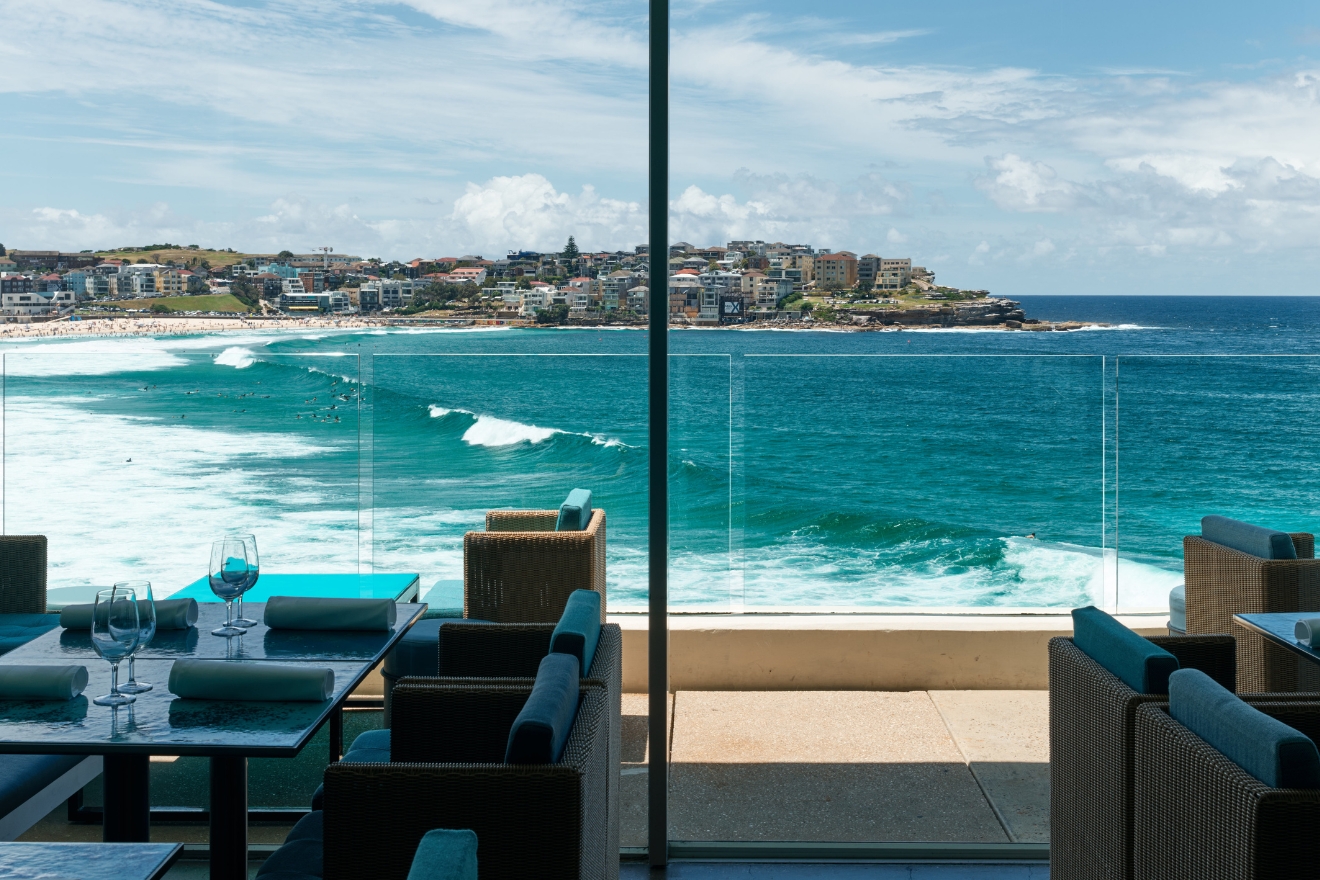
A curved run of pale sand stretches close to a kilometre between two headlands, to the north and a line of sandstone cliffs running south toward the . The swell breaks in separate banks across the width of the beach, and red and yellow flags mark off whichever stretch the lifeguards are working that day.
runs along the top of the sand, a wide boulevard lined with Norfolk pines and low apartment buildings on its inland side. The , a four level block built in 1938, sits back from the kerb behind a raised garden bed. Its flat facade is broken up by a band of brick relief around the windows, and most of the parade's other blocks are three to five storeys and much the same age.
The sits at the centre of the beach behind a paved forecourt, a two storey building dating from 1929, in pale render with a run of arches along its ground floor and a shallow tiled roof. Cafe tables and umbrellas are set out under the arches, and the surf club stands beside it in the same low, arched style.
At the southern end, the Icebergs pool is cut straight into the rocks below Notts Avenue, a tidal pool with a white concrete surround where the ocean breaks clean over the far wall at high tide. Ben Buckler rises at the opposite end, a rocky point where a narrow road runs past a row of flats to a lookout over the whole curve of the beach.
Shot in Bondi Beach
Bondi Rescue followed Waverley Council's lifeguards patrolling this beach for eighteen seasons, shooting on the sand itself rather than any built set. The show moved with the surf, following the flagged swim areas from one end of the beach to the other.
Bondi Rescue, 2006 to 2024
The lifeguards moved the flagged swim areas along the sand as the rip banks shifted through the day, working one end of the beach and then the other. Bondi Rescue's cameras followed the patrol rather than any one fixed spot, so the flagged stretch of sand is the location rather than a building behind it.
What Bondi Beach can double for
Hove in Brighton and Hove, England
Hove's seafront mansion blocks, built through the 1930s, have the same flat rendered fronts and curved balconies as the apartment blocks above Bondi. Both stand right behind a wide promenade facing the water. The pebble beach and the colder light are the tells in any shot that includes the shoreline itself. Try searching 1930s seafront mansion blocks now.
The Art Deco hotels along Ocean Drive share Bondi's height and beachfront promenade layout, most of them built in the 1930s and 1940s. Both curve along a strip of sand with buildings meeting the promenade directly. Miami's pastel paint and palm trees give away the difference in a wide shot, so tighter frames on the plainer beachfront hotels work better. Try searching Art Deco beachfront hotels now.
Muizenberg in Cape Town, South Africa
Muizenberg has the same run of low apartment buildings behind one curving beach, with a strong surf lifeguard culture to match Bondi's own patrols. The mountain backdrop and the row of painted bathing boxes on the sand belong to Muizenberg alone, so keep them out of any wide frame. Try searching curving beach lifeguard patrols now.



Rain_Bondi_Beach.jpg)