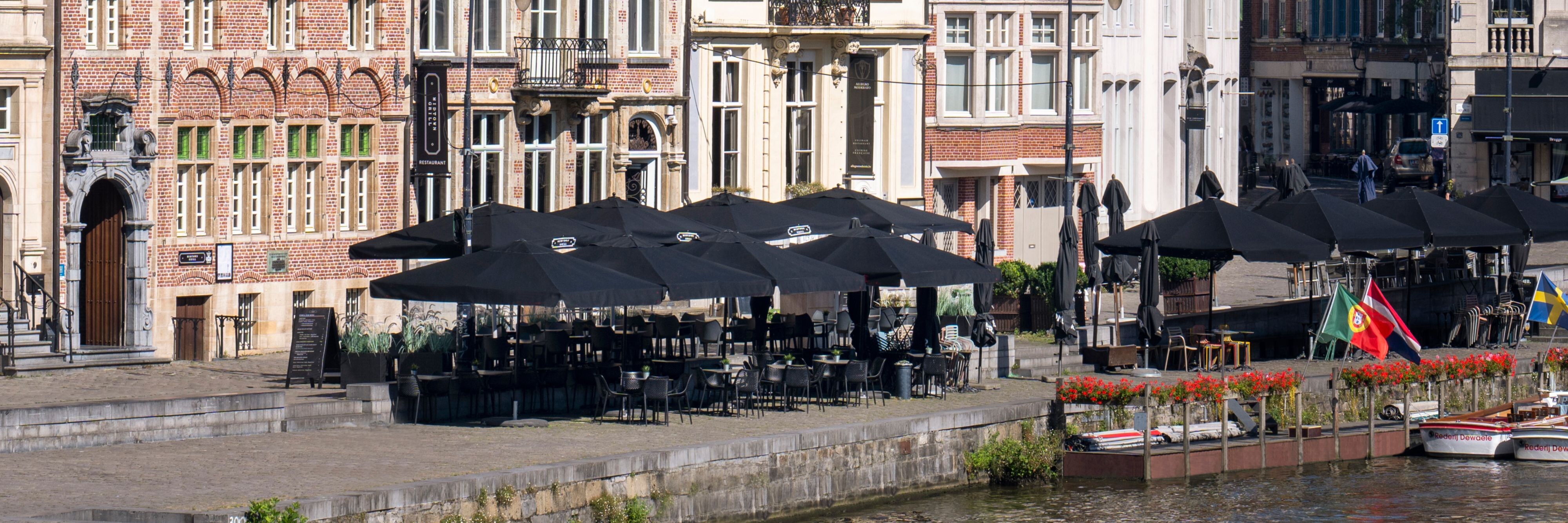
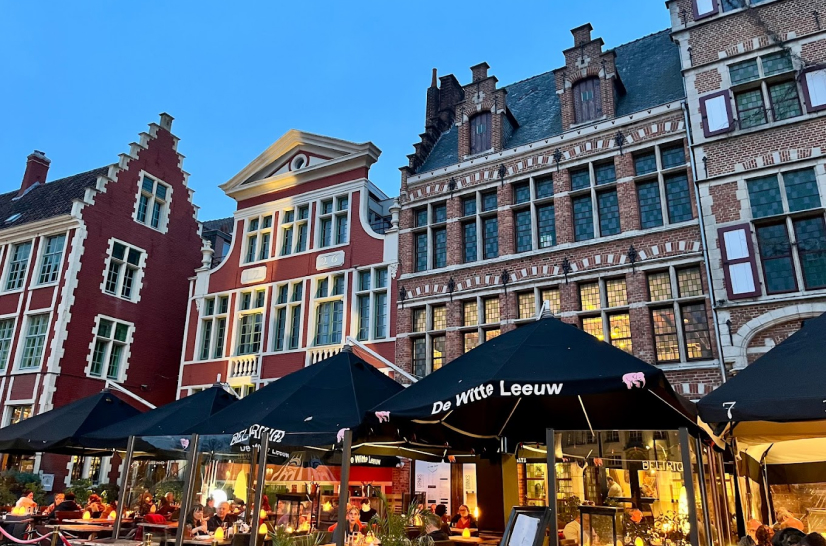
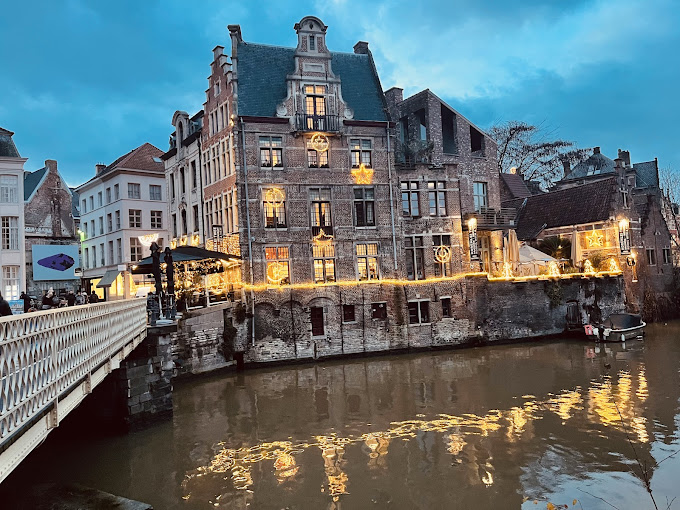
Stepped and bell gables in sandstone and brick line the quay, with the Korenlei facing them across the Leie.
What Graslei looks like
Two- and three-storey houses line the right bank of the Leie, and many of their gables are stepped while some are bell shaped. The has a stepped gable of Balegem sandstone in Brabantine Gothic style, dated 1531. has a stepped gable built entirely of sandstone.
The Spijker is a Romanesque building with a wide stepped gable of Doornik limestone. A bell gable of brick and French limestone in Louis XIV style stands among them. The , built between 1899 and 1910, has Gothic and Renaissance elements and a clock tower. The hotel 1898 The Post now occupies it.
The quay across the river is the , and its fronts mix stepped gables with plastered facades. Korenlei 2 has a stepped gable with six steps, while Korenlei 4A and 5 are plastered with a central pediment dated 1765.
The crosses the river at the north end of the quay. From the at the south end, a long run of gables is visible along the water.
Shot in Graslei
The production dressed the entrance hall and terrace of 1898 The Post on the Graslei as a weapons depot for the film Lords of War. Part of the Graslei was closed while the crew filmed there on 4 December 2025.
Lords of War
1898 The Post
Played a weapons depot
The entrance hall and terrace of the hotel stand in for a weapons depot in the film. The hotel is in the old post office on the quay, the building in the photograph. Street View
The Oude Delft is a canal lined with stately townhouses and gable stones. The house at Oude Delft 197 has a rococo list gable from the 18th-century remodelling. The Graslei's stepped and bell gables look like the same kind of townhouse front, seen from the water. Frame one list gable tight and keep the stepped gables and the water out of the shot, since a wide view shows Ghent. Try searching canal townhouses rococo now.
The Dijver runs along the southern bank of a canal in Bruges. Museums line that canal front, the Gruuthuse among them. The Gruuthuse palace was remodelled in the early 15th century, and a chapel of 1472 joins it to the Church of Our Lady. The Leie's moored boats and the Korenlei across the river would give Ghent away in a wide frame, so shoot the gables tight. Try searching canal front museums now.