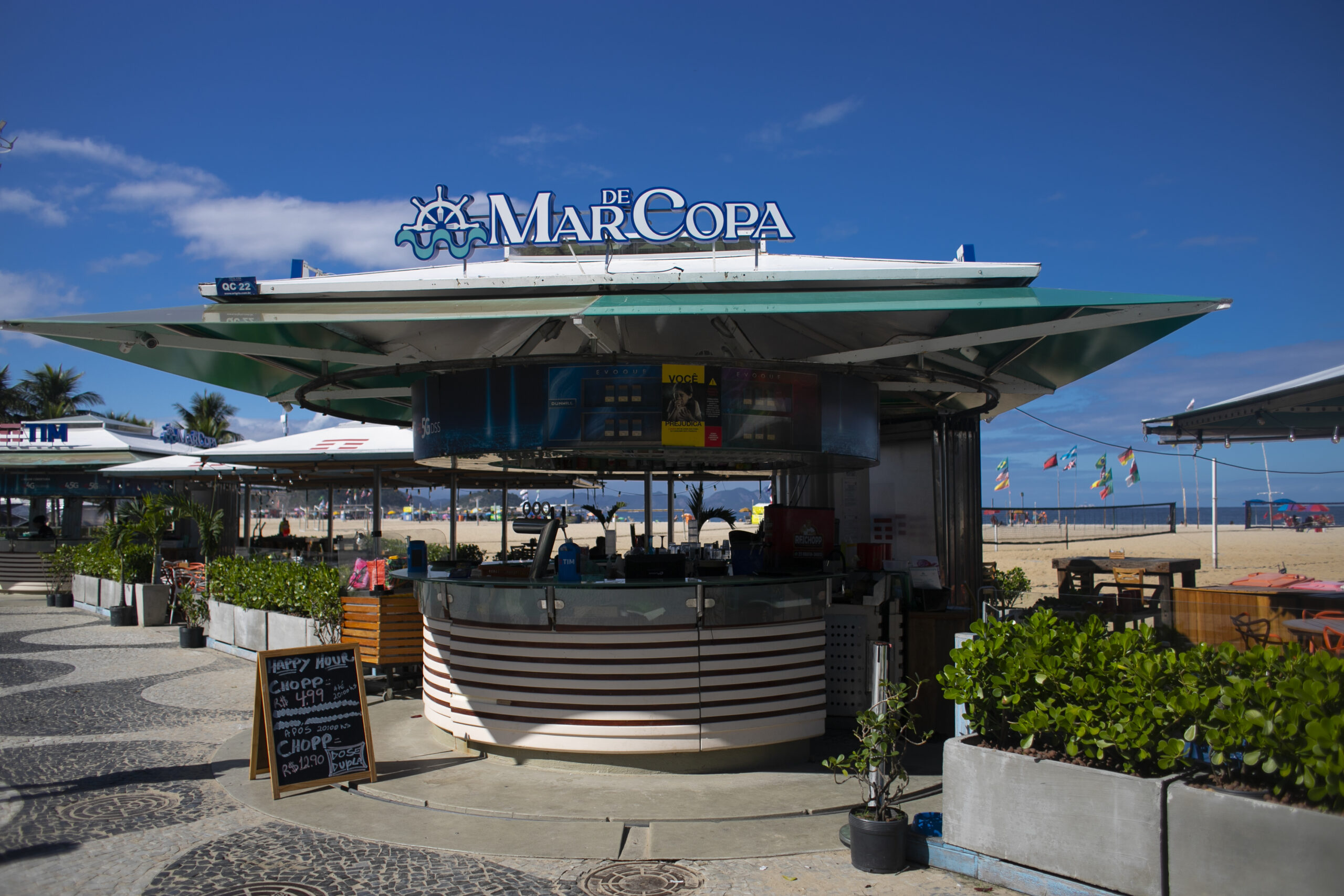
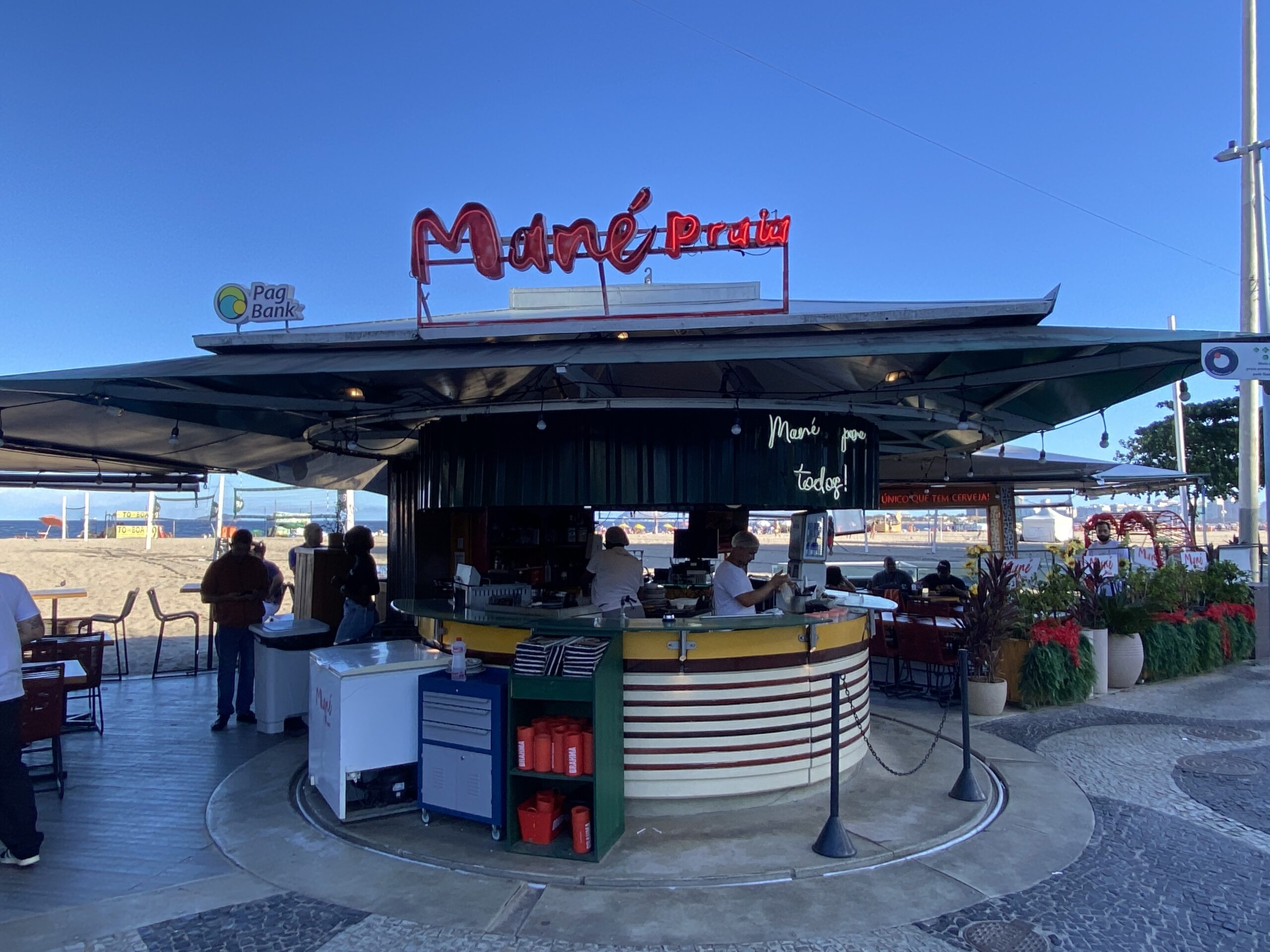
A curved four kilometre beach below a wall of highrise apartment towers, with a wave pattern stone promenade running its length.
What Copacabana looks like
runs for four kilometres along the curve of the beach, six lanes wide. The sidewalk's wave pattern mosaic, relaid in a 1970s redesign, runs the whole length in black and white stone. Apartment towers eleven to thirteen storeys tall stand close together on the inland side. Their concrete and stucco faces are painted white or pale pastel, with hotels, restaurants and shops filling the ground floors.
The sand is crowded for most of its length on a clear day, towels and umbrellas set close together from the waterline to the promenade. Lifeguard posts and kiosks selling drinks under striped awnings are spaced along the sand at intervals.
The stands apart from the towers near the northern end, a six storey white building with arched windows, striped awnings and a row of flags along the roofline. occupies the headland at the southern end, a low fortification now open as a museum, with the whole curve of the beach visible from its ramparts. marks the beach's northern end, where the avenue curves into the neighboring Leme.
The side streets running back from the avenue are narrower and steeper in places, with apartment blocks continuing a few storeys shorter. Corner pharmacies and bars sit at street level, and the wave pattern mosaic gives way to plain pavement after the first block. 's Art Deco front still stands on Avenida Nossa Senhora de Copacabana, three blocks in from the beach.
Shot in Copacabana
The 1962 Italian French Brazilian comedy Copacabana Palace filmed at the hotel itself. Its Belle Époque front, arched windows and striped awnings on Avenida Atlântica are what the camera recorded, not a built set.
Copacabana Palace, 1962
The Copacabana Palace hotel
The 1962 Italian French Brazilian comedy Copacabana Palace was filmed at the hotel itself rather than on a built set, in contrast with Flying Down to Rio, whose 1933 Rio hotel scenes were recreated on a soundstage in Los Angeles. The one source for this credit is specific about the hotel being used on location but does not say which rooms or corridors appear on screen, so this is a credit for the building rather than for any one interior. Street View
What Copacabana can double for
Levante Beach in Benidorm, Spain
Benidorm's wall of mid-century apartment towers rising directly behind a curved beachfront is the closest match for Copacabana's own mass of highrise towers above the shore. Levante Beach's density of ten to twenty storey blocks from the 1960s and 1970s plays the same scale. Copacabana's black and white wave pattern pavement is a giveaway in any wide shot and would need to be avoided or dressed out, and Benidorm's own promenade runs narrower than Avenida Atlântica. Try searching mid-century highrise beachfront towers now.
Waikiki Beach in Honolulu, Hawaii
Waikiki's curved wall of highrise hotels along a narrow strip of sand works at the same scale as Copacabana, both lined with apartment and hotel towers running straight into a beachfront road. Most of Waikiki's own towers went up from the 1960s through the 1980s, the same decades as most of Copacabana's own apartment blocks. Diamond Head's volcanic headland rises at Waikiki's southern end and would need to be kept out of frame, and the wave pattern pavement under foot is specific enough to Rio that a close shot of it gives the location away. Try searching curved beachfront hotel towers now.
Surfers Paradise in Gold Coast, Australia
Surfers Paradise has the same curved beachfront backed by a wall of towers, though its skyscrapers are taller and glassier than Copacabana's mid-rise concrete blocks. The comparison works best for a contemporary setting rather than for Copacabana's own mid-twentieth-century towers. Surfers Paradise's tower heights and reflective glass give the skyline a newer look on camera, so tight framing on a lower floor works better than a wide establishing shot. Try searching curved beachfront tower skyline now.