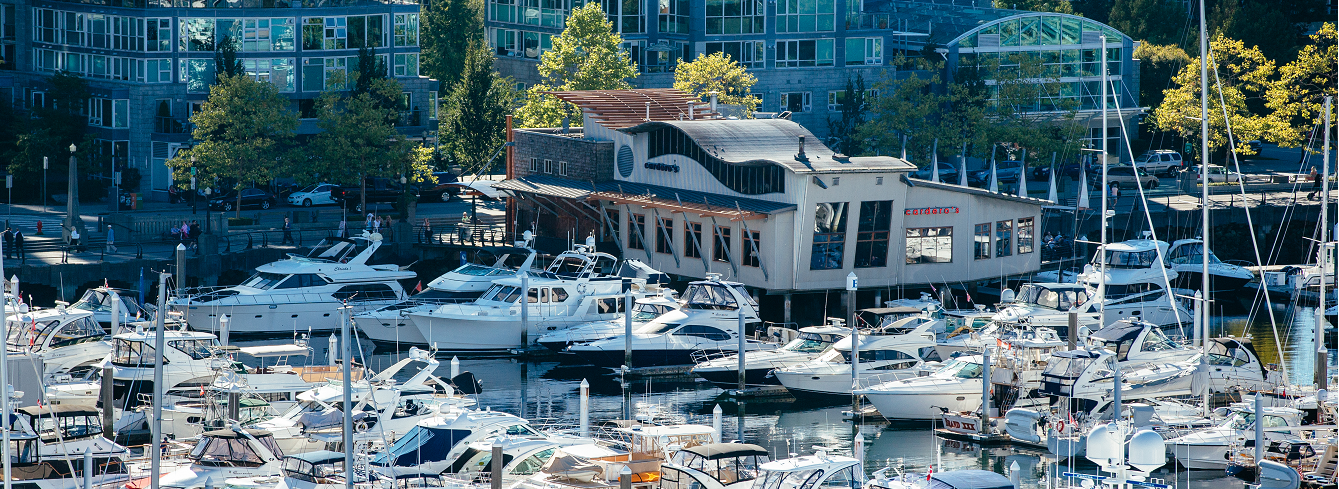
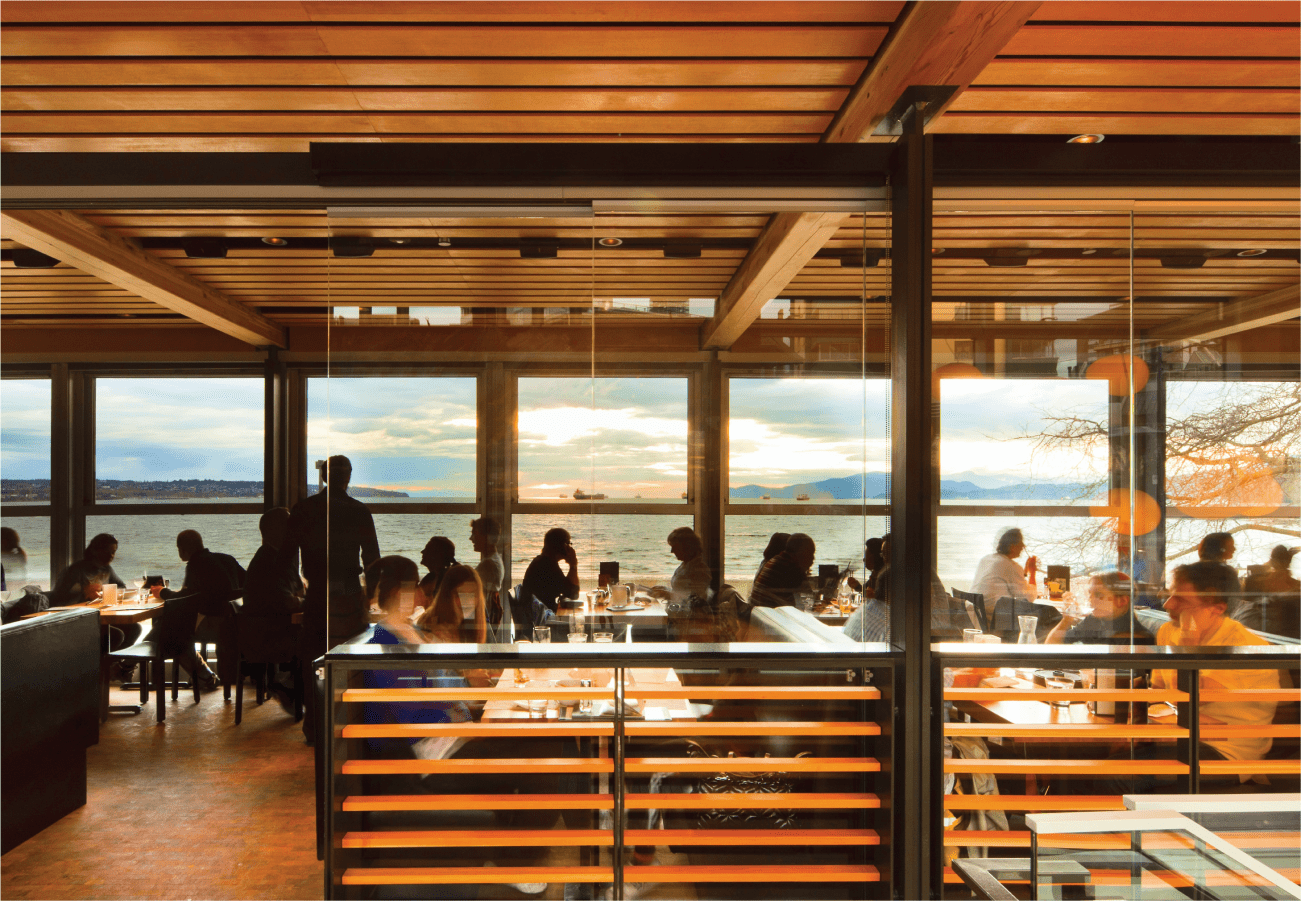
Concrete apartment towers built after the Second World War stand along streets that run down to the seawall, and Holly Lodge on Jervis Street has hosted scenes from three television series.
What West End looks like
Concrete apartment towers stand in even rows, many of them over twenty storeys. Their boxy facades are stacked with balconies, and nearly every entrance has its own driveway and canopy. Between the towers, older six and eight storey apartment blocks survive, brick or stucco fronting straight onto the sidewalk.
Tree lined streets run down toward the water, parked cars along both curbs and leaves collecting on the asphalt in fall. and Davie Street carry the ground floor shops and restaurants that serve the towers, their storefronts under awnings and hanging signs. A rainbow crosswalk marks , inside the same commercial stretch.
The seawall runs along English Bay at the foot of Denman Street, a paved path between a sandy beach and a strip of lawns and trees. Stone groins reach into the water along the sand, and the path curves past benches toward Stanley Park.
A handful of older buildings interrupt the towers. on Barclay Street is a green wood frame Victorian with a corner turret and a covered porch. on Jervis Street dates from 1910 and 1911. The ivy covered on Gilford Street dates from 1913.
Shot in West End
Holly Lodge, an apartment building on Jervis Street built in 1910 and 1911, has been a location for three television series. The Flash used it for a rescue from a burning building, and Fringe and Supergirl each shot separate scenes there in later seasons.
The Flash, season 1
Holly Lodge
The Flash filmed a rescue from a burning building at Holly Lodge on Jervis Street. The scene is in the show's second episode, Fastest Man Alive.
Fringe, season 4
Fringe filmed a scene from its fourth season episode Subject 9 at Holly Lodge on Jervis Street. The building is the same one The Flash and Supergirl also used for scenes of their own.
Supergirl, season 4
Supergirl filmed a scene from its fourth season episode Parasite Lost at Holly Lodge on Jervis Street. The same building appears in scenes from The Flash and Fringe as well.
What West End can double for
St. James Town in Toronto, Ontario
St. James Town's concrete apartment towers date from the 1960s and 1970s, with the same boxy massing and stacked balconies. Streets between the towers carry the same short driveways and canopied entrances. St. James Town's towers stand closer together with less green space between them, so a wider shot needs careful framing to avoid crowding several towers into one frame. Try searching concrete apartment towers now.
Streeterville in Chicago, Illinois
Streeterville's lakefront apartment towers stand close to Lake Michigan's shoreline in a similar arrangement of dense residential blocks meeting open water. Balconies and boxy massing from the same postwar decades give the streets a comparable rhythm. The towers in Streeterville run taller and glassier on average. An older, lower concrete block keeps the period more convincing. Try searching lakefront apartment towers now.
Nob Hill mixes older apartment buildings from the early twentieth century with taller postwar towers, the same layering that puts Holly Lodge and the Sylvia Hotel beside concrete high rises here. Both neighbourhoods sit on rising ground above open water. Nob Hill's grid runs steeper and its cable car lines are a giveaway in any wide shot, so tighter street level framing on one of the older apartment buildings holds the illusion better. Try searching older apartment buildings now.