Grey stone walls and grass ramparts enclose a reconstructed 1740s town beside a harbour.
What Fortress of Louisbourg looks like
Grey stone walls and grass ramparts enclose the reconstructed town. The stands among the reconstructed works on the walls.
Most of the buildings are reconstructions from the 1960s to the 1980s, built to recreate the town as it stood in the 1740s. Stone houses with steep slate roofs and dormers stand beside long wood-frame houses in grey clapboard, with shingled roofs and shuttered windows.
The lanes between the houses are gravel, and a row of homes lines the slope of . Vegetable beds lie along a picket fence, with a small stone icehouse beyond it.
The is among the fully restored buildings, and the houses the Harbour Gallery on the tour route. On Rue Royale, a storehouse keeps its original 18th century paved floor.
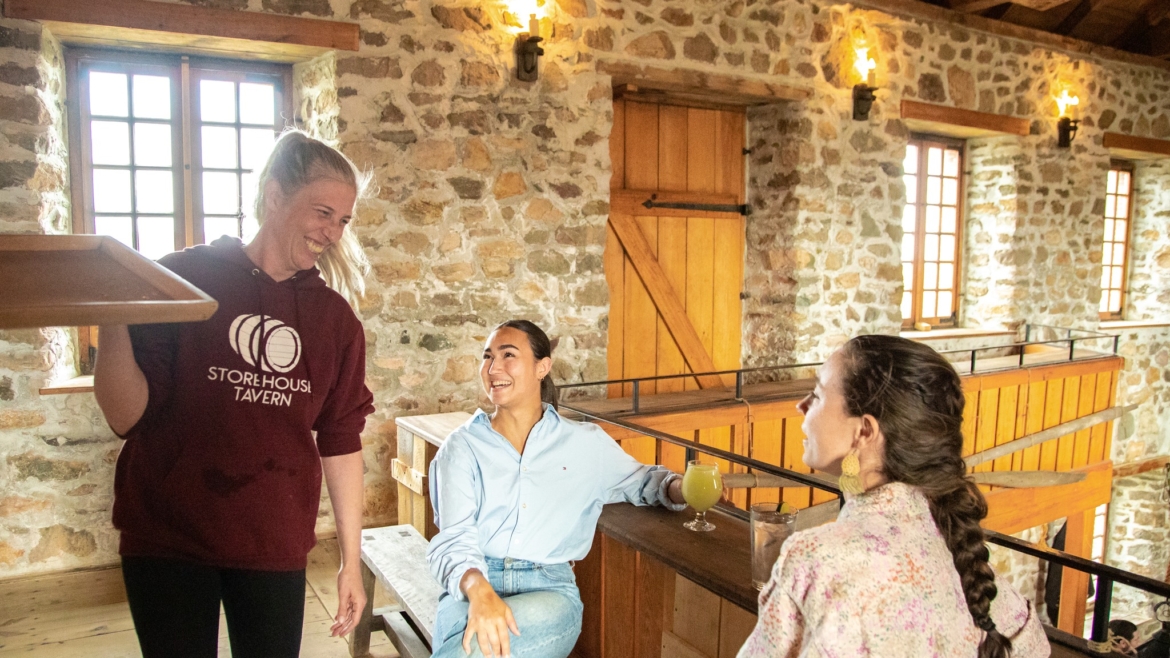
Several buildings are furnished as working rooms. A stone storehouse holds barrels and wicker baskets. The Artillery Forge keeps a fire going, with a costumed smith at the anvil.
Shot in Fortress of Louisbourg
The CBC miniseries The Book of Negroes and the Discovery Canada series Frontier both filmed at the fortress in 2014 and 2015. The television series Washington Black also filmed a scene there.
The Book of Negroes, 2015
Played New York City, New York, 1776
The six-part CBC miniseries dressed the reconstructed town as New York City in 1776, subtly retouching the settlement to match. Close to 100 local people were on scene as extras when filming began in April 2014.
Frontier
Played late 18th century
Much of one production day for Frontier took place at the fortress, where the production was getting ready to shoot what appeared to be a battle scene, with an estimated 30 to 50 people on site. The rest of the series was being shot mostly in Newfoundland.
What Fortress of Louisbourg can double for
Manhattan in New York City, New York
The Book of Negroes dressed this fortress as 18th century Manhattan in 1776, and the production retouched the settlement to match. The grass ramparts and the harbour below them show in any wide shot, so frame tight on the houses and streets. Keeping the bastions out of the frame lets the period dressing show. Try searching 18th century Manhattan streets now.
Colonial Williamsburg in Williamsburg, Virginia
Colonial Williamsburg is a reconstructed 18th century town, with about 500 buildings reconstructed or restored and costumed interpreters on its streets. Its Georgian houses are a looser fit for the French stone and clapboard here, but both towns show period streets at street level. Stone walls and steep slate roofs give Louisbourg away in a wide shot, so frame close on gardens and clapboard doorways. The bastions and harbour have no place in Williamsburg, so keep the walls and water out of frame. Try searching 18th century colonial streets now.