Brick duplexes with iron staircases surround a covered produce market, filmed for a full season by a National Film Board series.
What La Petite-Patrie looks like
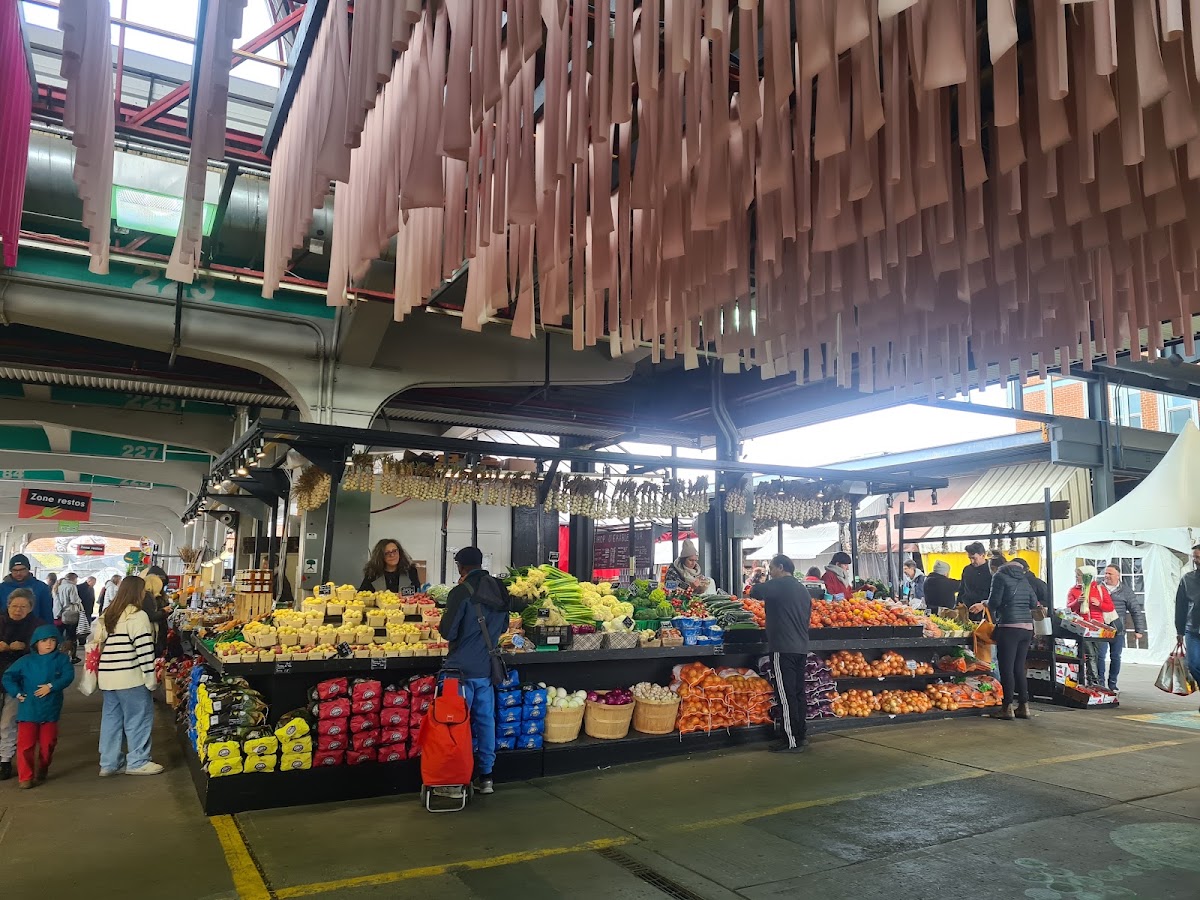
fills the block bordered by Jean-Talon Street, Mozart Avenue, Casgrain Avenue and Henri-Julien Avenue. It is the largest public market in Montreal. Open stalls run under long shed roofs around a central hall, and vendors set up daily with produce stacked in bins and hand lettered price signs propped between the crates.
On , a glass canopy has run over both sidewalks since 1984, covering about a kilometre of storefronts between Jean-Talon and Bellechasse streets. About 400 businesses operate under it today, with awnings, painted signs and window displays filling the ground floor shops beneath the canopy.
On , brick duplexes and triplexes rise two to three storeys, with exterior iron staircases leading up to the second floor door. Small brick outbuildings and wooden fences back onto the lanes behind them.
stands at Henri-Julien Avenue and Dante Street in red brick, each of its twin towers topped with a round rosette of mosaic tile below the gable. Built in 1918, its interior holds frescoes painted by Guido Nincheri. Italian grocers and cafes line nearby, with fruit stands and hand-painted awnings set out on the sidewalk.
Shot in La Petite-Patrie
The National Film Board series Marché Jean-Talon filmed for six months inside Jean-Talon Market, following the vendors through a full season. Directors Jean-Philippe Duval and Hélène Choquette shot all six episodes inside the market's own stalls and aisles. The series won Best Documentary Series and the Multiculturalism Prize at the 2004 Prix Gémeaux.
Marché Jean-Talon, 2004
Jean-Talon Market
The documentary follows vendors at their own stalls through a full season inside the market. It was filmed over six months for the National Film Board, directed by Jean-Philippe Duval and Hélène Choquette.
What La Petite-Patrie can double for
Italian Market in Philadelphia, Pennsylvania
The Italian Market is a run of outdoor stalls under awnings inside a dense rowhouse grid, the same way stalls run through Jean-Talon Market's covered sheds, with produce piled on tables at the kerb. Both markets trade daily with real vendors rather than a dressed set. The Italian Market's rowhouses are red brick with white marble front steps rather than Montreal's exterior iron staircases, which shows in any shot that pulls back from the stalls themselves. Try searching outdoor produce market stalls now.
Narrow streets of small storefronts sell produce and specialty foods at a similar scale to the blocks around Jean-Talon Market, with crates and signage out on the sidewalk. Both neighbourhoods carry a similar multicultural commercial mix around a market identity. Kensington's houses are mostly wood frame or plain brick without exterior staircases. The overhead wiring and parking pattern also differ, so a wide shot needs care. Try searching narrow market storefront street now.
Aisles of open stalls run under a long covered roof at Borough Market, the same way they run through Jean-Talon Market's covered sheds. Both keep vendors trading inside one continuous covered structure rather than in separate shopfronts. Borough Market's cast iron and glass roof reads Victorian rather than the market's own plainer steel sheds, so a shot that includes the roof structure gives the difference away immediately. Try searching covered market stalls now.