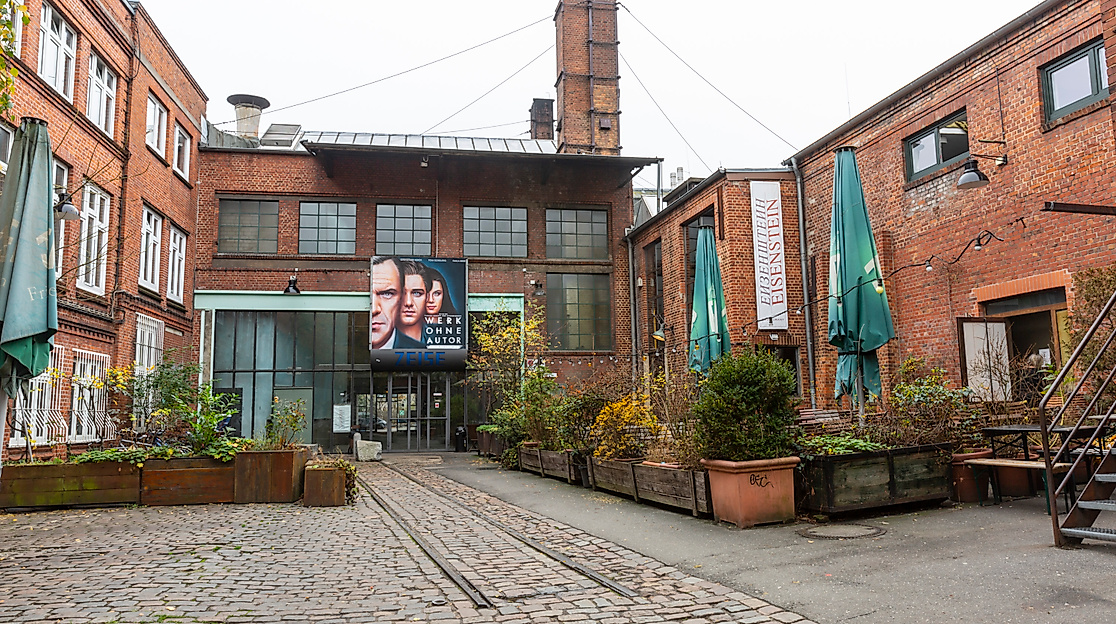
Low brick housing backs onto converted factory yards along a pedestrian shopping street.
What Ottensen looks like
Rows of low brick and rendered housing run behind the main shopping street, two and three storeys with plain window surrounds and shallow gabled roofs. Ground floors are a mix of flats and small workshops, with mailboxes and bicycle racks set into doorways along the narrower side streets.
Red brick factory blocks from the turn of the last century stand a few streets over, their window bays running the full height of the facade under flat or saw tooth roofs. A wide brick archway leads through to a courtyard where a disused rail spur, laid for shunting goods wagons, still curves across the concrete.
A narrower passage off a side street runs under a building's upper floor and opens into a smaller yard behind, old company lettering for a wire works still fixed to the corner pier. Low two storey rowhouses nearby carry their original front doors and mailboxes side by side.
The pedestrianised main street is lined with taller corner buildings in yellow and cream brick, ground floors fitted with pharmacies, bakeries and a covered shopping arcade. A parallel street repeats the same scale of shopfront, stone window surrounds on some of the older buildings and outdoor tables set along the pavement.
Shot in Ottensen
Fatih Akin filmed his 1998 debut Kurz und schmerzlos in Ottensen, including a fight at the corner of Nöltingstraße and Piependreiherweg and a scene in a jewellery shop at 28. The friends argue afterward in a narrow passage at 28.
Kurz und schmerzlos (Short Sharp Shock), 1998
The passage at Zeißstraße 28
The friends argue here after the fight nearby, in the passage behind Zeißstraße 28. A district archive now occupies the building, its old wire works sign still mounted beside the gateway. Street View
Ancoats still has its red brick mill blocks and loading archways, with disused rail sidings set into some of the yards, a close match for a converted factory courtyard. The mills run taller than Ottensen's factory halls, so a street level frame reads closer than a wide shot that takes in the roofline. Try searching red brick mill courtyard now.
Wrangelkiez in Berlin, Germany
Red brick Gründerzeit blocks with rear courtyards give Wrangelkiez a similar mix of housing and small workshop space, mostly built between the 1880s and 1900s. Berlin's courtyards tend to run deeper and the brick runs darker, so a tighter frame on one gateway or yard holds the match better than a full street. Try searching red brick courtyard housing now.
Holbeck's brick mill buildings and former yards have gone the same way, converted into offices and workshops behind a working street. Leeds mixes in taller modern blocks nearby, so framing tight on one courtyard or facade avoids giving the skyline away. Try searching converted brick mill yard now.