Rows of two and three storey wooden houses from the 1920s, beside a disused rail line and the Seaplane Harbour.
What Kalamaja looks like
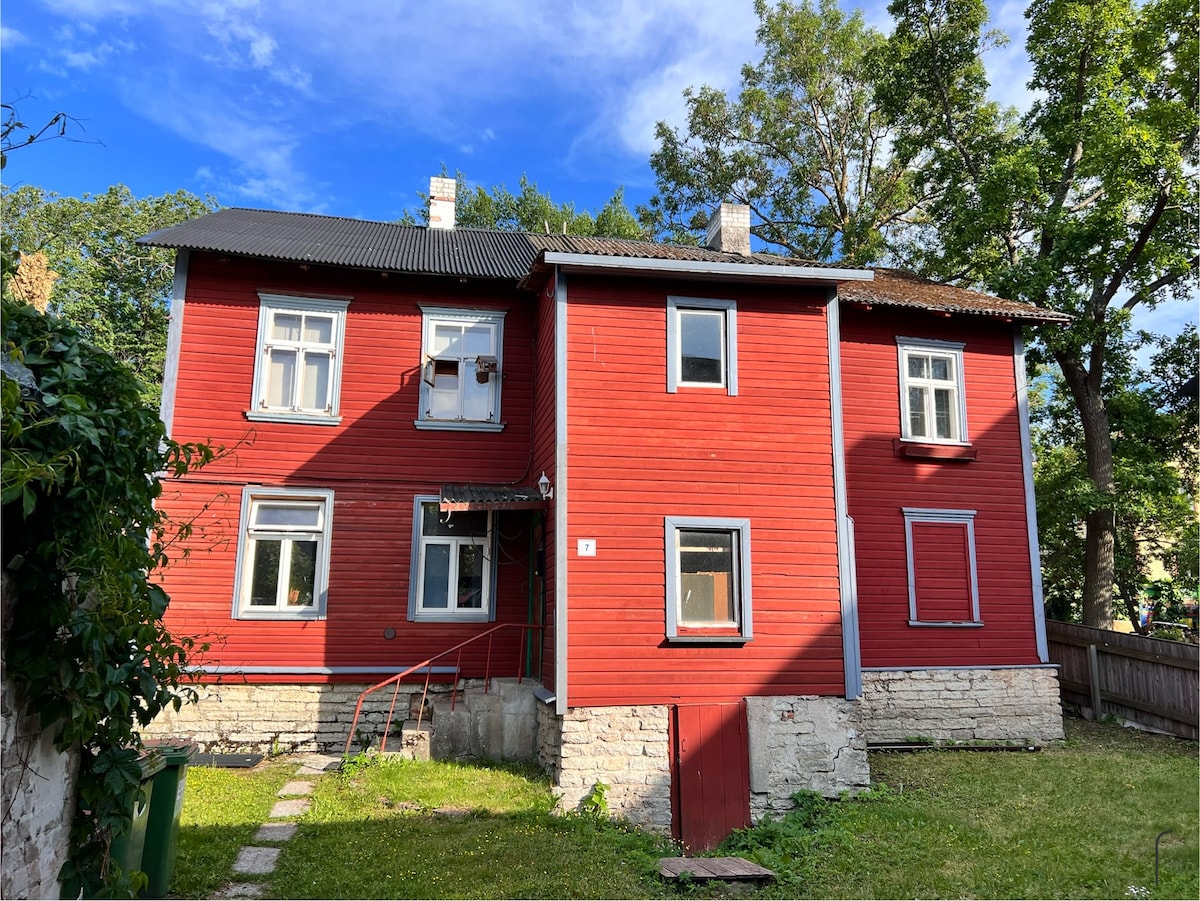
The streets are lined with two and three storey wooden houses, their fronts horizontal plank siding in muted greens, greys and browns with white window trim. Each house is built as two symmetrical wings around a central stone stairwell. Most are freshly repainted, though a few side streets still carry a house with plywood over the windows.
Valgevase and Kalju carry some of the most brightly painted rows, with Kungla and Niine close behind. keeps some of the best preserved houses, each one a different paint colour from its neighbour down the block.
At the district's edge, former factory buildings now make up . Eleven converted blocks of brick walls and loading doors hold shops, bars and studios. A disused freight line runs along the far side of the complex, with the Tallinn Old Town's spires visible across the tracks.
's hangar stands on the waterfront at Vesilennuki 6, a reinforced concrete shell now restored as a maritime museum. , a former cemetery, still keeps its 1780 gate and bell tower among open lawns. The neo gothic faces the street a block away.
Shot in Kalamaja
Tenet used the freight rail yard beside Telliskivi Creative City for one of its early sequences, with the Tallinn Old Town's spires and a corner of the complex visible behind the action. The Protagonist is held and beaten at the trackside before the story moves on.
Tenet, 2020
This is the freight yard where that sequence was shot, alongside the rail line that still runs past Telliskivi's converted factory buildings. The production has not confirmed the exact camera position along this stretch of track.
What Kalamaja can double for
Puu-Käpylä in Helsinki, Finland
The wooden houses built for factory and city workers in the early 1920s give Puu-Käpylä a close match for Kalamaja's own decade and worker housing scale. Its houses sit in pairs around shared courtyards rather than facing straight streets, so wider shots read differently. Steeper gabled roofs and matching paint colours across each pair are the tell in a wide shot. Try searching wooden houses around courtyards now.
Kalnciema Quarter in Riga, Latvia
Kalnciema Quarter's wooden houses date from the late nineteenth century and carry the same horizontal plank siding and street scale found here. Carved gable trim and taller window surrounds set the Riga houses apart in close shots. The market stalls now filling the yards between houses need clearing from a period frame. Try searching wooden plank siding houses now.
Nordnes in Bergen, Norway
Nordnes has a similar run of small wooden houses close to the water, though its houses are a century older and narrower, with steep roofs and tightly packed lanes rather than straight streets. The peninsula setting matches this harbour edge more than its architecture does. Cobbled lanes and alpine style roof pitches would need dressing out of a period frame here. Try searching small wooden harbour houses now.