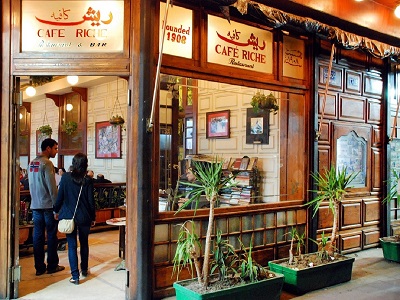
Wide stone-faced streets meet at circular squares, with deep balconies and ground floor cafes.
What Downtown Cairo looks like
Talaat Harb Street runs between and , lined with five to seven storey stone blocks whose upper floors carry deep balconies and shuttered windows. Ground floors open onto cafes and shuttered shopfronts, with awnings angled low over the pavement and granite kerbs along the asphalt.
At No. 34 Talaat Harb Street, the real Yacoubian Building is a stone Art Deco block that still shows its name in neon lettering over the entrance. Talaat Harb Square itself is ringed by French neoclassical facades, Groppi's tearoom on one corner and a short walk down the street toward Tahrir. Qasr el-Nil Street crosses Talaat Harb at the square. It mixes the same Beaux-Arts fronts with pointed arches and strapwork from the Egyptian Islamic Revival style, on some of the same balconied blocks.
Tahrir Square opens out wider than the streets feeding into it, asphalt roads curving around a central island with trees and street lamps. Hotel towers and taller modern office blocks face the square from several sides, plainer than the stone rows closer to Talaat Harb.
Corner buildings through the grid carry stacked Arabic and English signage over their shopfronts, with wrought iron balcony railings repeating up each facade. Some fronts are still bare carved stone, others painted over in browns and ochres.
Shot in Downtown Cairo
Downtown Cairo's grid has drawn two very different productions to the same streets. used a nearby block to stand in for its own famous namesake, and The Square filmed Tahrir Square as itself through the uprisings it covers.
The Yacoubian Building and The Square
Talaat Harb Street and Tahrir Square. One production dressed a stand-in block for a building it could not access, the other filmed the square exactly as it stood.
The Yacoubian Building, 2006
The production was refused permission to shoot inside the real Yacoubian Building at No. 34 Talaat Harb Street, so it shot this exterior at a nearby address instead. Accounts differ on which building was used. One source names this address, No. 32 Talaat Harb Street; another places the substitute near Shorbagy Street a block over. Street View
The Square, 2013
Tahrir Square
The 2013 documentary The Square follows demonstrators through the Tahrir Square uprisings, filmed largely on the plaza itself across the 2011 uprising and the renewed protests of 2013. It shows the square as it already stood, since a documentary has no set to dress. Street View
Microcentro's carved stone facades and deep iron balconies read close to Talaat Harb Street, both built up through the same decades by European trained architects. Avenida de Mayo lines a similar run of carved stone facades meeting at a grand square. Buenos Aires widens its boulevards more than Downtown Cairo's streets, so a tighter frame on one block holds the match better than a wide shot. Try searching carved stone facades now.
Boulevard Mohammed V in Casablanca, Morocco
Boulevard Mohammed V was built under the same French trained planning as Downtown Cairo, with Art Deco facades and deep balconies over ground floor shops. Both cities share wide gridded streets meeting at circular squares. Casablanca's buildings run taller and plainer in places, so a scout should favor the more ornamented blocks near the boulevard's own squares. Try searching deep balconies Art Deco now.
Derybasivska Street in Odessa, Ukraine
Derybasivska Street's stuccoed facades and wrought iron balconies share Downtown Cairo's scale, built up in the same decades under similarly European trained planning. The street narrows more than Talaat Harb though, with less of Cairo's wide sightline to a square. Odessa's cooler stone tone and narrower street give it away in a wide shot, so tighter frames on the wrought iron balconies hold the match best. Try searching wrought iron balconies now.