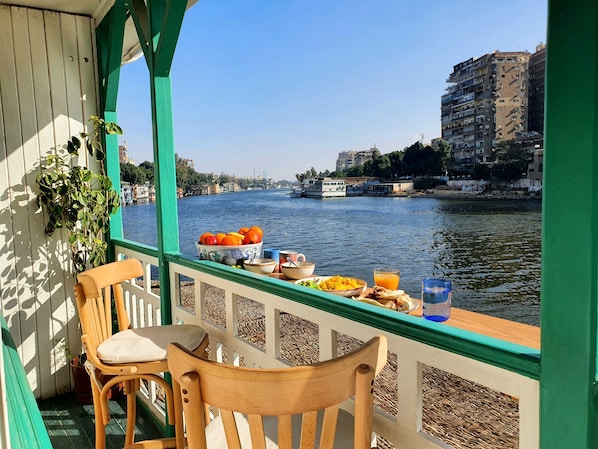
Balconied stucco apartment blocks and villas on a Nile island, with bridges to the mainland on every side.
What Zamalek looks like
is the island's commercial spine, lined with five and six storey apartment blocks built mostly in the 1920s and 1930s. Their ground floors hold shops and cafes. On quieter streets such as and , the same stucco blocks have iron balconies and shuttered windows under a tall canopy of street trees.
Lower villas survive between the apartment blocks on these residential streets, their stucco fronts set with shuttered windows and a geometric frieze under the roofline. Iron railings and walled front gardens separate several of these buildings from the pavement. One now serves as a foreign embassy, its gate marked by a flag and a guard post.
Four bridges cross to the mainland, among them the 15th of May and Qasr El Nil bridges. River boats and floating restaurants moor along both banks of the Nile, and taller towers rise across the water on the Cairo side.
runs along the island's western edge, past the walls of the . Inside, an artificial stone grotto holds a staircase and covered passages lit from alcoves in the rock, with a pond where visitors feed the birds and palms filling the grounds around it.
Shot in Zamalek
Yousry Nasrallah's 2008 film The Aquarium centres on Cairo's Grotto Gardens, built around the Aquarium Grotto Garden on Gabalaya Street. The production used the garden's own grotto passages and ponds rather than a street or apartment building in the surrounding blocks.
The Aquarium, 2008
The Aquarium Grotto Garden
The Aquarium Grotto Garden is the public garden the film is built around, its artificial grotto passages lit from alcoves in the rock and a pond at its edge where visitors feed the birds. The garden is a public park rather than a private house, and no source ties a specific street or apartment building in Zamalek to the production. Street View
What Zamalek can double for
Camp Caesar in Alexandria, Egypt
Camp Caesar's balconied Art Deco apartment blocks and Arabic signage sit close to Zamalek's own, built across the same interwar decades. The street scale and tree cover are close matches for Zamalek's own side streets. Camp Caesar sits a block back from Alexandria's own corniche, so a water backdrop needs a different angle. Newer satellite dishes and wider traffic lanes need keeping out of a tight period frame. Try searching balconied art deco apartment blocks now.
Oval Maidan in Mumbai, India
Oval Maidan's Art Deco apartment houses share Zamalek's stacked iron balconies from the same interwar decade. Mature trees line the maidan's edge much as they do Zamalek's own streets. Mumbai's blocks run taller and closer together in a wide shot, and English and Devanagari signage would need covering. Monsoon staining on the facades is heavier than anything in Cairo's drier climate. Try searching art deco apartment balconies now.
The White City in Tel Aviv, Israel
The White City's International Style apartment blocks went up across the same 1930s decade as Zamalek's own rows, with stacked balconies and ribbon windows down the block. Both sit under mature street trees planted when the buildings went up. Tel Aviv's facades run plainer and whiter, with almost no applied ornament, so Zamalek's painted stucco detail would need toning down. Hebrew signage and newer glass additions are the giveaways in a wider shot. Try searching 1930s apartment block balconies now.