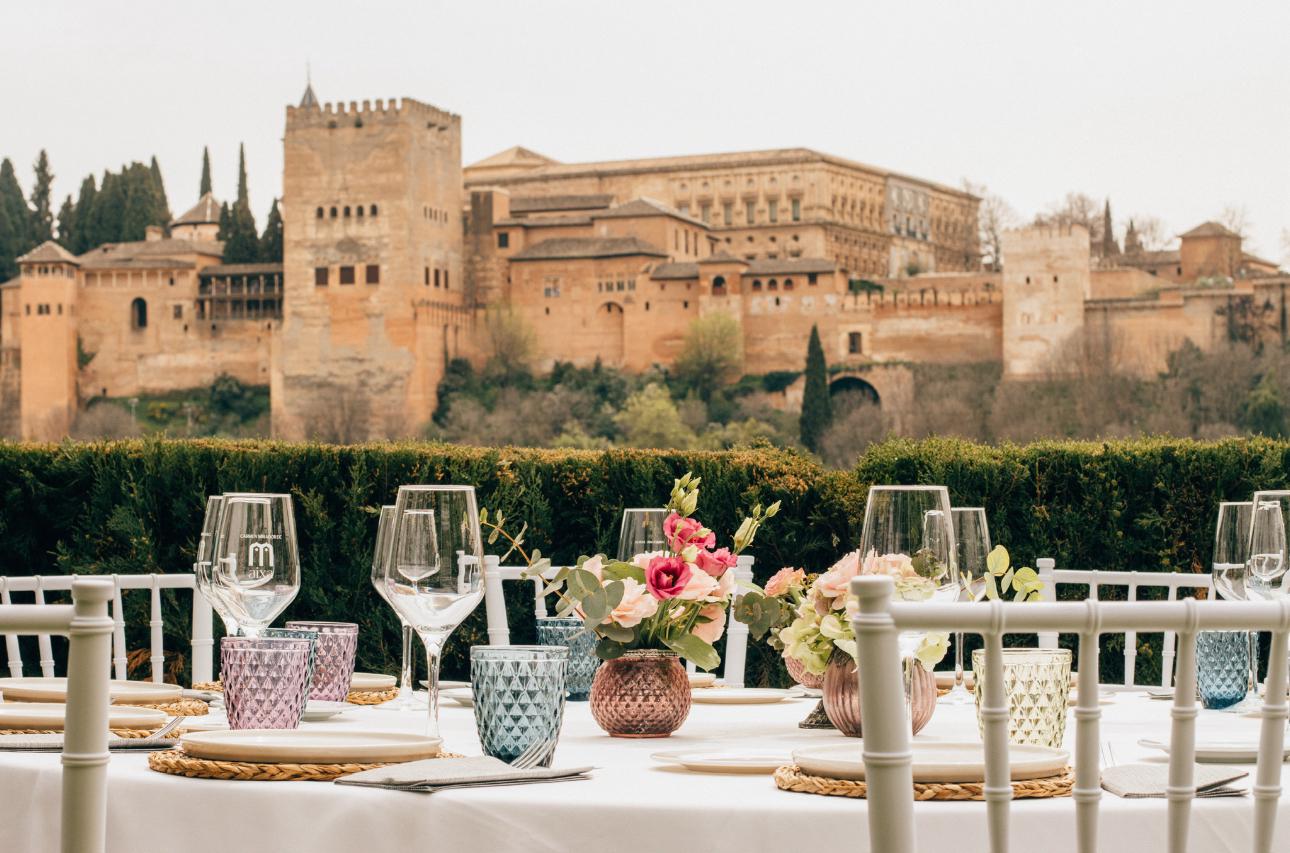
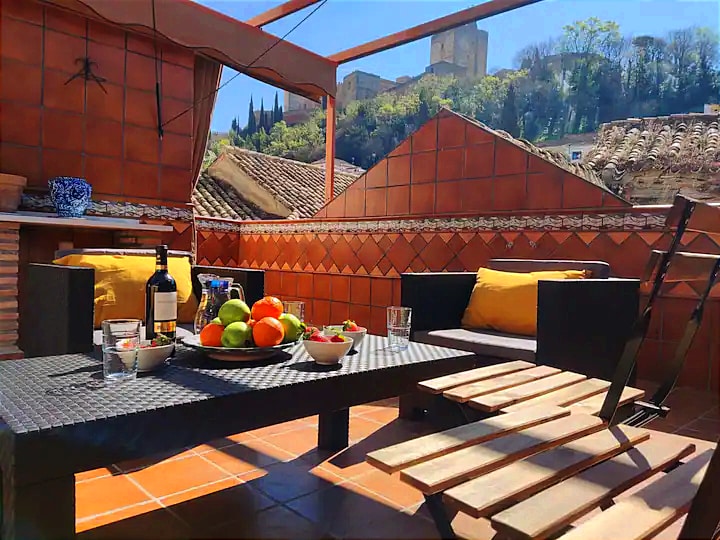
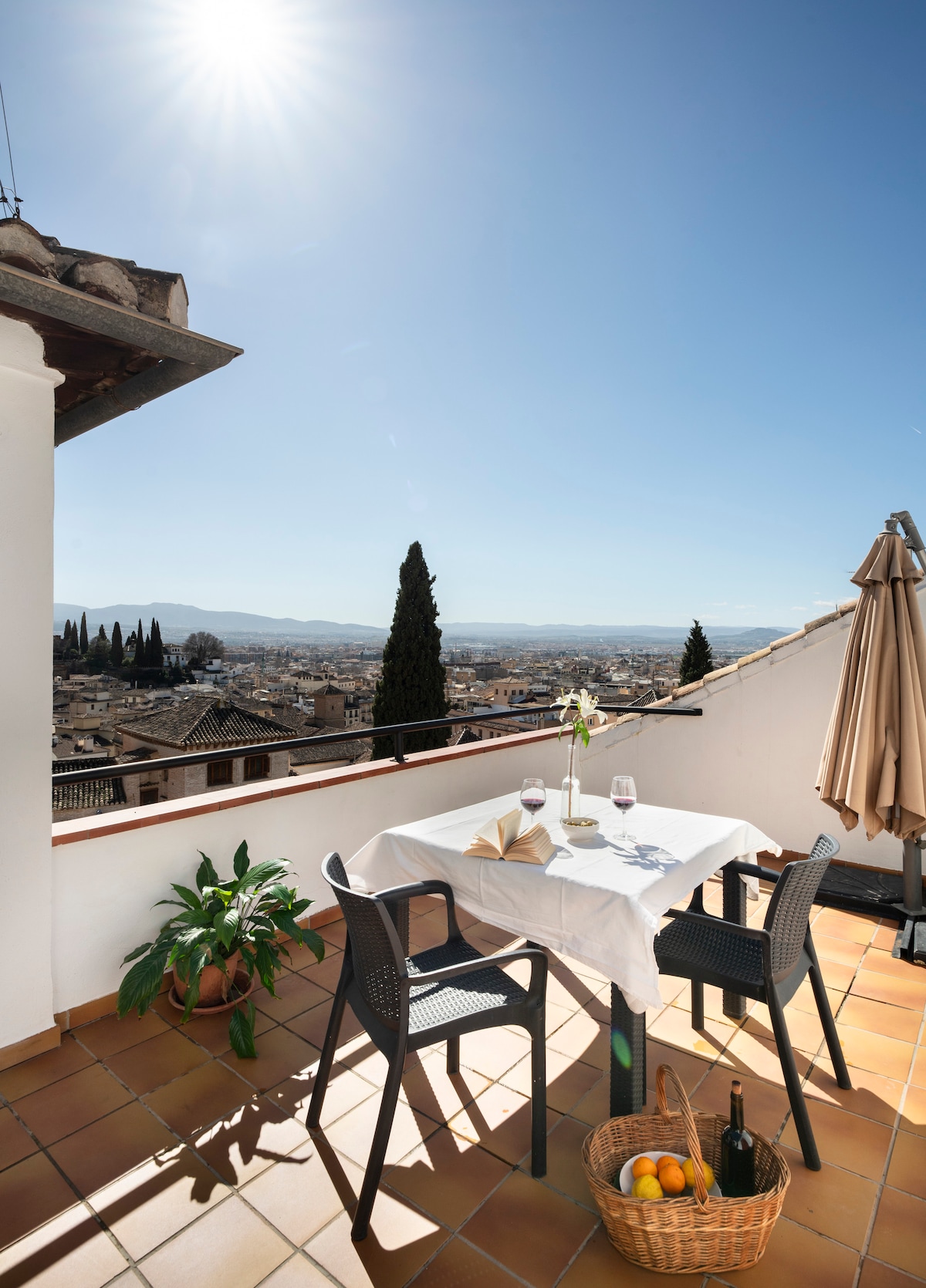
Whitewashed carmen houses line narrow cobbled lanes climbing a hillside that faces the Alhambra across the Darro valley.
What Albaicín looks like
Narrow lanes climb the hillside in tight switchbacks, too narrow for a car. Whitewashed walls line them on both sides, with wooden doors set flush to the stone. Behind many of those walls sit carmen villas, each a freestanding house with a small orchard or garden screened from the street. The street plan itself dates from the Nasrid period, the thirteenth to fifteenth centuries.
Several lanes keep their empedrado granadino, a pebble mosaic of black and white river stones set by hand into bands and medallions. 's floor is paved this way. Calle Correo Viejo, farther down the hill, has its own worked pattern underfoot. Iron window grilles and potted plants on the walls are the usual breaks in the white plaster.
The Church of San Nicolás stands near the top of the hill, its square white bell tower rising over the plaza known as the , where the Alhambra and the Sierra Nevada appear across the valley. Cuesta de las Cabras drops away from the same plaza past the white walls and tiled minaret of Granada's mosque, its garden courtyard behind them.
runs along the river at the foot of the hill, sixteenth and seventeenth century buildings on one side and the Alhambra's walls rising directly across the water on the other. At least twenty medieval cisterns survive under the streets above, among them the Aljibe del Rey, now a walled garden court.
Shot in Albaicín
Caníbal used two real buildings on the lower Albaicín's Carrera del Darro as a tailor's shop and the tailor's home across the Puente Cabrera. Granada Nights shot its drama at the Mirador de San Nicolás, the plaza where the hillside's lanes open onto the Alhambra.
Granada Nights, 2021
The Mirador de San Nicolás
The 2021 British drama Granada Nights filmed scenes at this plaza, framed against the Alhambra and the Sierra Nevada beyond it. The viewpoint sits at the top of the lanes that climb from the Darro valley below. Street View
Alfama climbs the same kind of hillside above the Tagus in narrow, switchbacking lanes, with whitewashed walls meeting the street directly and a castle on the hill above it standing in for the Alhambra. Laundry lines and painted tile panels are common on Alfama's walls in a way the Albaicín's plainer white plaster is not. Keep tiled facades and tram rails out of frame where the shot needs Albaicín's flatter, untiled walls. Try searching narrow whitewashed lanes now.
Casbah in Algiers, Algeria
The Casbah of Algiers is also a UNESCO listed hillside quarter of narrow stepped lanes and whitewashed houses, built in part by Andalusian refugees after 1492 in a density similar to the Albaicín. Ottoman era doorways and ironwork are more decorated here than in the Albaicín's plainer frontages. Favor the plainer doorways over the more ornate Ottoman ones to hold the Andalusian reading. Try searching narrow stepped whitewashed lanes now.
Chefchaouen, Morocco
Chefchaouen's old town was partly settled by refugees from Granada after 1492 and keeps the same narrow lanes and whitewashed walls climbing a hillside in the Rif Mountains. Many of its walls are also painted a deep blue, which the Albaicín's walls are not. Frame around the blue painted walls, or choose the plainer white alleys near the top of the town to hold the match. Try searching whitewashed hillside lanes now.