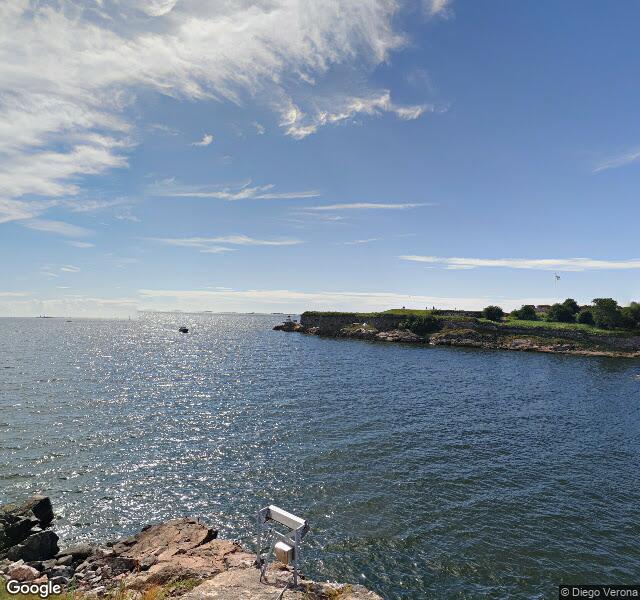
Earth ramparts over granite bastions face the water, beside a dry dock cut into the rock in 1756.
What Suomenlinna looks like
The fortress spreads across six linked islands, joined by bridges and a causeway, with earth ramparts rising straight from the water over bare granite bastion walls. Grass grows along the top of the ramparts, and the bastions follow the shape of the islands' own rock rather than running in a straight line.
Barracks built into the ramparts are rendered in yellow ochre or red over stone, with tall brick chimneys and small window openings. Cobblestone lanes connect the islands to vaulted stone tunnels that run through the walls. On Susisaari, the dry dock cut into the rock in 1756 still holds wooden ships under restoration between its granite walls.
Cannon sit in open embrasures along the bastions at , facing the strait where ships pass between the islands. , a brick building from 1854, has a green dome that also works as a lighthouse beacon after dark. A passenger ferry is the only way in, docking at a quay on Iso Mustasaari.
The 1946 Swedish film Harald the Stalwart shot its exterior scenes on the island, with its interiors built in a Helsinki studio. The 1972 documentary Viapori-Suomenlinna filmed the fortress itself, cutting contemporary footage of the walls and tunnels together with archival photographs and newsreel film.
Shot in Suomenlinna
A 1946 Swedish production used the island's exteriors as a 15th century coastline. A 1972 documentary filmed the fortress as itself, cutting contemporary footage together with archival material.
Harald the Stalwart
A 1946 Swedish adventure film used the island's exteriors for its rebellion story, with its interiors built in a Helsinki studio.
Harald the Stalwart, 1946
Played rural Sweden, 15th century
Harald the Stalwart shot its exterior scenes on the island. The production made its interiors in a Helsinki studio soon after.
Viapori-Suomenlinna, 1972
The documentary Viapori-Suomenlinna filmed the fortress itself. It cuts contemporary footage of the walls and tunnels together with archival photographs and 1918 newsreel film.
What Suomenlinna can double for
Vaxholm Fortress in Vaxholm, Sweden
Two metre thick granite walls cover a small island fortress in the Stockholm archipelago, rebuilt from the 1830s to the 1860s and reached by a cable ferry from the town. The fort covers its whole islet with no surrounding lanes or barracks blocks, so a settled fortress town still needs Suomenlinna's own wider spread. Try searching granite walls island fortress now.
Oscarsborg Fortress in Drøbak, Norway
A granite gun battery sits over earth ramparts on a small island in the Oslofjord, reached only by a short ferry from Drøbak. The islets are smaller and the batteries sit closer together than Suomenlinna's own bastions. Tighter frames read better than wide ones, since the fortress covers less ground and the modern town is close behind it. Try searching granite gun battery island now.
Landskrona Citadel in Landskrona, Sweden
A star shaped fort with bastioned earthwork ramparts and a water filled moat faces the Öresund strait, built from 1549 and expanded after 1667. It sits on the mainland shoreline rather than an island, and its round corner towers and square moat look more geometric than Suomenlinna's rock cut bastions. Try searching star fort earthwork moat now.