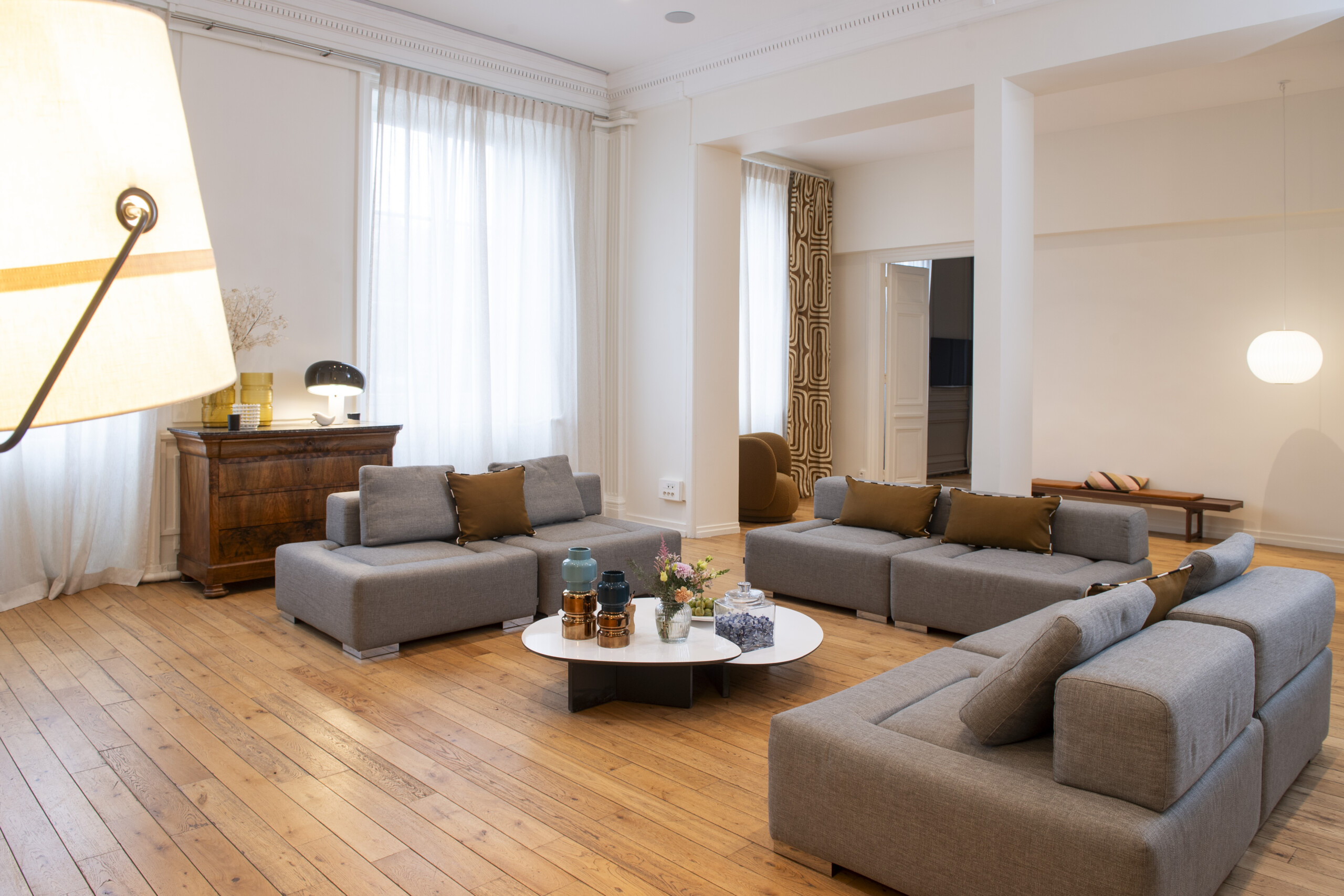
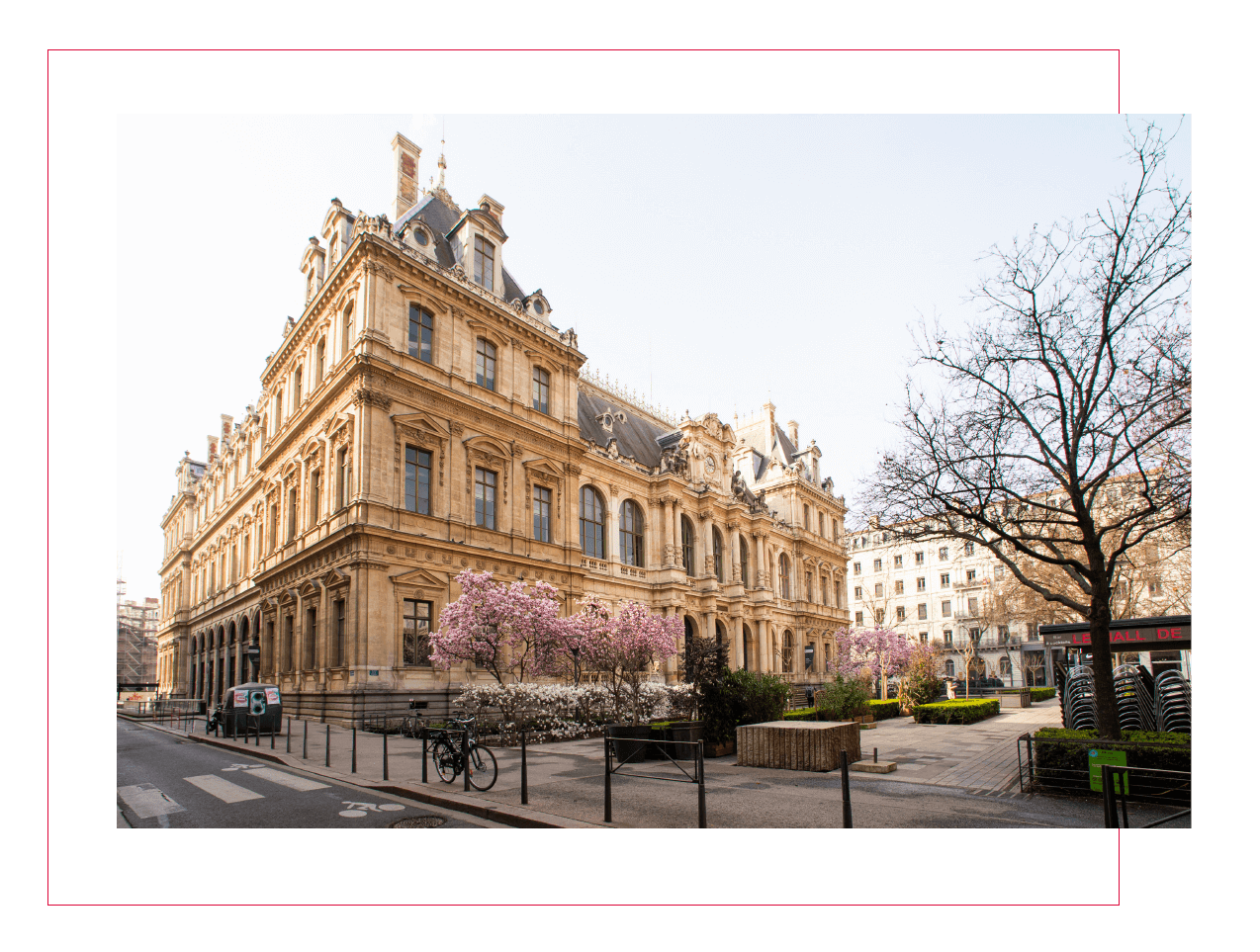
Ochre stone townhouses rise four and five storeys above narrow cobbled lanes, with spiral stair towers behind courtyard doors.
What Vieux Lyon looks like
runs the length of the Saint-Jean quarter, paved and closed to cars, about 500 metres from end to end. Ochre and pinky orange stone fronts rise four and five storeys on either side, their ground floors given over to shops and restaurants.
The townhouses date mainly from the 16th and 17th centuries, with a few earlier Gothic and Romanesque survivals. Rue du Boeuf runs parallel and narrower, its cobbles about 4.5 metres wide between the house fronts. The , at number 16, has a pinkish plastered spiral stair tower rising through an inner courtyard. It is one of several such towers behind the district's plain street doors.
A traboule links 54 Rue Saint-Jean to 27 Rue du Boeuf, cutting straight through several buildings and courtyards rather than following the street. occupies one of the largest hotel particulier buildings in the quarter, two towers each built around their own staircase. The stands at the south end of the district, its Gothic west front facing the open paving of Place Saint-Jean, with the Romanesque Manécanterie built directly against its side.
still trades from its corner at Rue Saint-Georges, a block from Place de la Trinité, in the southern end of the Saint-Georges quarter. climbs north toward Place du Change, lined with the same ochre stone fronts and ground floor shopfronts as the rest of the district.
Shot in Vieux Lyon
Place Saint-Jean, the open square facing the cathedral, has drawn three separate productions across five decades. L'Horloger de Saint-Paul used it for a scene at the astronomical clock in 1974, and Les Lyonnais staged a killing there in 2011. La Bataille de Gaulle: J'écris ton nom opened its story on the same stones. Café du Soleil, the corner cafe at 2 Rue Saint-Georges, is a second recurring address. L'Armée des ombres staged a wartime rendezvous there in 1969 and Les Lyonnais a second killing in 2011.
L'Horloger de Saint-Paul, 1974
Michel looks at the cathedral's astronomical clock on the square outside, late in the film. The scene needed no dressing, the square used as it already stood in 1974. Street View
Les Lyonnais, 2011
The square is where the film stages the killing of a rival gang boss, one of two assassination scenes shot in the quarter for this production. The second takes place at Café du Soleil, on Rue Saint-Georges. Street View
La Bataille de Gaulle: J'écris ton nom, 2026
The square opens the second part of this two part film, shot in Vieux Lyon over four days in July 2024. Shopfronts were covered and aged, the bollards were lifted and the road markings hidden under mats to turn the square back to the 1940s Occupation. Street View
Trastevere shares a similar scale and colour. Its lanes are ochre walled and narrow, car free streets built up as a maze of passages rather than a grid. Ivy over the balconies and Rome's rounded roof tiles are the tells in a wide shot, so a tighter frame on the stone itself holds the match best. Try searching ochre walled lanes now.
Le Marais has the same shape, hotel particulier courtyards behind narrow street frontages from the same two centuries. Its stone runs paler and greyer than Lyon's ochre and pink, so a closer courtyard frame holds the match better than a wide street elevation. Le Marais has no traboules to cut through either, which a moving shot would give away. Try searching hotel particulier courtyards now.
Via di Città in Siena, Italy
Via di Città runs narrow under tall medieval and Renaissance palazzi, a similar scale though built in brick rather than stone. The red brick medieval lanes read warmer and redder than Lyon's ochre plaster in direct sun, so the match holds best in shade or on an overcast day. Try searching red brick medieval lanes now.