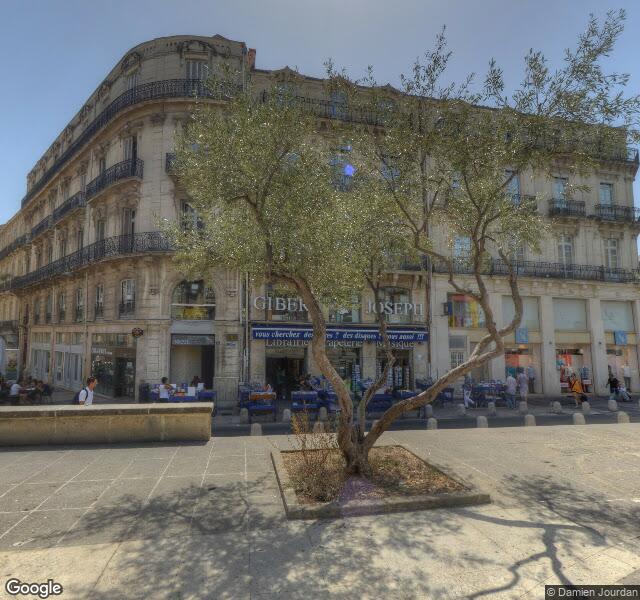
Narrow pedestrian lanes thread between pale limestone hotels particuliers and Haussmann era townhouses with wrought iron balconies.
What L'Écusson looks like
L'Écusson takes its shape and its name from a roughly pentagonal outline, said to resemble an écu, a medieval shield. Narrow lanes run through the middle of it, closed to most traffic, opening onto small squares including place Saint-Ravy and place de la Chapelle Neuve. keeps a house dating to the fourteenth century, and the spire of the Sainte-Anne church rises above the rooftops nearby.
Behind plain street fronts, the district's hôtels particuliers open through carriage gates into stone courtyards with external staircases. The oldest, the Hôtel des Trésoriers de France, dates to 1432, and the Hôtel de Saint-Côme, built between 1752 and 1756, held the city's anatomy amphitheatre. Walls run 600 to 800 millimetres thick, faced in Pierre de Castries, a pale limestone quarried locally and laid as dressed stone over a rubble core.
Rue Foch and rue de la Loge carry the district's commercial frontage, three to four storeys of the same pale stone with wrought iron balconies corbelled on carved brackets. Shopfronts sit under arched stone openings along these streets, with awnings and signage at street level. Boulevard du Jeu de Paume, on the line of the old fortifications, carries the same stone and the same iron balconies a little further apart.
Shot in L'Écusson
For Deux hommes dans la ville in 1973, José Giovanni shot several scenes around L'Écusson with Jean Gabin and Alain Delon. A printworks at 2 to 6 rue Glaize became the shop where Delon's character finds work after his release, and the production also used for a cityscape shot.
Deux hommes dans la ville (Two Men in Town), 1973
The production used the real Court of Appeal building for the film's sentencing scene, filming it as itself rather than dressing it as anywhere else. Alain Delon's character is sentenced here before the story moves him toward the printworks across town. Street View
What L'Écusson can double for
Quartier Mazarin in Aix-en-Provence, Provence-Alpes-Côte d'Azur
Aix-en-Provence holds close to 150 hotels particuliers, the densest concentration in France outside Paris, many of them in the Quartier Mazarin and along the Cours Mirabeau. A production after carriage gate entrances and interior courtyards has more of them to choose from here than in L'Écusson itself. Aix's hotels particuliers run to a grander scale with wider courtyards, so a hotel particulier courtyard reads most convincingly in a tight frame rather than a wide establishing shot. Try searching hotel particulier courtyard now.
Pézenas, Occitanie
Pézenas keeps a protected historic centre of hotels particuliers and bourgeois houses from the fifteenth to eighteenth centuries, strung along a maze of paved historic lanes. The scale is closer to a single L'Écusson street than to the whole district, so it suits a tighter brief. Pézenas is a town rather than a city district, so frame single lanes and courtyards rather than looking for a wider historic centre to match L'Écusson's full extent. Try searching paved historic lanes now.