Stone and timber framed cottages line a car free high street, backed by a medieval abbey whose cloisters played Hogwarts corridors in the Harry Potter films.
What Lacock looks like
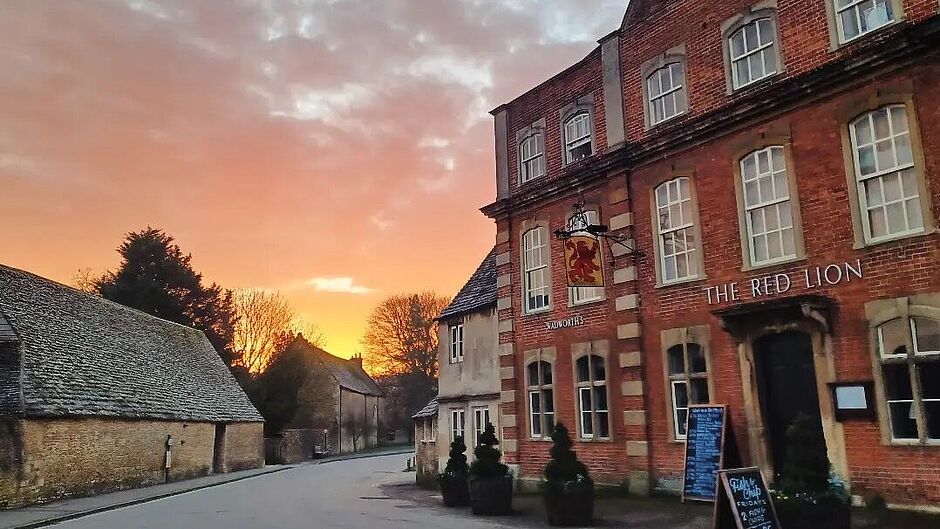
The high street runs car free between rows of stone and timber framed cottages, mostly two storeys with attic dormers under stone tiled roofs. Timber framing is painted or colour washed over ground floor stone or brick, and fronts step forward and back along the row rather than holding one flat building line. No overhead wires or satellite dishes break the roofline, and the surface underfoot is stone flagging and grass verge rather than kerb and tarmac.
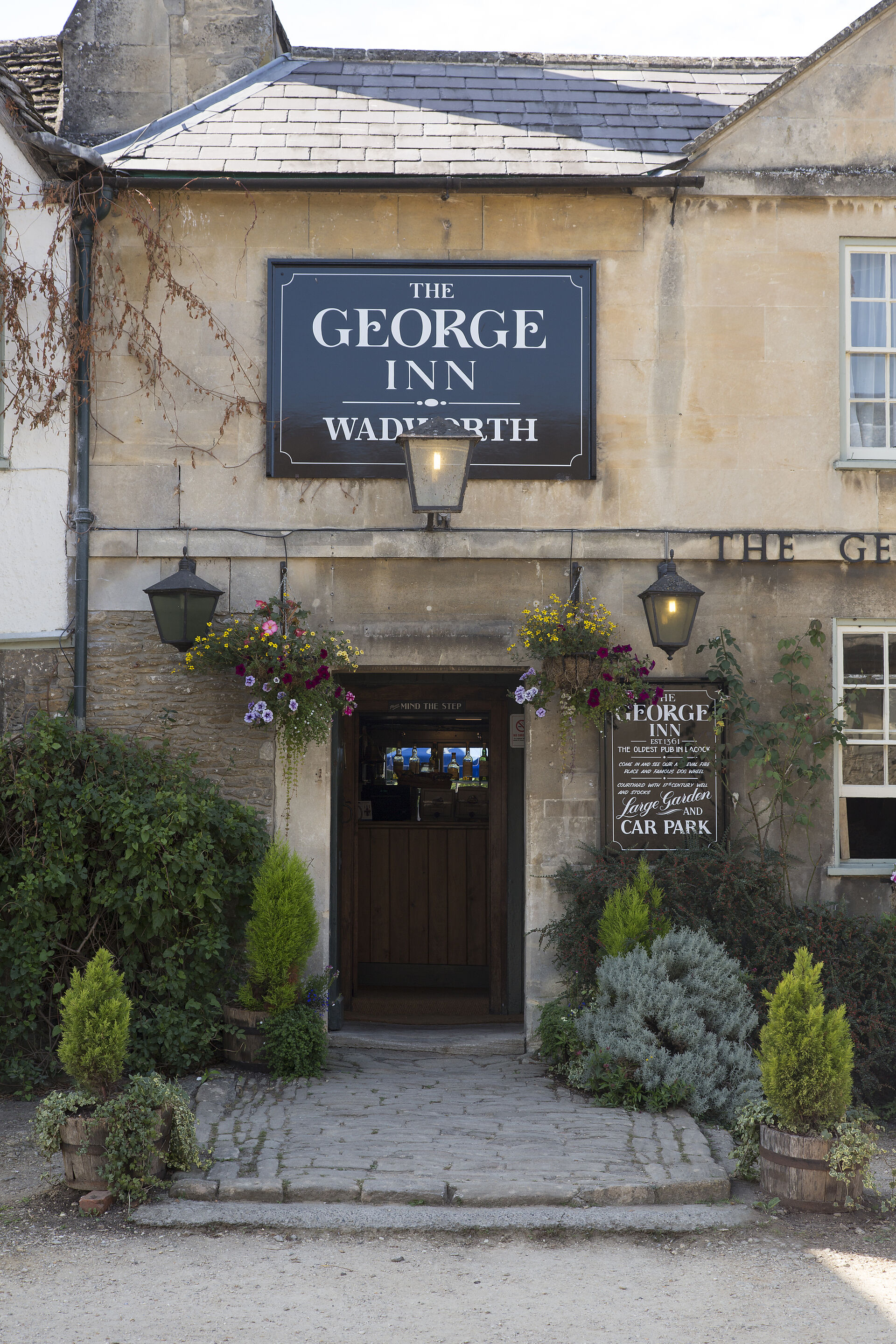
On Church Street, the is a late 15th century house with a jettied upper storey and leaded windows, run today as an inn. Mullioned windows, stone porches and low doorways repeat along the row toward , whose spire marks the street's east end. Most of the surrounding cottages are 18th century or earlier, with a few later brick fronts set between them.
The abbey stands at the village edge, reached across a bridge and through a stone gatehouse court. Inside, the medieval cloisters survive at ground level beneath the later house built over them. The arcaded walk runs around vaulted rooms that include the chapter house and the sacristy, with no modern fittings visible in the stonework.
climbs west from Church Street past private houses with walled front gardens, and West Street and Cantax Hill carry the same pale stone cottages onto narrower lanes away from the centre. Parked cars are the one modern note on most frontages, kept to the kerb rather than driveways cut into the gardens.
Shot in Lacock
's medieval cloisters survive as an arcaded walk at ground level beneath the house. They played Hogwarts corridors and classrooms across the first two Harry Potter films and returned for the 2018 Fantastic Beasts sequel, The Crimes of Grindelwald. The village street doubled for Meryton in the BBC's 1995 Pride and Prejudice, closed to traffic and covered in grass and soil for the shoot, while St Cyriac's Church further along Church Street stood behind a market scene in the 1996 ITV serial Moll Flanders.
Harry Potter and the Philosopher's Stone, 2001
Lacock Abbey cloisters
Played Hogwarts corridors and classrooms, Hogwarts School of Witchcraft and Wizardry, fantasy, contemporary production
Inside the house, the medieval cloisters survive as an arcaded walk at ground level. The production dressed this walk and its vaulted side rooms as Hogwarts corridors and classrooms for the first two films. The same cloisters returned the following year for Harry Potter and the Chamber of Secrets, including the walk where Harry hears the basilisk after leaving the Defence Against the Dark Arts classroom. Street View
Pride and Prejudice, 1995
Played the Meryton assembly rooms, Meryton, Hertfordshire, Regency era
The BBC used the Red Lion's exterior for the Meryton assembly rooms, with the dance scenes themselves built on a studio set. The production closed the main street to traffic for the shoot and covered its tarmac surfaces in grass and soil for a period look. Street View
The Fortunes and Misfortunes of Moll Flanders, 1996
St Cyriac's Church
Played a market scene, 17th century
St Cyriac's Church stood behind a market scene in the four part ITV serial, a Granada Television and WGBH Boston production set in the 17th century. The scene uses the church as a backdrop rather than an interior. Street View
What Lacock can double for
Castle Combe in Wiltshire, England
No new house has gone up in the Castle Combe village centre since about 1600, and its Cotswold stone cottages converge on a market cross the way Lacock's streets converge on its own crossroads. The scale and the stone are close enough that the two villages are regularly proposed for the same brief. A car park sits at the top of the hill and can creep into a wide shot from that end, so frame tight to the lower street and the market cross for the period look. Try searching Cotswold stone village street now.
Gloucester Cathedral in Gloucester, Gloucestershire
Gloucester Cathedral's cloisters played Hogwarts corridors in the first, second and sixth Harry Potter films, the same franchise that used Lacock's medieval cloisters for the first two. Both are real ecclesiastical cloisters standing in for the same fictional school rather than a set built to resemble one. Gloucester's fan vaulted ceiling is far more ornate than Lacock's plainer stone vaults, so a close shot of the vaulting gives away which abbey it is. Try searching fan vaulted medieval cloisters now.
Bibury in Gloucestershire, England
Arlington Row's honey coloured stone cottages were converted from a 14th century wool store into weavers' cottages in the 17th century, a similar conversion story in stone to Lacock's own older fronts. The row has stood in for a period street before, including in the 2007 film Stardust. The row is one terrace facing the River Coln rather than a full street with buildings on both sides, so it suits a tight terrace shot rather than a wide high street frame. Try searching honey stone weavers cottages now.