A single cobbled lane runs between matching stone terraces of tall chimneys, narrowing toward a chapel at one end and a hall at the other.
What Vicars' Close looks like
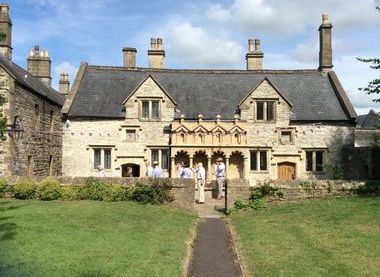
A single cobbled lane runs dead straight between two unbroken rows of stone houses, each front cut to the same pattern as its neighbour. The roofline was unified in the 1460s into one continuous slope over both sides. A line of octagonal chimney stacks breaks the roofline at intervals, each one set with a pair of small heraldic shields.
The close narrows by nearly nine feet over its length, so the two rows draw closer together toward the north end and the lane looks longer than its actual 460 feet. The houses themselves are grey coursed stone, two storeys each, a ground floor hall under a single upper room. Most of the window frames were replaced in the 18th century.
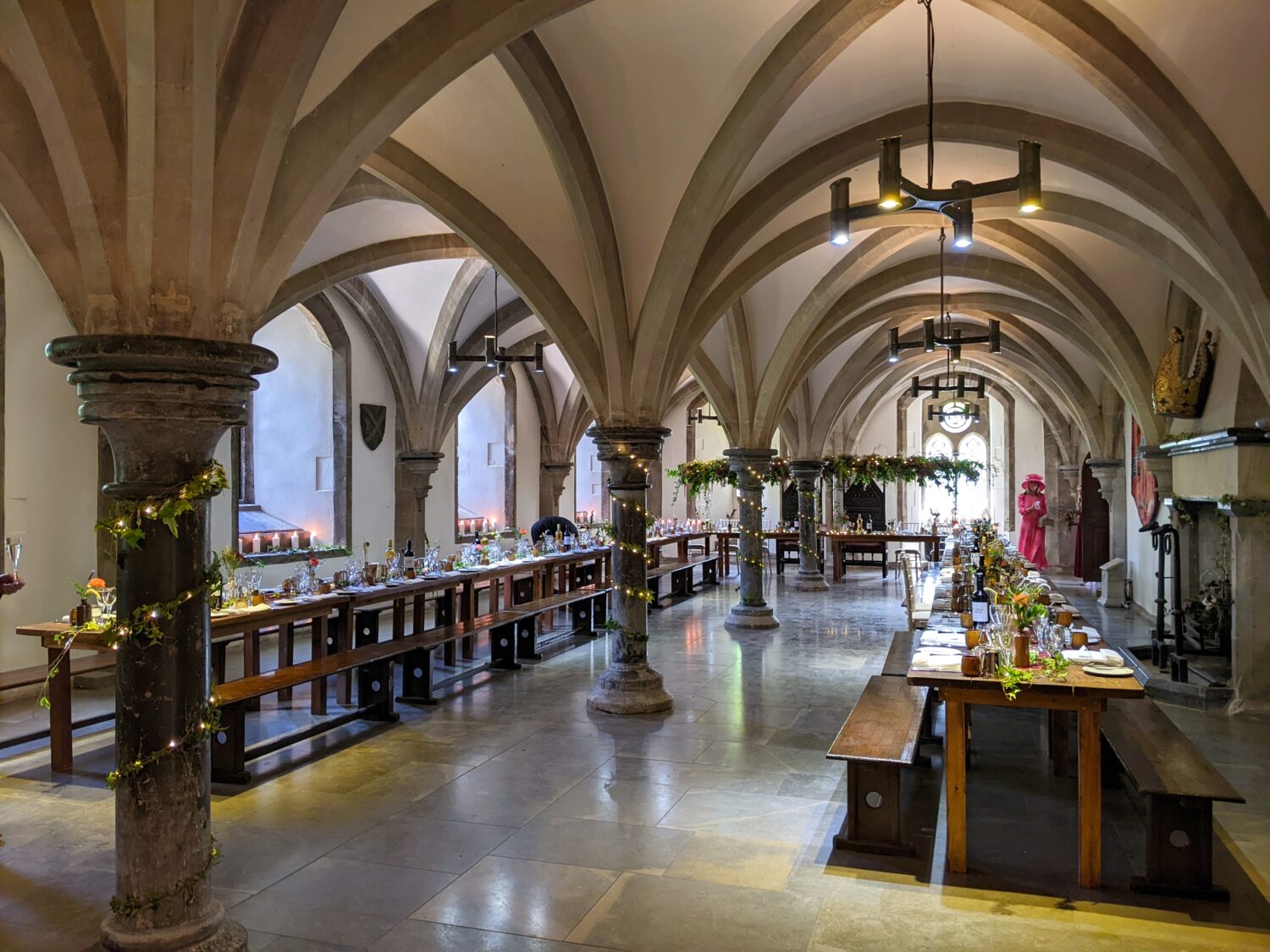
At the south end a stone archway, the , runs under Vicars' Hall and opens onto the cathedral green. The hall's own window steps out over the arch in a small projecting bay. At the north end the close ends square against the , its front faced in a paler stone with traceried windows filling most of the wall.
Small gardens run along the house fronts behind low stone walls, climbing roses and clematis reaching up some of the stonework. A single cast iron lamp stands part way down the cobbles, the only break in the two straight lines of chimneys receding to the chapel end.
Shot in Vicars' Close
Pier Paolo Pasolini's 1972 adaptation of The Canterbury Tales used the length of the close for Sir January's walk past prospective brides, and the BBC's Poldark filmed Georgian era street scenes along the same cobbles decades later. Both productions used the close as it stands, with no set dressing beyond costume and cars removed from the lane.
The Canterbury Tales and Poldark
The Canterbury Tales and Poldark used the same unaltered close for two different periods, one for its medieval fronts and one for a Georgian street.
The Canterbury Tales, 1972
Vicars' Close
The production ran the length of the close for the scene where Sir January, played by Hugh Griffith, inspects a prospective bride. The camera moves down the cobbles with the matching stone fronts and chimneys lining both sides. Street View
Poldark
Vicars' Close
The BBC series Poldark filmed Georgian era street scenes at the close and around the cathedral precinct for its Wells material. The matching stone fronts and uniform chimneys need no dressing to pass for an 18th century street. Street View
What Vicars' Close can double for
Arlington Row in Bibury, Gloucestershire
Arlington Row in Bibury is a narrow row of stone cottages built around 1380 from local limestone, the closest period match in stone and date to Vicars' Close. Both are Grade I listed and owned for preservation rather than altered. The row is shorter than Vicars' Close and has no matching forced perspective or chimney stacks. Visitors fill the lane through the day, so shoot early and frame the cottages alone to leave the modern road out of shot. Try searching narrow row of stone cottages now.
Castle Combe, Wiltshire
Castle Combe's street of stone cottages runs down to the Market Cross. The village has stood in for period English villages on screen repeatedly, including Doctor Dolittle, War Horse and Stardust. The cottages vary more in height and roofline than Vicars' Close's identical repeated fronts, so a tight frame on one short run holds the match better than a wide shot of the whole street. Try searching stone cottages market cross now.
Lacock, Wiltshire
Church Street in Lacock has the same uniform run of stone cottages that defines Vicars' Close, free of satellite dishes and overhead cable for filming. The street itself played a 1920s livestock market for the BBC's Downton Abbey, and the wider village has also carried Pride and Prejudice and Cranford. Lacock's cottages mix timber framing in among the stone ones and the street bends, so hold the lens on the straightest stone stretch to avoid the half timbered fronts and keep the look consistent with a plain stone street. Try searching uniform stone cottages street now.