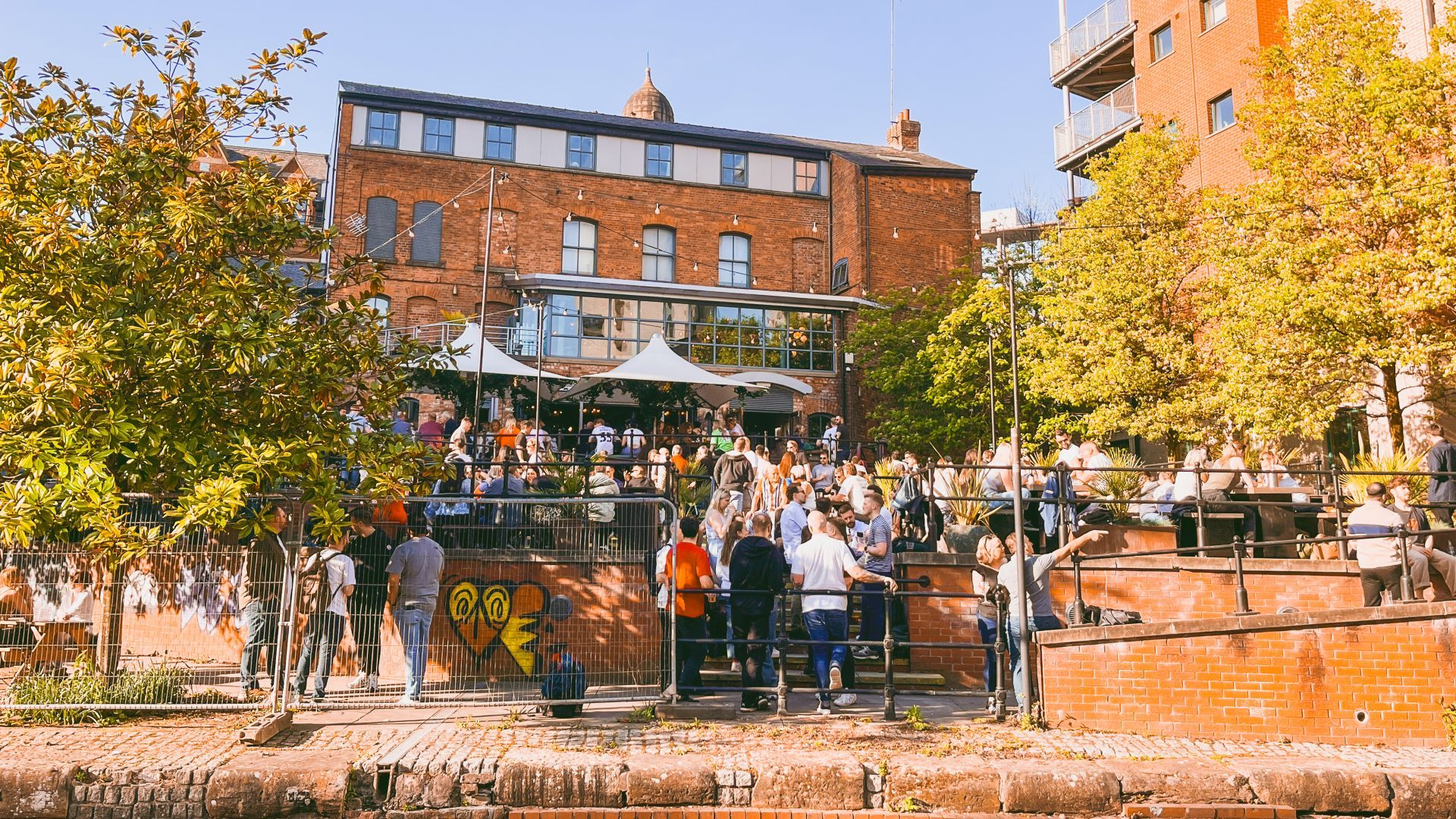
Brick canal warehouses under black iron railway viaducts, and the basin streets Peaky Blinders dressed as Birmingham's Small Heath.
What Castlefield looks like
Four railway viaducts cross the canal basin on brick piers, their dark arches meeting overhead close to where the Bridgewater and Rochdale canals join at . Narrowboats moor along the cobbled towpath below, painted in maroon, black and red. They sit tied up against iron railings and stone bollards.
faces the water with round brick arches and glass infill where the loading bays once opened onto the canal, four and five storeys of red brick rising straight from the water's edge. Cobbled lanes run behind it toward , where the ground opens out between the warehouse walls and the bar terraces on Castle Street.
, now part of the Science and Industry Museum, stands at the northern edge of the basin behind a plain brick frontage and a long platform canopy. A short stretch of reconstructed Roman wall stands nearby in the , low sandstone footings set into the grass.
Steel lattice bridges span between some of the viaduct piers, the ironwork riveted and streaked with rust. A Metrolink tram stop sits tucked under the arches at Deansgate, and and the other canalside pubs put tables out on the level ground below the warehouses.
Shot in Castlefield
Peaky Blinders dressed Castlefield's canal basin as Birmingham's Small Heath for its final season, building a mock frontage for the Garrison Pub along the cobbled streets. The production also used the area beneath one of the railway viaducts for a shootout and dropped a bomb from one of the canal footbridges in the same finale.
Peaky Blinders
The canal basin streets
Played the Garrison Pub set, Small Heath, Birmingham, 1934
The production built a mock frontage for the Garrison Pub along Castlefield's cobbled canal basin streets, redressing them as Birmingham's Small Heath for the show's final season. The source does not name the exact block, so the basin's own streets and warehouse fronts stand in for what the cameras saw. Street View
Peaky Blinders
Played Birmingham, 1934
The season finale staged a shootout in the area beneath one of the railway viaducts crossing the basin. The source does not name the exact street, so the pin marks a representative stretch beneath the arches rather than the specific block used. Street View
What Castlefield can double for
Granary Wharf in Leeds, England
The Dark Arches beneath Leeds railway station are red brick viaducts built in the 1860s over the Leeds and Liverpool Canal, the same combination of railway arches and canal water Castlefield has. Granary Wharf's cobbled quarters sit right under the arches, close to Castlefield's own towpaths. The arches run mostly as tunnels rather than open basin, so a wide shot needs a spot where the canal is visible under the brickwork. Leeds brick also runs darker and sootier than Castlefield's paler warehouse fronts. Try searching brick railway arches over canal now.
Stanley Dock's North Warehouse was built in the 1850s in brick with a cast iron colonnade along its ground floor, close in material and scale to Castlefield's canal warehouses. The dock itself is wider and more open than the basin here, without railway viaducts crossing overhead. Keep the frame tight on the brick and cast iron columns rather than the open dock water, and stay off any angle that shows the dock's scale against Castlefield's much narrower canal. Try searching brick warehouse cast iron colonnade now.
Speicherstadt in Hamburg, Germany
Speicherstadt is a red brick warehouse district built between the 1880s and the 1920s, crossed by narrow canals and iron bridges in a similar arrangement of water and warehouse walls. The scale and the canal crossings are close to Castlefield's own basin. The steep Gothic gables and green copper roofs look German rather than English in a wide shot, so tighter frames on brick and water hold the illusion better. Try searching red brick warehouse canal district now.



.jpg)