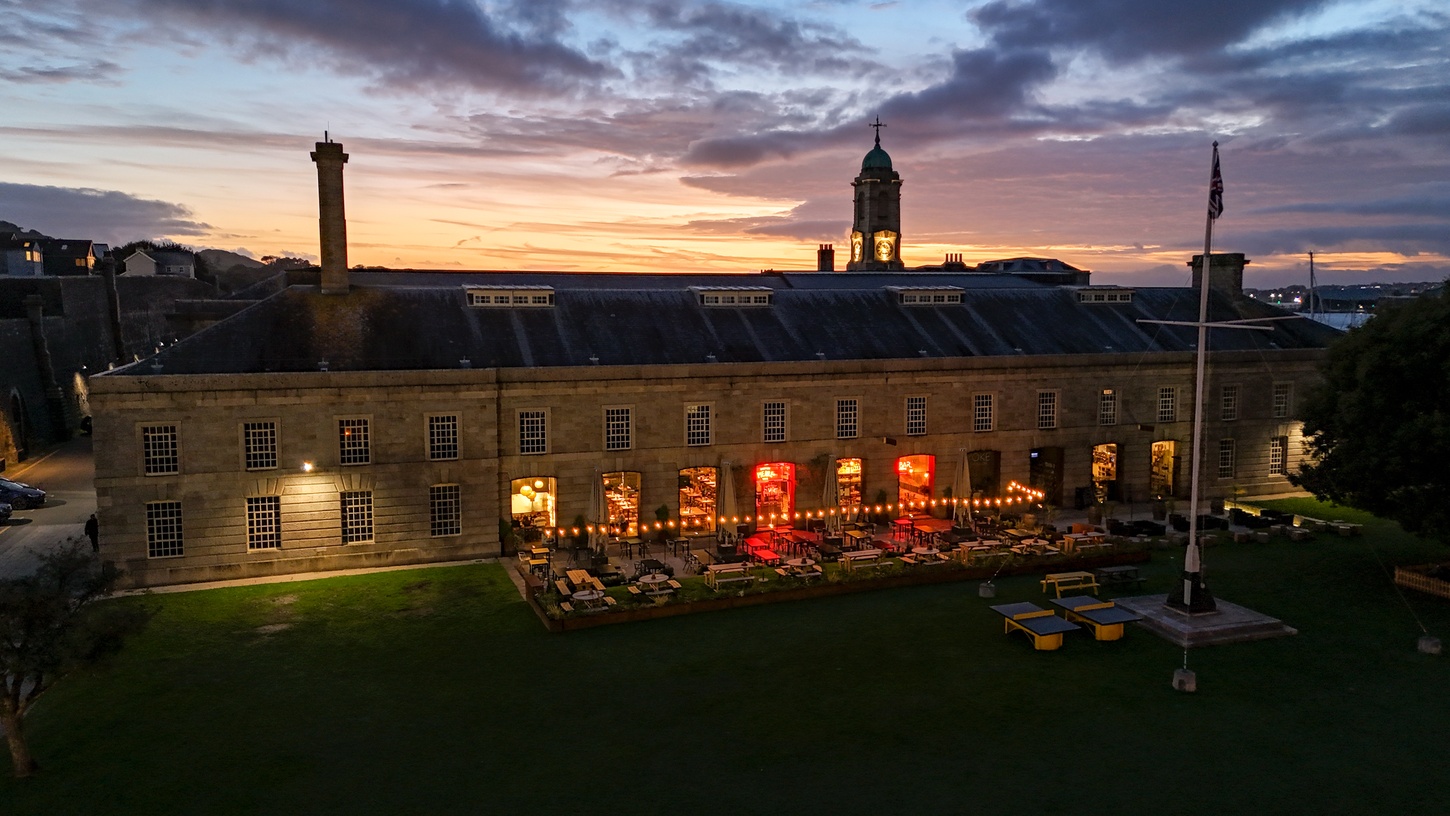
Grade I listed limestone storehouses with granite trim and columned porticoes face a harbourside basin now holding flats, restaurants and offices.
What Royal William Yard looks like
Royal William Yard is arranged around a granite lined harbour basin, its limestone ashlar storehouses built between 1826 and 1835 with granite dressings throughout. stands at the centre of the square, three storeys of banded stonework with a square clock tower and a copper dome rising over its central archway.
The faces Cremyll Street apart from the square, a granite triumphal arch with carved ox heads over its pilasters and a statue of William IV in Roman dress on top. A columned portico runs along the former slaughterhouse beside it, plain limestone piers under a flat roof over the pavement.
faces its own quay on the water, a long run of limestone bays with a single tall chimney behind it. The holds a corner of the square in rusticated granite, still lettered over its door. continues the range with round arched windows set close together under a shallow roof.
The basin holds a marina of yachts and motor cruisers, reached through a narrow stone entrance with a swing bridge. A detached Georgian house, smaller and plainer than the storehouses, stands apart on open grass behind the yard. Cars are parked along the quay in front of the buildings, whose ground floors now sit behind glazed shopfronts and signage for the restaurants and offices inside.
Shot in Royal William Yard
A 2004 comedy turned the yard into a 1940s London street, dressing its Main Gate as the British War Office. The ITV series Hornblower filmed at the Melville building during its original run. The BBC's Antiques Roadshow has filmed twice at the dockside, with the yard appearing as itself.
Churchill: The Hollywood Years, 2004
Main Gate, Royal William Yard
Played the British War Office, London, 1940s
The Main Gate and the square beyond it were dressed as a 1940s London street, with period buses and signage along the archway. The Guard House beside the arch stood in for the British War Office, and filming at the yard ran three days in spring 2003 with local residents hired as extras. Street View
Hornblower, 1998 to 2003
Melville, Royal William Yard
Melville, the yard's former administration building, was used as a location during the series' original run. The production's own sources name the building specifically, alongside the Barbican, among its shooting locations. Street View
Antiques Roadshow, 2015
The BBC's Antiques Roadshow filmed two episodes at the dockside here, broadcast in October 2015 as Royal William Yard 1 and Royal William Yard 2. The yard appears as itself, with experts valuing antiques against the storehouses and the water. Street View
Chatham Historic Dockyard's Georgian storehouses and granite quay buildings read the same period as Royal William Yard, and Call the Midwife and Bridgerton have both shot there as a naval dockyard complex. Chatham's covered slips and ropewalk give it a scale beyond Royal William Yard's own basin. Its buildings mix brick with stone more than Royal William Yard does, so a shot that needs pure pale limestone has to stay on the ashlar fronted ranges rather than the covered slips. Try searching Georgian naval dockyard storehouses now.
Charlestown Navy Yard in Boston, Massachusetts
The Ropewalk at Boston's Charlestown Navy Yard is a granite naval works from the 1830s, the same decade as Royal William Yard's own construction, with plain round arched window openings. Its length as one long range rather than a square makes it a workable double for Royal William Yard's own quayside storehouses. The Ropewalk runs in a straight line with no harbour directly in front of it, so a wide shot that needs open water in frame will give it away. Try searching granite naval storehouses now.
Royal Arsenal in Woolwich, London
The Grand Store at the Royal Arsenal in Woolwich is a run of classical storehouses from the 1800s and 1810s, close enough in period to double for Royal William Yard's own 1826 to 1835 construction. Both are long stone ranges built for naval and ordnance stores rather than domestic use, which keeps the proportions and window spacing close. The Arsenal's brick sits further back from the water than Royal William Yard's limestone quay, so a shot that needs the pale ashlar look should stay on the Grand Store's own stone fronted range. Try searching classical naval ordnance storehouses now.