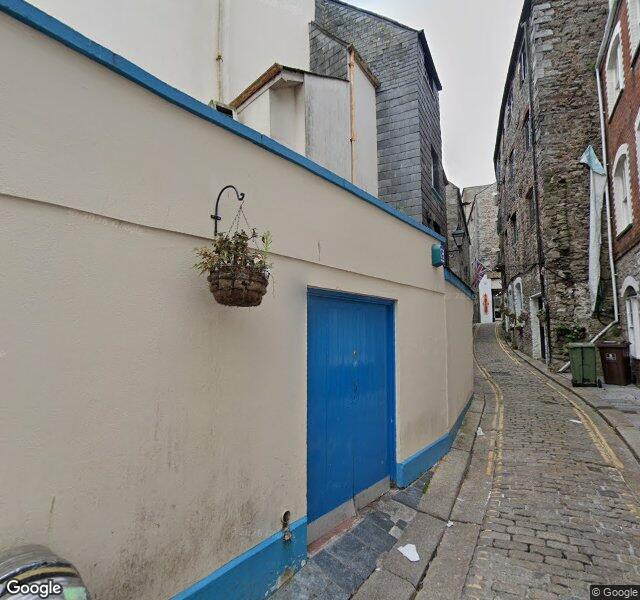
Narrow cobbled lanes run past Tudor and Elizabethan house fronts down to a working fishing harbour where boats moor at the quay.
What The Barbican looks like
runs through the middle of the area. Three and four storey buildings line it in rendered limestone, granite and shillet, their ground floors mostly shops. The street itself is surfaced in tarmac rather than the granite setts that cover most of the area's other lanes.
holds the clearest run of the area's earliest buildings, a narrow cobbled lane with timber framed upper floors jettied out over the shopfronts below. The Elizabethan House at its western end dates from the late 1500s, its leaded windows and timber frame largely intact behind a 2021 restoration.
The stands on Southside Street in a building remodelled for gin production in 1793, its brick chimney rising above the three storey shopfronts around it. Plymouth Gin still distills there today, inside what was a merchant's house around 1500.
The harbour runs along the area's eastern edge, with fishing boats and small craft moored at the quay below the . Island House, overlooking the same stretch of water, also dates from the late 1500s and is timber framed behind white render.
Granite setts still cover the narrower side lanes, with granite kerbs and dressed granite quay walls along the harbour edge. A few limestone warehouses from the Napoleonic era stand close to the water, taller and plainer than the shopfronts on Southside Street.
Shot in The Barbican
The ITV series Hornblower used the Barbican as a location during its original run from 1998 to 2003, drawing on C.S. Forester's Napoleonic Wars novels. The production does not identify a specific street or building within the area.
Hornblower, 1998 to 2003
Sutton Harbour quay
The series used the Barbican as a location during its original run. The production's own sources name the area generally, and do not point to one street or building within it. Street View
What The Barbican can double for
The Mermaid Street quarter in Rye, East Sussex
Rye's Mermaid Street quarter has the same jettied timber houses over cobbled lanes, climbing a similarly tight hill above the harbour below. Keep modern road markings and parked cars out of frame, and note that Rye's harbour sits further from its old town than Sutton Harbour does from the Barbican's lanes. Try searching jettied timber houses cobbled lanes now.
Vieux Bassin in Honfleur, Normandy, France
Honfleur's Vieux Bassin is ringed by half timbered merchant houses on a harbour close to Sutton Harbour's own working scale. Steeper slate roofs and French shopfronts give it away in a wide shot. Tighter, harbour level frames hold the illusion better. Try searching half timbered harbour houses now.
East Looe in Looe, Cornwall
East Looe's narrow lanes run down to a working fishing quay on a similar scale to Southside Street and the harbour below it. Looe's lanes carry more modern shopfronts and parked cars than the Barbican's, so a production would need to dress storefronts rather than just frame around them. Try searching narrow lanes fishing quay now.