Single storey stucco houses in pink, yellow and ochre line a cobbled grid under three volcanoes, with roofless Baroque church ruins standing behind restored facades.
What Antigua Guatemala looks like
Antigua Guatemala sits on a flat valley floor in a strict colonial grid, cobblestone streets running straight between blocks of single storey houses. Walls are thick stucco painted in blue, ochre, rust and mustard. Low terracotta tile roofs and squat bell towers top the blocks. Volcán de Agua rises directly south of the central plaza and is visible down several streets, with Fuego and Acatenango visible from the edges of town.
Several Baroque churches stand open to the sky. , on 1a Calle Poniente, is a roofless shell of collapsed stone arches and a bare presbytery. It sits inside its own parkland, with public access to the cloisters. , on 7a Calle Oriente, pairs an active sanctuary with a ruined bell tower and clock tower standing beside it. The tomb of Hermano Pedro is inside the working half.
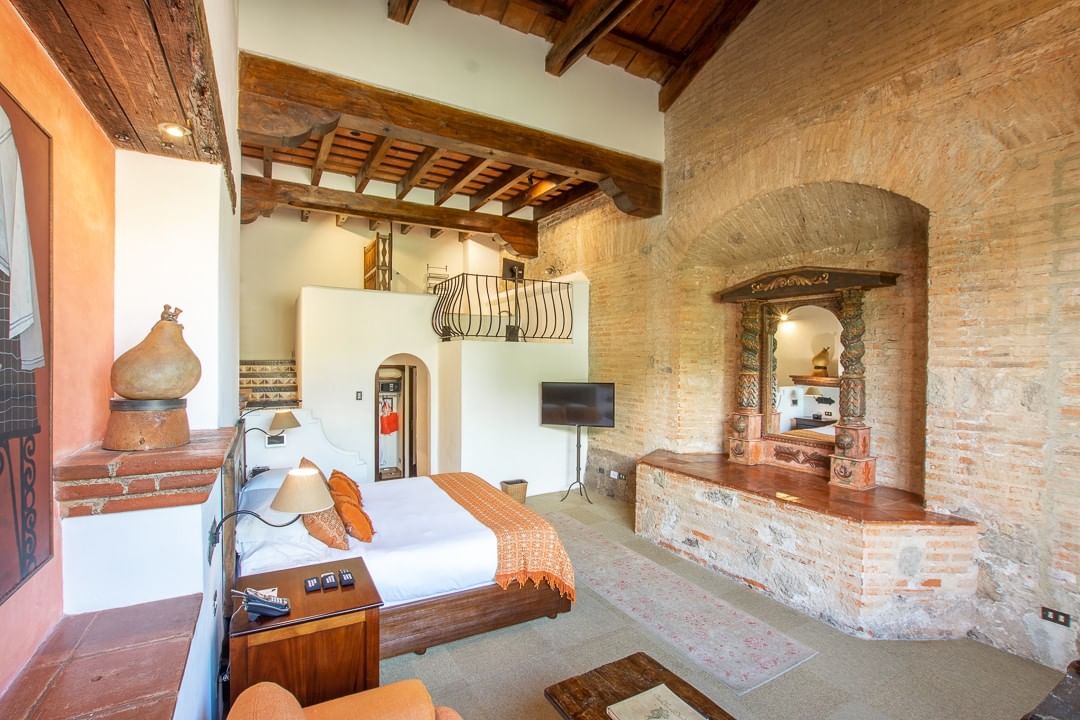
Colonial houses carry oversized double doors sized for a rider on horseback, with a smaller human sized door cut into one leaf. Window grilles are iron, set flush against the stucco. The roofline rarely rises above a single low parapet.
The occupies the full southeast side of , a two storey arcaded facade rebuilt in the late 19th century from recovered colonial stone columns and now the National Museum of Guatemalan Art. The spans 5a Avenida Norte in yellow stone a few blocks north, a clock mounted over the passage, with Volcán de Agua framed directly behind it.
Shot in Antigua Guatemala
The 1935 serial The New Adventures of Tarzan filmed inside the ruins of Iglesia de San Francisco. The ruined bell tower and clock tower beside the active sanctuary still show the same open stonework the production recorded.
The New Adventures of Tarzan, 1935
San Francisco el Grande
Played the temple of the Green Goddess, a lost Mayan city, Guatemala
The 1935 serial filmed its captured-explorers sequence inside the ruined nave, among the same roofless stone walls that stand today. Part of the complex was not rebuilt into an active chapel until 1967, so the ruin the cameras recorded then was larger than what stands now. Street View
What Antigua Guatemala can double for
Granada, Nicaragua
Granada's narrow colonial grid has the same low rise and brightly painted stucco facades, with church towers rising above the rooflines. The dormant Mombacho volcano stands south of the city, visible from the cathedral and several bell towers. Granada runs more two storey buildings than Antigua and leans toward brighter primary colours. It has no roofless church ruins to match Antigua's broken naves. Try searching narrow colonial grid Granada now.
San Cristóbal de las Casas, Chiapas, Mexico
San Cristóbal de las Casas has a similar narrow colonial grid and pastel stucco facades under red clay tile roofs, with wrought iron balconies. Forested hills stand at the end of its streets instead of volcanoes. Its facades run taller and more ornate than Antigua's single storey rows, so tight street level frames read closer than any wide shot. Try searching pastel stucco facades now.
Trinidad, Cuba
Trinidad's low-slung houses have a similar pastel washed stucco and red tile roofs along a cobbled colonial grid. Wrought iron window grilles repeat block to block. Trinidad has no earthquake ruins and no volcanoes at the end of its streets, so a wide establishing shot gives it away. Try searching pastel stucco cobbled grid now.