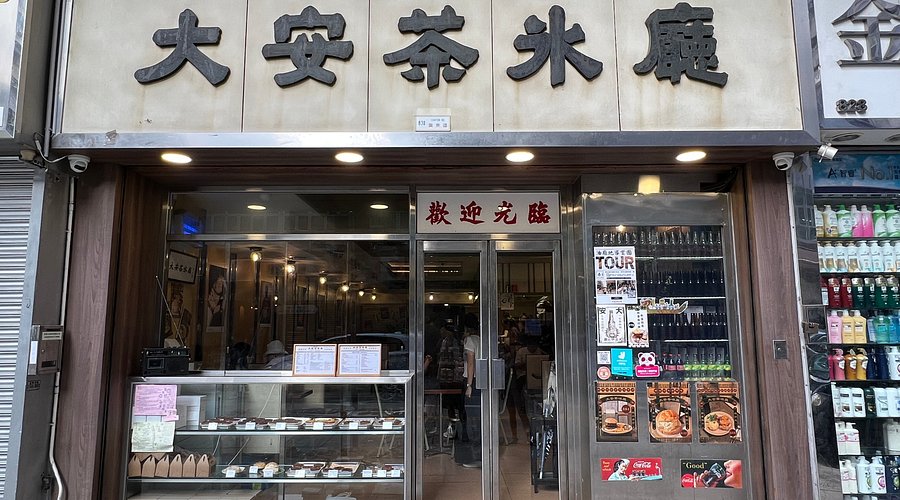
Prewar tong lau shopfronts line Shanghai Street, with a fruit market of low brick sheds and the night stalls of Temple Street nearby.
What Yau Ma Tei looks like
runs through blocks of three to five storey tong lau, their upper floors fronted by cantilevered balconies and roller shutters painted with the names of the shops below. Carved stone gables above some entrances still carry the brand names of prewar traders. Taller residential towers now rise directly behind these shopfronts, so a single corner can hold a narrow prewar facade under a forty storey block.
North along Reclamation Street, the Yau Ma Tei Wholesale Fruit Market occupies one and two storey brick and stone sheds between Waterloo Road and Ferry Street. Covered arcades run under the upper floor balconies, and painted pre-war signboards remain on the outer walls.
's night market opens in the afternoon and is busiest after dark, when cars are barred from the street and more than a hundred stalls set up under strings of bare bulbs between Jordan Road and Kansu Street. A block north, the links five adjoining buildings separated by four narrow lanes.
At Canton Road and Public Square Street, the former stands three storeys over a semicircular portico, its stuccoed walls rusticated and its window arches voussoired in the Edwardian style. It stopped operating as a police station in 2016.
Shot in Yau Ma Tei
Temple Street's own market strip appears on screen in two films named for it. Queen of Temple Street and The God of Cookery used the actual stalls rather than a built set. The Yau Ma Tei Wholesale Fruit Market on Reclamation Street was the real backdrop for the 2018 TVB series Apple-Colada. The former Yau Ma Tei Police Station stands at Canton Road and Public Square Street. Its exterior drew Infernal Affairs, Election and Life Without Principle, since nobody can film inside a station still on duty.
Queen of Temple Street, 1990
Temple Street night market
Both films used the market strip itself rather than a built set, timed to when the stalls are busiest after dark. Vendors run their stalls from folding tables under strings of bare bulbs, with cars barred from the street while the market runs. Street View
What Yau Ma Tei can double for
George Town, Penang, Malaysia
George Town's shophouses carry the same covered five-foot way arcade along the ground floor as Shanghai Street's balcony arcades, with shuttered upper floors and carved gables from roughly the same decades. Malay and Jawi shop signs would need swapping for Cantonese ones, and trishaws parked along the five-foot way would give the shot away as Malaysia rather than Hong Kong. Try searching five-foot way arcade now.
Kreta Ayer in Singapore
Kreta Ayer's shophouses share Shanghai Street's two to three storey scale and covered five-foot way walkways, with shuttered upper floor windows over ground floor shops. Singapore's shophouses are more uniformly restored and brightly painted, so an unrenovated corner or a block under scaffolding holds the look better than a freshly painted row. Try searching shophouses five-foot way now.
Chinatown in San Francisco, California
San Francisco's Chinatown fills with produce stalls and lit signage after dark, as crowded as Temple Street's own night market. The buildings are a different lineage entirely, pagoda topped cornices and painted masonry rather than tong lau balconies, so only a tight stall level frame avoids the skyline behind it. Try searching night market produce stalls now.