A white travertine cube with two hundred and sixteen identical arches rises off a straight boulevard, the steps where The Last Man on Earth staged its 1964 chase.
What EUR looks like
runs dead straight through here, a wide dual carriageway with a planted median and umbrella pines along both sides. Nearby, at the Quadrato della Concordia, the rises as a plain travertine cube. Six rows of nine identical arches repeat on each of its four sides, two hundred and sixteen in total, with equestrian statues of the Dioscuri at its corners.
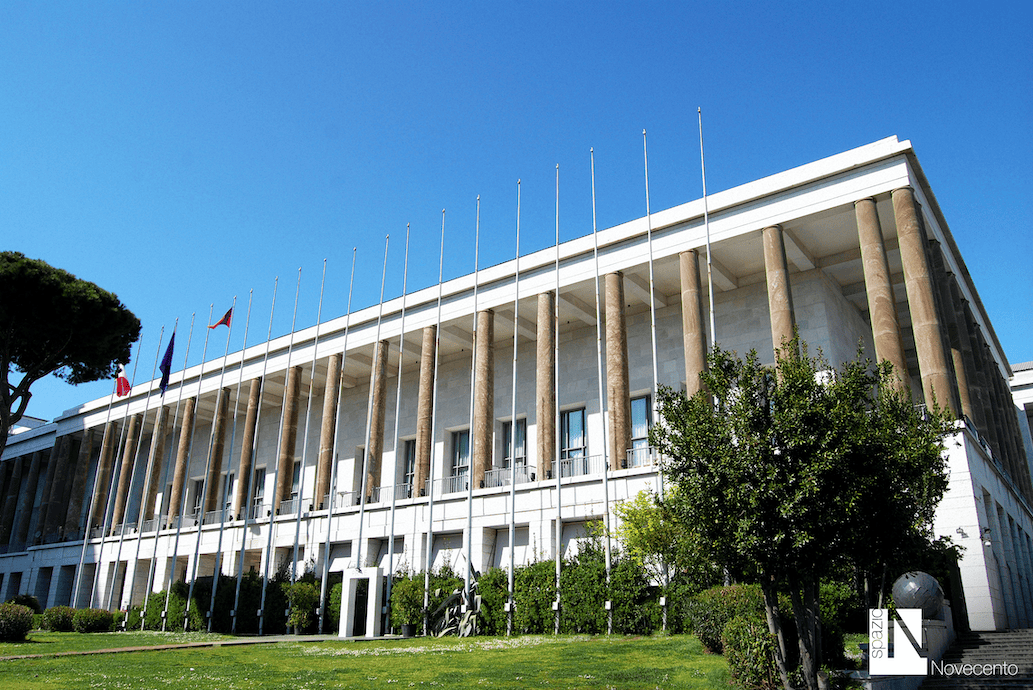
A few blocks north, Piazza John Kennedy holds a second travertine block, the . It is a rectangular hall under a glass and concrete dome. Nearby, a newer glass walled hall holds a curved steel structure suspended inside it, visible through its own facade.
An artificial lake sits between the two squares, its banks lined with clipped hedges and used for sailing dinghies and rowing lanes. On its far side, the domed faces a slender water tower on the hill opposite. It was built for the 1960 Olympics, and its cap is shaped like a mushroom.
The opens straight onto the pavement. Its concrete stairwell is layered with years of graffiti and flyposting. Low walled embassy villas and plain 1930s and 1940s government blocks fill the quieter streets around the lake.
Shot in EUR
The travertine cube at the Quadrato della Concordia has appeared on screen since Rome, Open City in 1945. Later credits include Hudson Hawk in 1991 and Titus in 1999. It turned up again in Zoolander 2 in 2016, and the steps at its base are where The Last Man on Earth staged its most direct use of the building in 1964.
The Last Man on Earth, 1964
Palazzo della Civiltà Italiana
Morgan, the story's last survivor, chases a black dog down these steps after it runs from his home across the district. The Belly of an Architect used the same steps in 1987, its own figure climbing them and disappearing into one of the arches.
What EUR can double for
Asmara in Asmara, Eritrea
Asmara's government and commercial buildings went up in the same Italian Rationalist idiom between 1935 and 1941, in travertine and stucco with blank arcades and the same cubic massing. The whole historic center is a UNESCO listed collection of this architecture, wider than any one EUR block. Most buildings run one and two storeys rather than six, and local street furniture and the surrounding highland scenery would both need dressing to hold a Rome era match. Try searching Italian rationalist government buildings now.
Sabaudia in Lazio, Italy
Sabaudia's town hall is the same travertine clad Rationalist civic architecture, built in 1933 with a matching cubic mass and a civic tower. It sits on one square rather than a whole avenue district, so a wide shot shows a small town rather than a capital. Keep the frame tight on the town hall and its tower and stay off the surrounding low rise coastal streets. Those streets give the smaller town away. Try searching Rationalist travertine town hall now.
The Olympiapark's stadium and surrounding halls share the same monumental 1930s scale and travertine and limestone cladding from the same authoritarian architectural period. Its colonnades use rounder classical columns rather than repeated arches, and the wooded park setting is unlike EUR's open avenues. Hold to tight facade shots that avoid the columned porticoes and the surrounding forest, both of which give the German site away. Try searching 1930s monumental limestone stadium now.