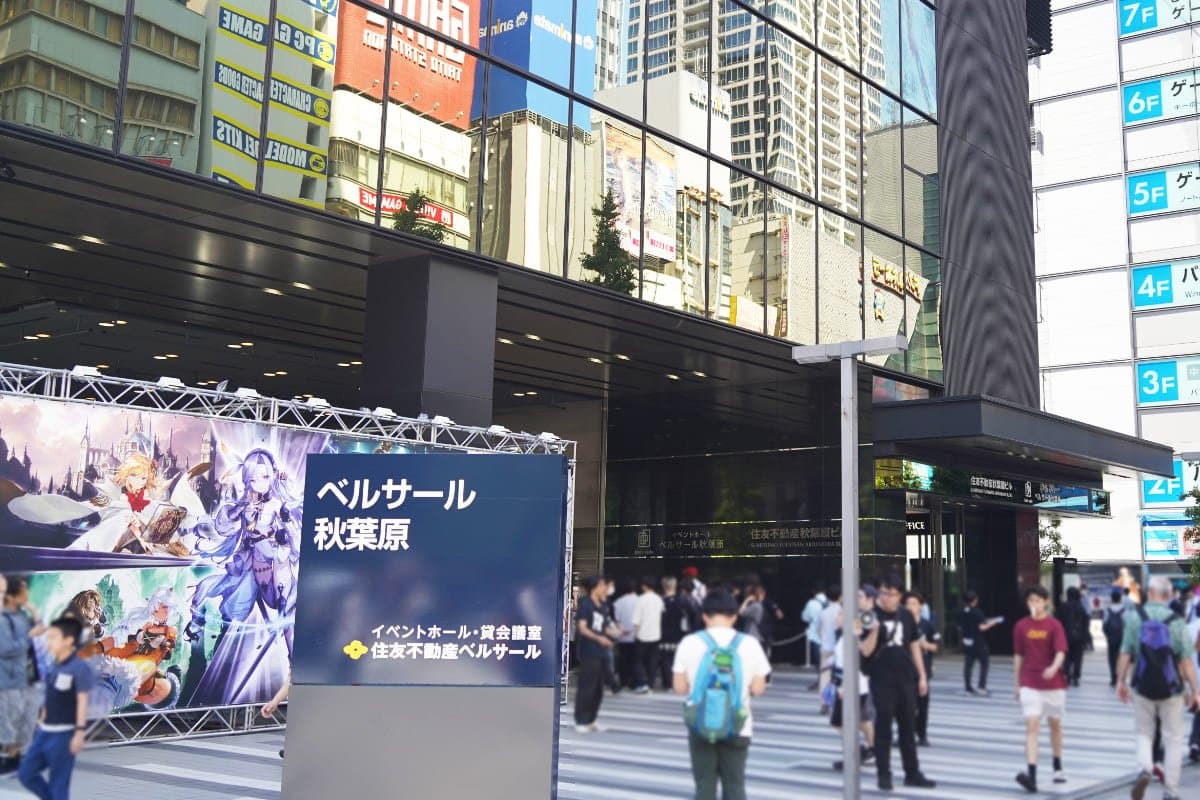
Buildings faced floor to ceiling in printed advertising rise above a warren of tiny electronics stalls under the elevated tracks.
What Akihabara looks like
Chuo-dori runs through the middle of the district, its buildings faced floor to ceiling in printed anime posters, LED screens and vertical shop signage stacked one above another. On Sunday afternoons the street closes to cars and pedestrians walk down the middle of the road between the towers.
rises ten storeys of narrow glass and metal panels at Sotokanda, the current building dating from 2014. The Radio Center runs beneath the JR tracks close by, its stalls dating from 1949. Each one is barely wide enough for a single customer in front of a counter of loose resistors, capacitors and salvaged parts.
UDX rises twenty two storeys of glass curtain wall a short walk north of the station. 's grey tower opposite the east exit wears the same stacked advertising panels down its full height, camera ads and phone ads layered over each other. West of the station, the brick arches of the old railway viaduct at Manseibashi now hold a row of shopfronts, with the Yamanote and Chuo lines still running across the top on the original masonry. At night the advertising towers stay lit long after the shops close, and trains on the elevated tracks show as strips of light above the street.
Shot in Akihabara
The TV drama Densha Otoko returned to Akihabara Station repeatedly across the series, since its plot follows an otaku who frequents the district's electronics shops. Fuji Television aired it from July to September 2005.
Densha Otoko (Train Man), 2005
The drama returned to Akihabara Station repeatedly across the series, including a scene in its opening episode and another in its finale. The production does not name a specific exit. Street View
Sham Shui Po's Apliu Street and the surrounding electronics stalls have the same density of small shopfronts and stacked signage as Akihabara's under track arcades. Its buildings carry similarly saturated advertising down several storeys, close to Akihabara's own facades. Cantonese and Traditional Chinese characters on the signs give the location away in close shots, so a wider frame that keeps the crowd and the stalls in view reads better than one that holds on a legible sign. Try searching electronics stalls now.
Yongsan Electronics Market in Seoul, South Korea
Yongsan's electronics market buildings stack small parts and retail stalls over several floors, the same vertical density as Akihabara Radio Kaikan and the Radio Center. Both markets are built around one specialty trade rather than general retail. Korean signage and a different street grid mean only tight interior stall shots hold the match, since a wide exterior gives away the skyline immediately. Try searching electronics market stalls now.
Times Square's buildings carry wall to wall advertising down their fronts, floor to ceiling video screens and posters replacing the facade underneath. The scale of signage and the density of crowds moving through it match this district's own scale of commercial signage. Times Square's screens are almost entirely digital video rather than printed posters. The street is also far wider, so a tight shot on one screen holds the match better than a wide one. Try searching wall to wall advertising now.