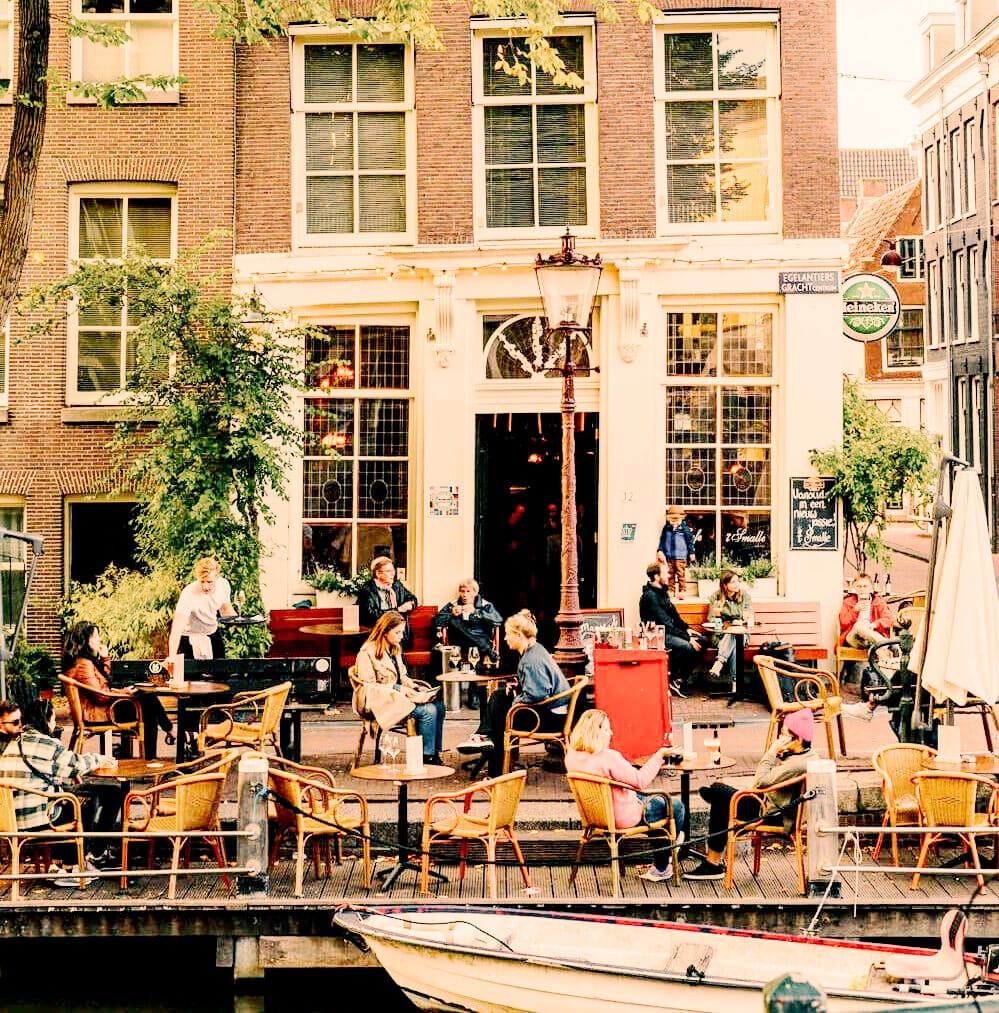
Orange brick canal houses with stepped and bell gables over hoisting beams, and the Prinsengracht stretch where The Diary of Anne Frank shot its exterior scenes in 1959.
What Jordaan looks like
The gables here mostly step up in narrow blocks toward a point, though a rounded bell shape appears further down some streets. Canal houses run three to four storeys under whichever gable tops them, faced in orange red brick. A hoisting beam sits under the peak on many facades, built to lift furniture past the narrow inside stairs. Carved stones set into a few fronts show a trade sign worked into the stone, a pair of scissors or a cooper's barrel.
The streets are narrow and irregular, curving from block to block instead of running in a grid. and run in short straight stretches, each crossed by a low arched bridge every block or two. Bicycles line the railings above the water, and a few houseboats sit moored under the windows.
The stands on in the same orange brick, its plan a plain cross under a pyramid roof. Cars are kept off the square for a market most Mondays and Saturdays, stalls set up between the church steps and the houses around it.
Prinsengracht forms the eastern edge, wider and straighter than the canals behind it, with the Westerkerk's tower visible along its length. Most of the canal houses on both sides of that boundary date from 1613 to the 1660s, narrow and deep on plots cut to the same width as their neighbours.
Shot in Jordaan
In 1959, The Diary of Anne Frank filmed its exterior canal scenes on Prinsengracht at the Bloemgracht junction. That stretch sits right where the Jordaan meets the neighbouring Grachtengordel. The Westerkerk's tower is visible from the same stretch of canal, the same view described from Westermarkt on the other side of the church.
The Diary of Anne Frank, 1959
The production shot its exterior street scenes on this stretch of Prinsengracht rather than on a soundstage. The Westerkerk's tower is in view along the canal. The real building where Anne Frank and her family hid is a short walk away, just over the boundary into the Grachtengordel.
Oude Delft is the city's oldest canal. It runs narrow and lined with brick merchant houses, much like the Jordaan's own canals, most of them raised in the same seventeenth century. Small humpbacked bridges cross the water at similar intervals, and the house fronts step up from the water the way they do on Bloemgracht. Delft's gables lean toward carved stone Renaissance detailing rather than the Jordaan's plainer brick stepped and neck shapes, so a tight frame on one bridge and its canal house row holds the match better than a wide view toward the Nieuwe Kerk. Try searching narrow canal humpbacked bridge houses now.
Nyhavn's canal houses date from the 1680s to the 1730s, brick fronted and gabled in the same Dutch Golden Age idiom as the Jordaan's own. A Dutch engineer, Henrik Ruse, laid out the canal itself in the 1670s. Several houses still carry a stepped or bell shaped gable over a hoisting hook, the same fittings found on Bloemgracht. Nyhavn's fronts are painted in bright colours rather than left as bare brick, and the canal is lined with tall ship masts and outdoor cafe seating that the Jordaan's smaller canals do not carry. Keep any deep background muted or dressed out. Try searching brick gabled canal houses now.
Groenerei's narrow canal runs behind close brick house fronts crossed by arched stone bridges, close in scale to the Jordaan's own smaller canals. Most of Bruges's canalside houses date from the thirteenth to sixteenth centuries, older and taller gabled than the Jordaan's seventeenth century brick. Bruges's crow-stepped gables run taller and more ornate than the Jordaan's plainer ones, and the cobbled quay is wider. Keep the frame tight on the bridge and the nearest house front rather than a long view down the water. Try searching narrow canal arched bridge houses now.