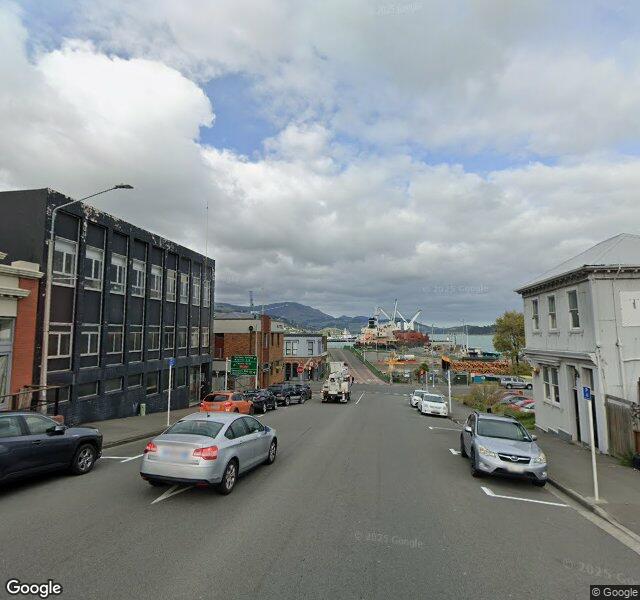
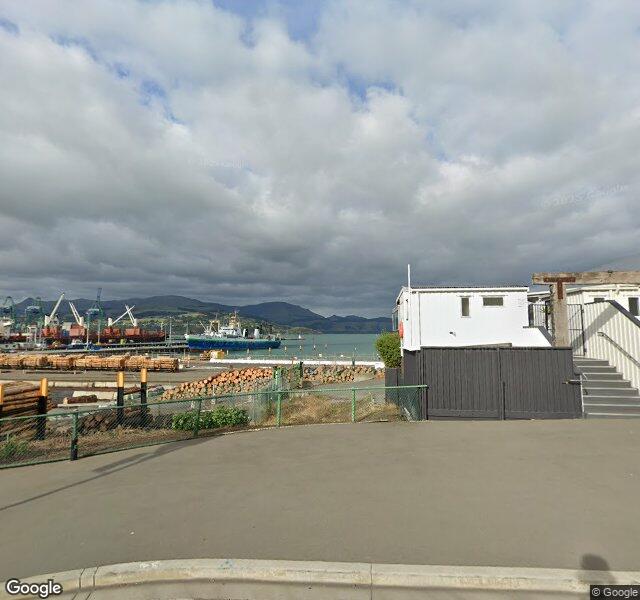
Timber shopfronts climb London Street above a working container port inside an old volcanic crater.
What Lyttelton looks like
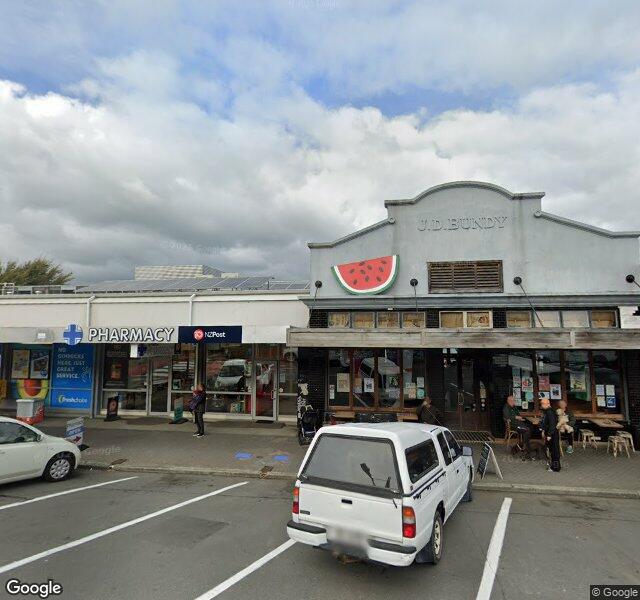
London Street is the commercial spine, lined with shopfronts in neo-classical, Renaissance, Art Deco and Spanish Mission styles, built in brick, stucco and timber under corrugated iron roofs. The is one of several bars and cafes along the strip. Cross streets including Oxford, Canterbury and Dublin Street run straight downhill off London Street, each framing a short, steep view down to the water, the port and the open sky beyond.
Off the main street the houses are mostly one and two storeys, built in kauri, matai and totara timber with steep pitched roofs. Some retaining walls and church buildings use the local red volcanic stone, a dark, rough material against the lighter weatherboard around it.
The octagonal stone Timeball Station stands on the hillside above the town, its tower a rebuild of the 1876 original, reopened in 2018 after the base building beside it was left as ruins. Below it, the working port runs container cranes and loading berths along the flat strip at the bottom of the slope.
Lyttelton Harbour is a flooded volcanic crater, with bare, rounded hills ringing the water on every side. The settlement of sits on the opposite shore, reached by passenger ferry across the water.
Shot in Lyttelton
For The Frighteners, the production dressed the former Lyttelton Post Office on London Street as the fictional Bistro Sundown in May 1995. The building now serves as Lyttelton's library and customer service centre.
The Frighteners, 1996
The production dressed the real Lyttelton Post Office as a fictional restaurant called Bistro Sundown for a scene shot on London Street in May 1995. The building now houses Lyttelton's library and customer service centre. Street View
George Street's stone and brick shopfronts went up in the same decades as London Street's own rebuild in permanent materials, and Port Chalmers drops from its commercial street straight down to a working container port the same way Lyttelton does. Its own Renaissance revival post office on George Street is close in scale and material to the heritage buildings around Lyttelton's own former post office. Port Chalmers' container terminal sits closer to its waterfront edge than Lyttelton's, so a wide shot needs careful framing to keep modern cranes out of a period frame, or to use them deliberately. Try searching stone brick port shopfronts now.
Port Townsend in Washington, United States
Water Street's multi storey brick commercial buildings line a waterfront below a bluff of Victorian houses, the same climb from working shopfronts to residential streets that Lyttelton's cross streets make toward the crater rim. The cornices and storefronts read as a similar commercial vintage to London Street's own 1860s to 1920s range. Port Townsend's buildings generally run two to four storeys against London Street's one to two, so a wide shot reads a larger scale unless framed tight on a single storefront. Try searching Victorian brick waterfront storefronts now.
Tenby in Pembrokeshire, Wales
Pastel painted terraces climb a hill above a working harbour where boats rest against the quay at low tide, the same steep drop from townhouses to water that Lyttelton's cross streets make down to the port. The streets above the harbour are narrow and largely pedestrian, close in scale to London Street's own block. Tenby's houses are rendered in bright Georgian colour and ringed by a medieval town wall, both absent from Lyttelton, so the match holds only in a long harbour frame rather than on the streets themselves. Try searching pastel terraces above harbour now.