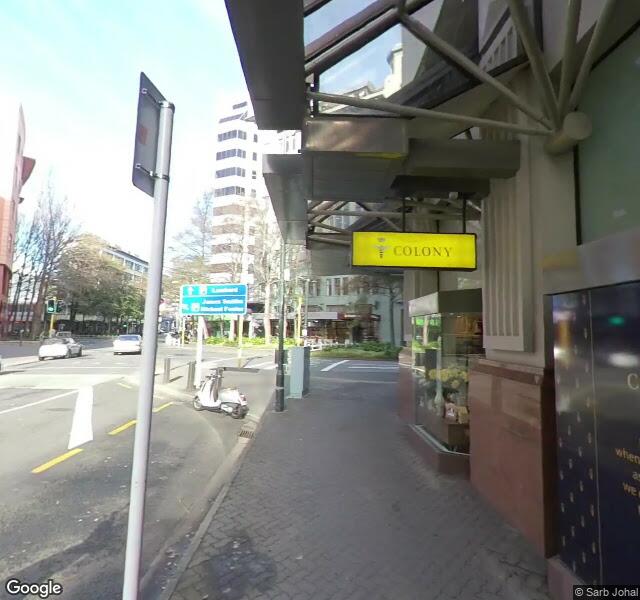
Two and three storey Victorian and Edwardian shopfronts run along Cuba Street under verandahs and glazed tiled entrances, hills closing off both ends of the view.
What Te Aro looks like
Cuba Street runs dead straight for close to a kilometre, climbing gently from the waterfront toward the hills at its southern end. Two and three storey shopfronts line both sides for most of that length, the oldest dating from the 1890s and the newest from the 1930s, with verandahs cantilevered out over the footpath and glazed, geometrically tiled entrances set into several of the ground floor fronts. Classical cornices and later Art Deco fronts sit next to each other with no gap for a modern facade to interrupt the run.
The central blocks are closed to traffic and paved over for pedestrians, with cafe tables pushed up against the shopfronts and the 's thirteen tiered buckets cascading water near the mall's northern end. Looking down the mall, hills close off the view at both ends, green above the rooflines where the street grid stops.
Away from Cuba Street, Te Aro sits on flat ground running from the harbour up to the foot of Mount Victoria and Mount Cook. stands on Boulcott Street in pale stucco under twin spires, and the triangular lawn of sits where Dixon Street meets Taranaki Street. , on the area's eastern side, carries a run of theatres and late bars instead of Cuba Street's shopfronts.
Shot in Te Aro
Wellington Paranormal, the police mockumentary series created by Jemaine Clement and Taika Waititi, filmed its pilot episode at the Bucket Fountain outside Cuba Mall and used , a bar at 131 to 133 Cuba Street, as a location. Millie Lies Low, a 2021 feature film, shot scenes along Cuba Street as part of its Wellington location work.
Wellington Paranormal and Millie Lies Low
Cuba Street, both the pedestrian mall and the ordinary shopfront blocks running north of it.
Wellington Paranormal
Hotel Bristol
Hotel Bristol, a bar at 131 to 133 Cuba Street, was used as a filming location for Wellington Paranormal. The building sits on the corner of Ghuznee Street, at the upper end of Cuba Mall rather than the lower, waterfront stretch. Street View
Millie Lies Low
Cuba Street
Millie Lies Low's own Wellington location materials place this credit on Cuba Street generally, without naming a single address, so the pin marks the street rather than one building. The production used the street alongside its Wellington Airport and Karori locations during its 2021 shoot. Street View
Lydiard Street's run of two and three storey Renaissance Revival and Beaux Arts shopfronts under elaborate cast iron verandahs is close enough to upper Cuba Street that the South Korean feature Road to Boston shot its 1940s Boston scenes along it. Ballarat's street is wider and its blocks run longer, but the unbroken verandah line and matching cornices read the same way in a tight shot. Stay in mid shots that crop the extra lane width out of frame, since Ballarat's roadway is noticeably broader than Cuba Street's. The cast iron verandah brackets are heavier than Cuba Street's timber ones in a close shot. Try searching cast iron verandah shopfronts now.
South Terrace in Fremantle, Western Australia
South Terrace's two and three storey stone terraces, built from the 1890s, carry the same verandah over a glazed shop front pattern as Cuba Street, raised half a floor above the pavement with timber balustrading along the kerb. No production credit ties it to Wellington specifically, but the scale and the continuous street frontage are an unusually close architectural match. The raised verandah height and the timber balustrading read differently in a close shot than Cuba Street's lower, plainer verandahs, so keep the comparison to mid and wide shots of the street line rather than a single shopfront. Try searching raised verandah stone terraces now.
Katoomba Street in Katoomba, New South Wales
Katoomba Street keeps its own run of Edwardian shopfronts with glazed leadlight tiled entrances, the same ornamental detail Heritage New Zealand singles out on upper Cuba Street, under a mix of Art Deco insertions from the 1920s and 1930s. It is a looser match than Ballarat or Fremantle because the escarpment backdrop and the Art Deco additions give it a different skyline. Frame tight enough to keep the hills out of a wide shot, and favour the stretches between the Art Deco buildings where the Edwardian glazed shopfronts read closest to Cuba Street's own. Try searching glazed tiled shopfront entrances now.