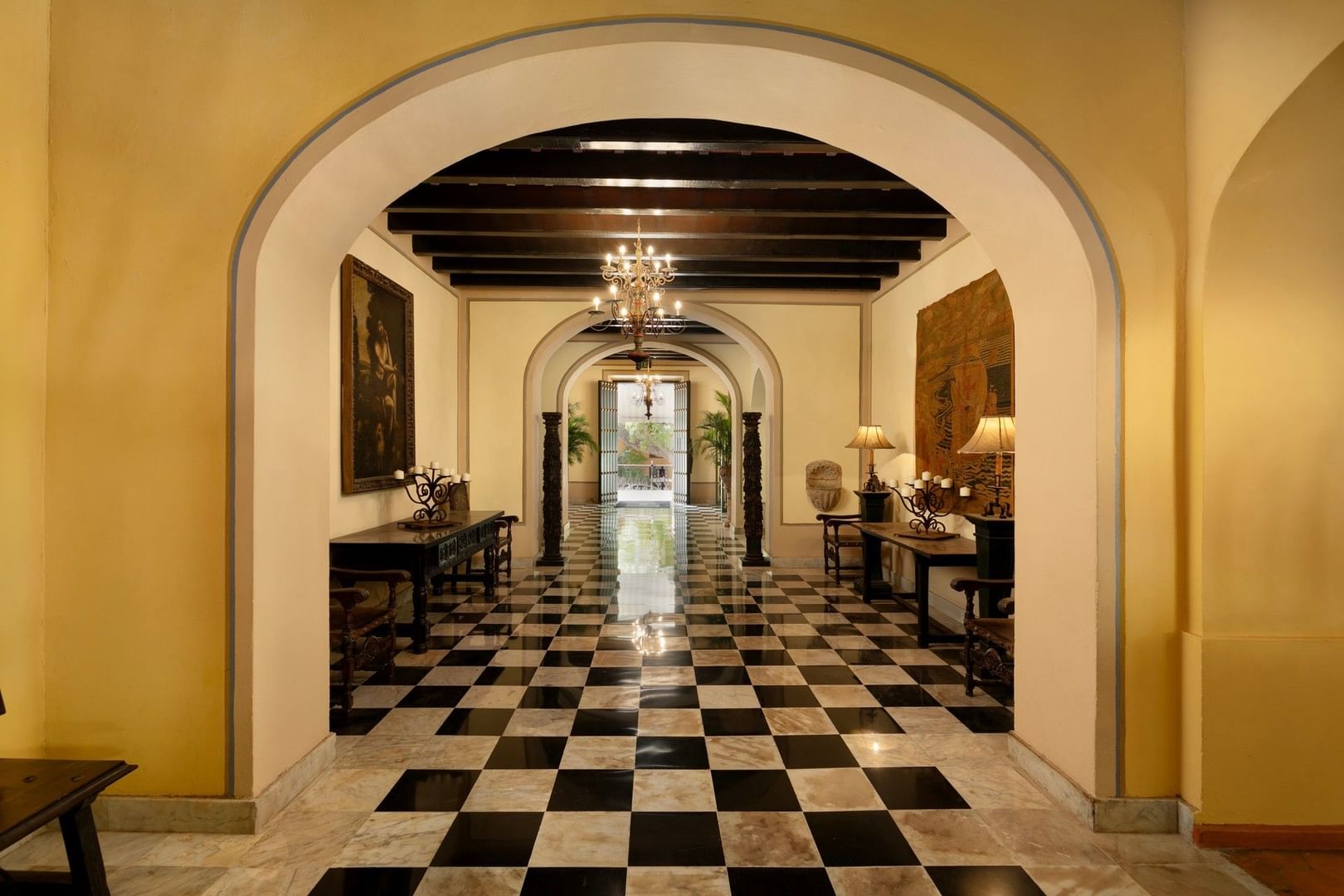
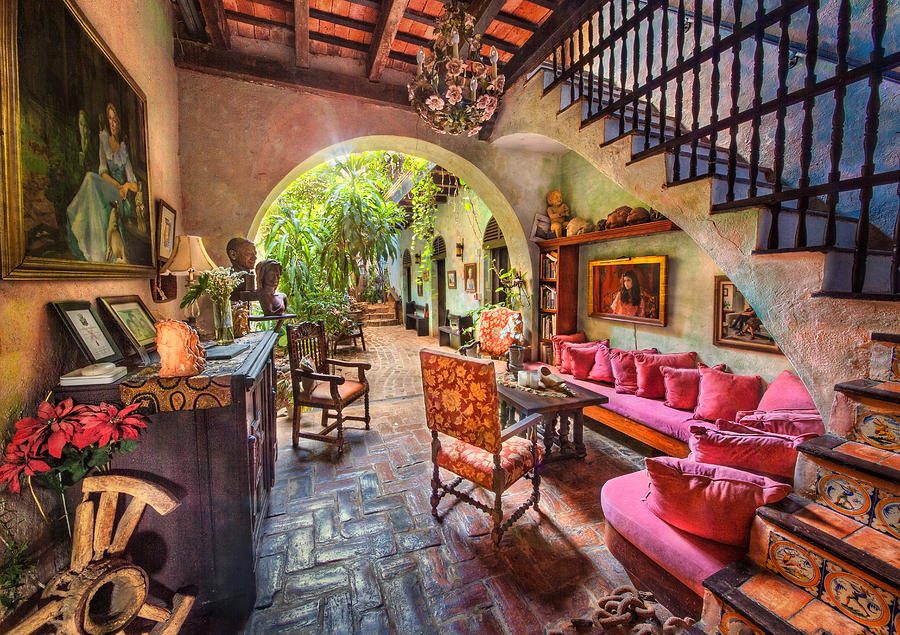
Blue cobbled streets run between balconied colonial houses in bright colours, ending at two stone forts above the sea.
What Old San Juan looks like
Blue grey adoquines, paving stones cast from iron smelting slag, cover the narrow streets inside the old city walls. The colonial grid runs tight between flat fronted houses two to three storeys tall, their doors opening straight onto the sidewalk.
Each house along Calle del Cristo and Calle San Sebastián is painted a different bright colour from its neighbour, chiefly yellows, blues and pinks, in a continuous unmatched row. Wrought iron balconies project over the street at the second floor, and heavy wooden doors and shuttered windows sit under them.
stands at the peninsula's northwestern tip, six storeys of sandstone, brick and limestone rising 43 metres above the shore, with open grass stretching from its walls back toward the city. covers about 27 acres on the eastern approach, climbing roughly 150 feet from the shoreline in three levels of masonry.
sits on the southern waterfront, a neoclassical facade over a 16th century fortress core, now the Governor of Puerto Rico's residence. runs along the outside of the northern wall below Castillo San Cristóbal, small colourful houses packed between the rampart and the sea.
Small paved plazas break up the grid where streets cross, shaded by ceiba and banyan trees with iron benches and lamp posts underneath. The Capilla del Cristo chapel stands at the base of Calle del Cristo behind a wrought iron gate, with the bay visible past the sea wall beyond it.
Shot in Old San Juan
Amistad used El Morro's outer ramparts for scenes set at a fort on the coast of Sierra Leone, and Despacito's music video shot through La Perla and inside the bar . Both productions worked with the walled city's own fabric rather than any set built for the camera.
Amistad, 1997
Castillo San Felipe del Morro
Played a fort, Sierra Leone, 1839
Amistad used El Morro's outer ramparts and the open lawn below them for scenes set at a coastal fort in Sierra Leone. The thick stone walls and gun batteries gave the production a defensible looking structure with no set dressing. Street View
Despacito, 2017
La Perla
Despacito's video crew shot through La Perla's narrow lanes between the houses and the harbour, the low rise colourful fronts and concrete stairways running through most of the frame. The neighbourhood sits outside the main colonial grid, strung along the base of the north wall between El Morro and Castillo San Cristóbal. Street View
Despacito, 2017
La Factoría
Despacito's interior shots were filmed inside La Factoría, the bar at the corner of Calle San Sebastián and Calle San José, among its exposed brick rooms and narrow connecting doorways. The street outside carries the same balconied colonial fronts as the rest of the quarter. Street View
What Old San Juan can double for
La Habana Vieja in Havana, Cuba
Dirty Dancing: Havana Nights shot its 1958 Havana scenes on Old San Juan's own streets, with underground parking arranged nearby so no modern car sat in frame. The blue cobblestones and mismatched pastel facades read as pre revolution Havana without alteration. Habana Vieja itself runs more salt worn and patched than Old San Juan's repainted walls, so weathering the paintwork and keeping air conditioning units out of frame closes the gap. Try searching pre revolution Havana now.
San Francisco de Campeche in Campeche, Mexico
San Francisco de Campeche is the other intact walled Spanish port of this scale, its houses painted ochre, turquoise and rose along streets close to Calle San Sebastián's own width. Its surviving bastions and gates are cut from pale stone comparable to San Cristóbal's curtain wall. Campeche sits on a flatter grid with no open sea visible from most corners, so a shot that needs water in frame has to use San Juan's own waterfront rather than Campeche's. Try searching ochre turquoise rose houses now.
Ciudad Amurallada in Cartagena, Colombia
Cartagena's Ciudad Amurallada pairs coral stone bastions with balconied colonial houses in strong paint, both cities fortified under Spanish military engineers working from the same era. Bougainvillea spilling over the ironwork is the detail most likely to mark a shot as Cartagena rather than Old San Juan. Cartagena's walls run higher and thicker at six to eight metres, so a tight frame on one bastion holds the match better than a wide shot that shows the difference in scale. Try searching coral stone bastions now.