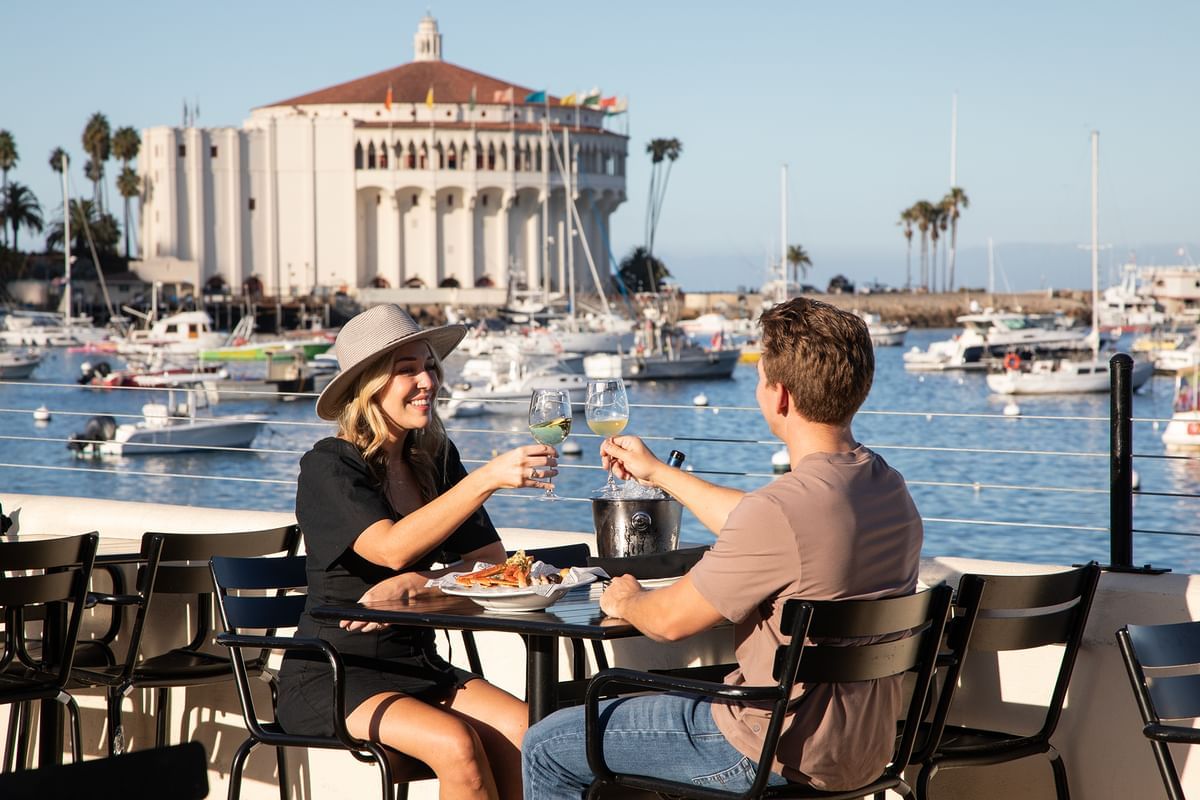
White stucco storefronts and palm trees line a pedestrian mall behind the beaches, with the Catalina Casino at the north end of the harbor.
What Crescent Avenue looks like
Crescent Avenue runs behind the three main beaches of Avalon Bay as a pedestrian mall. The walk is paved in decorative pavers and has fountains, palm trees and a serpentine seawall.
The main way to get around Avalon is by small motorcars called autoettes, which include many golf carts. Because of local restrictions, no regular vehicle ferry brings visitors' cars to Avalon.
The storefronts are white and pastel stucco under red tile roofs, two and three storeys high, with restaurants and shops on the ground floor. The Spanish Colonial look dates from the 1930s, with arched openings, metal balcony railings and Catalina tile trim.
The white Via Casino archway, also part of the 1930s work, spans the walk at the water's edge. At the north end of the harbor stands the , a circular building completed in 1929 that is the equivalent of twelve storeys tall. It is surrounded by sea on three sides, and from the water it shows a white circular wall and a red roof.
Chinatown (1974) includes shots of the Casino from its Catalina Island scenes. The is a clubhouse a short walk north of the street. In the film it becomes the Albacore Club.
Shot in Crescent Avenue
The 1974 film Chinatown used two buildings on Catalina Island. The Casino is one, and the Tuna Club stands in for the Albacore Club in a film set in 1937.
Chinatown, 1974
The Catalina Casino
Chinatown includes shots of the Casino during its Catalina Island scenes. The credit covers the building's exterior only. Street View
The El Paseo Building on North Palm Canyon Drive is a courtyard complex built in 1926 and 1927 in a Spanish style. That style is close to the Spanish Colonial redesign Philip Wrigley ordered for Crescent Avenue in the 1930s. Later storefront remodels hide much of the original frontage on Palm Canyon Drive, so frame on the courtyard rather than the street. Try searching spanish courtyard complex now.
Miracle Mile in Coral Gables, Florida
Designed in 1926, the Colonnade Building at 133 to 169 Miracle Mile mixes Spanish Colonial and Baroque facades on a commercial boulevard. It was built to house a growing sales operation. Miracle Mile is a through street with traffic, which shows in any wide frame, so keep the shot on the facades. Try searching spanish colonial facades now.