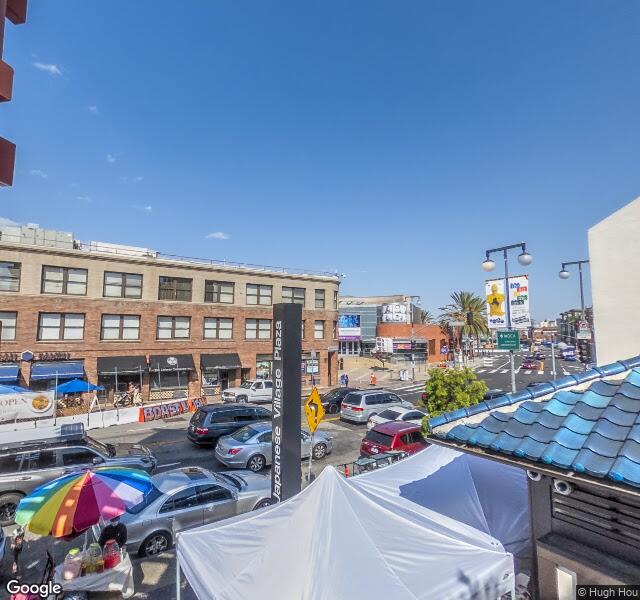
First Street's low brick storefronts open onto Japanese Village Plaza's tiled courtyards and a red beamed fire lookout tower.
What Little Tokyo looks like
First Street runs low and close to the sidewalk, two to four storey brick and stucco storefronts with stacked signage in Japanese and English. The keeps its arched Beaux-Arts facade and red Chop Suey sign, part of a row that dates from the 1890s to the 1920s. 's narrow confectionery storefront sits a few doors down, operating since 1903. The tower of Los Angeles City Hall rises past the rooflines at the end of the block.
Behind First Street, opens into a paved courtyard under curved glass and tiled roofs, restaurants and shops opening directly onto the walkway. A tower of stacked red crossbeams marks the plaza's entrance from First Street, built like a rural Japanese fire lookout. 's shops line Astronaut Ellison S. Onizuka Street, and 's tiled entrance sign marks Second Street two blocks over.
The former Japanese Union Church, now the , stands two blocks north on Judge John Aiso Street. It is a brick building with Ionic columns and a cross over its pediment. A small memorial court nearby pairs brick paving with black granite walls, apartment towers rising behind it. The and the Little Tokyo or Arts District Metro station sit at the district's northeast edge, trains running at street level against the downtown skyline.
Shot in Little Tokyo
Two buildings carry most of the credits below, the Far East Cafe on First Street and the former Japanese Union Church on Judge John Aiso Street. Both appear in productions over five decades, from The Crimson Kimono in 1959 to Lil Tokyo Reporter in 2012.
The Crimson Kimono, 1959
Nisei Week in The Crimson Kimono
Samuel Fuller shot this crime drama on location throughout Little Tokyo in the winter of 1959. Two LAPD detectives investigate a murder during Nisei Week, and the story climaxes in the middle of a Little Tokyo parade.
Farewell, My Lovely, 1975
Robert Mitchum played Philip Marlowe in this adaptation of the Raymond Chandler novel. A scene with Mitchum and Jack O'Halloran was filmed at the Far East Cafe, an 1896 building on First Street. Its arched facade and red Chop Suey sign still front the block, with the tower of Los Angeles City Hall visible down the street.
Lil Tokyo Reporter, 2012
Played a 1930s gambling den, 1930s
This short film about civil rights leader Sei Fujii was shot on First Street and used the Far East Cafe to stand in for a 1930s gambling den. Jeffrey Gee Chin directed for the Little Tokyo Historical Society, with Chris Tashima in the lead role.
Prince of Darkness, 1987
The former Japanese Union Church
Played Saint Godard's Church
John Carpenter filmed exteriors and some interiors here for a fictional church called Saint Godard's, when the building stood empty. The church is now the Union Center for the Arts, home to East West Players, LA Artcore and Visual Communications.
What Little Tokyo can double for
Japantown in San Francisco, California
San Francisco's Japantown went up in the same wave of postwar Japanese American redevelopment as Japanese Village Plaza, and its Peace Plaza pairs a tiled pedestrian mall with a five tiered pagoda the way First Street pairs storefronts with the Village Plaza's tower. The Peace Plaza opened in 1968, a decade before the Village Plaza, but both share the low tiled rooflines and paved plaza floor a wide shot needs. The Peace Pagoda is taller and more monumental than the Village Plaza tower, and San Francisco's plaza is more open with fountains. Tighter framing on a tiled walkway keeps the match, while a wide or aerial shot gives it away. Try searching tiled pedestrian plaza now.
Japantown in San Jose, California
San Jose's Japantown is one of the last prewar Japantowns still standing in the country, with one and two storey brick storefronts along a single commercial street, the same scale First Street had before its 1970s plazas went in. It has nothing like Japanese Village Plaza, so it only reads for the older street level of the district. Keep the frame on the storefronts at street level. San Jose's blocks back onto open parking lots rather than plazas, which shows in any wide or elevated shot. Try searching prewar Japantown storefronts now.
Chinatown in Los Angeles, California
Central Plaza in Los Angeles' own Chinatown is a similarly scaled pedestrian court, built in 1938, with painted timber gateways, string lanterns and tiled roofs standing in for a generic Asian American commercial street. No production has swapped one for the other, and the details are Chinese rather than Japanese throughout. Signage is the giveaway in both directions, so any shot that reads text needs it dressed for the right language. A wide shot showing Central Plaza's own gateway would not pass for Little Tokyo. Try searching pedestrian court painted gateways now.