A 1930s Art Deco boulevard with a fenced tar pit and mammoth sculptures at its center, and museum buildings lining both sides of Wilshire.
What Miracle Mile looks like
The sit behind a fenced lawn in the middle of Miracle Mile, asphalt still seeping up through the grass with life-size mammoth sculptures posed sinking into it. Wilshire Boulevard runs wide past storefronts with oversized signage over black-and-gold and buff terracotta facades, parking lots set behind the buildings rather than out front.
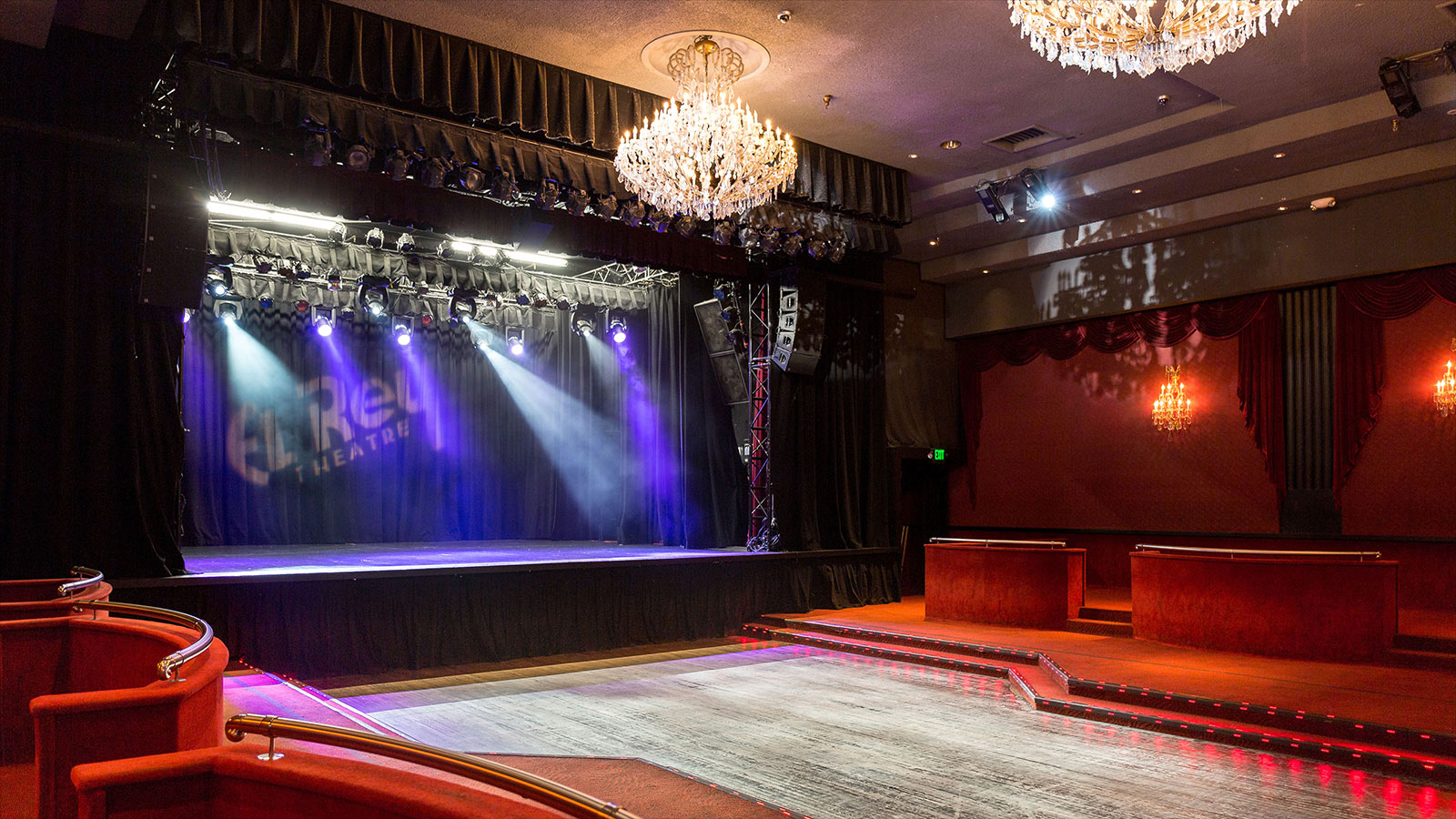
The , an eleven-story Art Deco building at Dunsmuir Avenue, and the black-and-gold Deco Building down the block both date from 1928 and 1929. The , a Streamline Moderne cinema at 5515 Wilshire built in 1936, is now a live music venue. , at Wilshire and Fairfax, is a low Googie diner from 1956 with a swept roofline, closed since 2000 but still standing.
LACMA's Wilshire campus is now the Peter Zumthor-designed David Geffen Galleries, a single concrete band that spans the boulevard itself. The , next door, wears a stainless-steel ribbon facade in loops around its original block. The occupies the old May Company building, its gold-tiled cylindrical corner drum connected by glass skyways to a new spherical theater.
The George C. Page Museum sits on the tar pits behind the same fenced lawn, its triangular concrete canopy carved with a frieze of Ice Age animals over the entrance. Fossil bison and mammoth skeletons are mounted inside. Tar still surfaces at the edges of Hancock Park, dark and glossy between the paved paths and a small lily pond crossed by a footbridge.
Shot in Miracle Mile
Steve De Jarnatt's 1988 film Miracle Mile takes its name from the neighborhood and uses several of its real landmarks. The tar pits turn up again in Encino Man in 1992. Johnie's Coffee Shop, the closed Googie diner at Wilshire and Fairfax, has also appeared in The Big Lebowski, American History X and Volcano.
Miracle Mile, 1988
The tar pits
Played The La Brea Tar Pits
The two leads meet at the tar pits and spend the afternoon together. By the film's end a helicopter is hit by the electromagnetic pulse of a nuclear strike and goes down in the same tar pits, sinking with them inside it. Johnie's Coffee Shop, down Wilshire at Fairfax, is where the news of the attack first reaches the diner earlier in the film. A rooftop scene near the end takes place atop the real high-rise at 5900 Wilshire, then called the Mutual Benefit Life Building. The Saban Building, then still an operating May Company store, is also used prominently.
Encino Man, 1992
Played The George C. Page Museum
In Encino Man, the main character tours the exhibits at the George C. Page Museum and recognizes that he was once a caveman himself. The museum sits on the tar pits, behind the same fenced lawn.
What Miracle Mile can double for
Emerson Street in Napier, New Zealand
Napier was rebuilt almost entirely in Art Deco after a 1931 earthquake, and Emerson Street still carries zigzag chevrons, sunbursts and stepped parapets close to what survives on Miracle Mile's own storefronts. The scale is smaller and the buildings are plaster rather than glazed terracotta, but the geometric ornament is close enough to read as the same period. New Zealand road markings, signage and right-hand-drive traffic give the location away in any wide shot with cars in it, so tighter frames on the storefronts themselves work best. Emerson Street is pedestrianized, unlike Miracle Mile's wide traffic lanes. Try searching zigzag chevron storefronts now.
Ocean Drive's hotels share the same zigzag and streamline Moderne vocabulary on their facades as Miracle Mile's storefronts, with porthole windows, rounded corners and racing stripes from the same era. The scale is different, low hotels built for pedestrians rather than storefronts built for a boulevard, but the ornament reads the same on camera. Miami's buildings are pastel stucco rather than Miracle Mile's black and gold and buff terracotta, so color grading and a tighter frame keep the material difference off camera. Palm trees and beach light also read differently than an inland Los Angeles boulevard. Try searching pastel stucco hotel facades now.