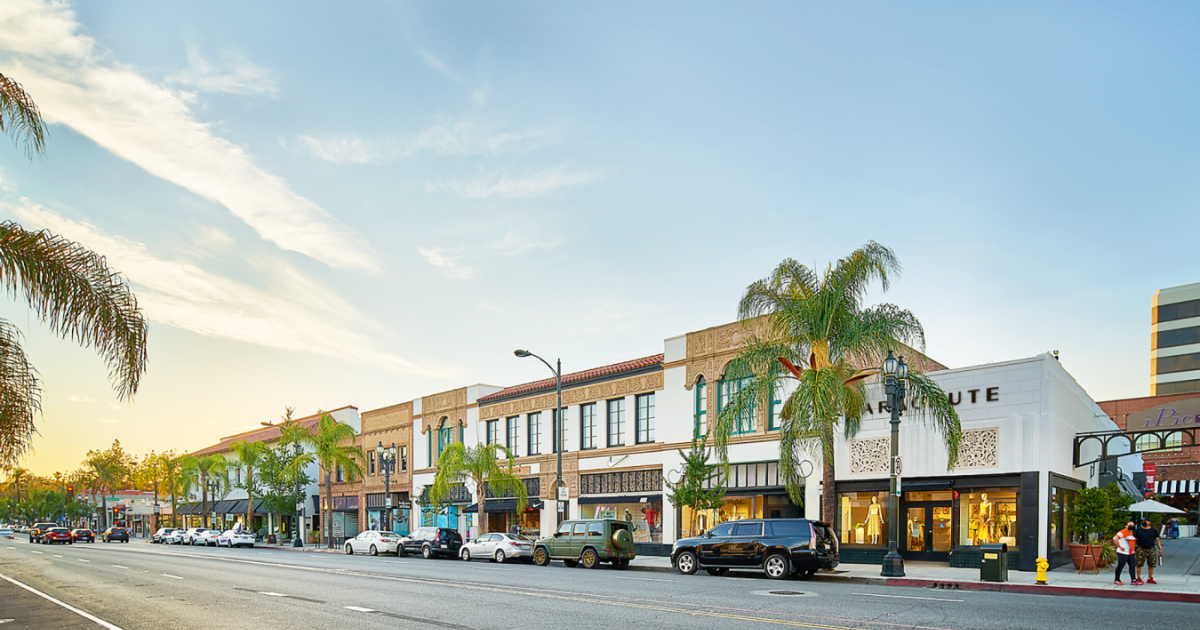
Two- to four-story brick and terracotta storefronts from the 1880s through the 1930s line Colorado Boulevard and Fair Oaks Avenue, with Castle Green's Moorish turrets a few blocks south on Raymond Avenue.
What Old Pasadena looks like
meets at Old Pasadena's center, where three intersections along Colorado use a pedestrian scramble crossing that clears every direction of traffic at once, the same system used on Rodeo Drive and the Las Vegas Strip. Queen palms line the sidewalks, and valet stands and sidewalk cafe tables sit in front of the storefronts.
The blocks around the intersection run two to four storeys in red brick, cream terracotta and stucco. Storefront windows are arched, and stepped cornices run along the roofline. A few of those cornices are capped with checkerboard brick parapets. Iron fire escapes zigzag down several corner buildings, and ground floor shops keep fabric awnings low over the sidewalk. A few storefronts still carry the vertical neon signs of earlier tenants.
Behind the main street, narrow service alleys including and run between the buildings at their original width and paving. One Colorado, a shopping courtyard built into seventeen of the district's historic buildings, backs onto Smith Alley rather than fronting Colorado Boulevard.
rises a few blocks south at Raymond and Green, its twin corner turrets topped with red tile domes over Moorish arched windows and iron balconies, palm trees planted close against the stucco. The 's 1920s facade fronts Raymond Avenue several blocks north, its auditorium replaced behind the facade by condominiums and retail space.
Shot in Old Pasadena
Castle Green has played more parts on screen than any other building in Old Pasadena. Its exterior and its interior rooms have stood in for a Havana hotel, a New York casino and a hotel restaurant, all at the same corner of Raymond and Green.
Bugsy, 1991
Castle Green
Played the Hotel Nacional de Cuba, Havana, Cuba, 1940s
Castle Green's exterior at 99 South Raymond Avenue played the Hotel Nacional de Cuba in Bugsy. The mob gathers there in Havana to question Ben Siegel's spending on the Flamingo. The lobby in that same scene is a different building, the Park Plaza Hotel in downtown Los Angeles. Street View
The Sting, 1973
Played a casino, New York City, 1930s
Castle Green's interior stood in for a New York casino in The Sting. The same rooms played an Austrian hotel in The Man With Two Brains, where Steve Martin's character honeymoons. Street View
The Last Samurai, 2003
Played the Moorish Room restaurant
Castle Green's Moorish Room introduces Nathan Algren to a group of Japanese businessmen early in The Last Samurai. In Babylon, Brad Pitt's character shares a drink with Li Jun Li's Lady Fay Wong in the same building, a scene the production placed explicitly in Old Pasadena. Street View
Castle Green's domed corner turrets and Moorish arched windows played the exterior of the Hotel Nacional de Cuba in Bugsy, set around the real 1946 meeting where the mob questioned Ben Siegel's spending. The actual hotel in Vedado is much larger and sits on the Havana seafront near the Malecon. Its own towers mix Moorish arches with Art Deco massing across a wider facade, and the resemblance to Castle Green holds only in the turrets and arches. Keep the frame tight on the turrets and arched windows. A wider shot loses the ocean and shows Castle Green's iron fire escapes and inland street. Try searching Moorish arched turrets now.
Erie, Pennsylvania
Old Pasadena's own brick and terracotta storefronts run two to four storeys around a plaza intersection. That look is close to what Old Towne Orange used to play 1964 Erie, Pennsylvania in That Thing You Do!, filmed a few miles away on North Glassell Street. No production has used Old Pasadena itself for Erie, but the two Southern California downtowns share the same period of storefront construction and street width. Palm trees at the curb are the giveaway in any wide shot. A Pennsylvania street would need them cropped or dressed out. Try searching brick storefront plaza now.
Seville, Spain
Hayes Alley, the narrow offshoot of Kendall Alley off Union Street, is briefly glimpsed standing in for a street in Seville in Knight and Day. No specific quarter of Seville is named in the source, and the alley's brick paving and American signage would need dressing for a longer look. A quick pass or a tight cut works better than a held shot, since the brick paving and American signage would give it away close up. Try searching narrow brick alley now.