A closed naval shipyard of red brick machine shops and granite dry docks, with a row of Victorian houses along Walnut Avenue.
What Mare Island looks like
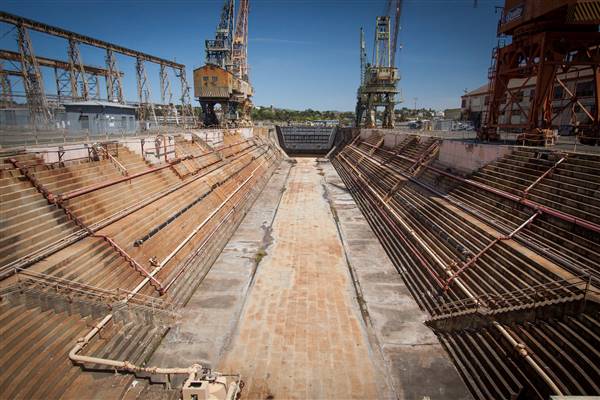
California Avenue and Railroad Avenue run through the shipyard's old core, past red brick machine shop buildings with round arched windows and iron sash. , a granite lined basin off Rickover Street finished in 1891, opens onto the strait behind concrete aprons wide enough for heavy equipment. , a smithery from 1856, stands on Railroad Avenue. It is one storey of red brick, with an anchor and coiled chain set on the pavement outside its arched windows.
On Nimitz Avenue, is a long white corrugated metal shed built in 1940 that runs the length of a city block, four rows of factory windows under a weathered parapet and full grown palm trees along the sidewalk. The shed measures 250,000 square feet under one open roof. A modular housing manufacturer operates a factory floor inside it today, and a similar shed elsewhere on the island has steel roof trusses rising in two ranks to a run of clerestory windows above the floor.
A row of coal sheds from 1903 lines Waterfront Avenue near Fourth Street, plain single storey buildings numbered 141 through 163 down the row. One now holds a brewery and taproom behind its original loading doors. Ferries dock at a pier further along the waterfront, red brick shipyard buildings and a tall crane rising behind them.
Walnut Avenue runs past , a line of Victorian houses built for the shipyard's officers, wide columned porches and balustraded balconies facing the street under mature shade trees. stands further along the same avenue, a shingled building from 1901 with a round window set into its gable end.
Shot in Mare Island
Metro used the shipyard's own machine shop and dry docks for its 1997 finale, one year after the base closed. A FIAT commercial found the same industrial waterside useful for a chase scene almost twenty years later.
Metro, 1997
The Building 680 machine shop
The action finale of Metro was shot inside Building 680, the shipyard's 1940 machine shop on Nimitz Avenue, one year after the yard closed. Additional scenes used the dry dock area nearby.
FIAT commercial, 2015
A 2015 FIAT commercial shot a chase scene on the loading platform of the coal sheds, a row of buildings from 1903 along Waterfront Avenue. The rest of the advert was filmed along the shipyard's industrial waterside.
Sherlock Holmes and its sequel used the dockyard's brick storehouses and slipways as Victorian London. Chatham closed as a working yard in 1984, and its brick sheds and dry docks read close to a nineteenth century shipyard with none of the paint and safety signage a working base leaves behind. Chatham's covered slips are taller and more elaborate than a plain machine shop, so a wide shot needs a lower, plainer building for the same period. Try searching Victorian dockyard sheds now.
Charlestown Navy Yard in Boston, Massachusetts
Charlestown's own Dry Dock 1, dating from 1833, sits beside brick machine shops and officers housing from the same century of naval construction. No documented production has doubled the yard for anywhere else, but its granite dock walls and worker housing are the same kind of nineteenth century naval yard fabric. The USS Constitution is permanently moored there, so a wide shot needs careful framing to keep her masts out of frame if the period is meant to stay ambiguous. Try searching granite dry dock naval yard now.
Sandstone and brick workshop buildings on Cockatoo Island date from its century as the Royal Australian Navy's dockyard, beside the Fitzroy Dock and the later Sutherland Dock. It closed as a working yard in 1991, leaving a similar mix of empty sheds and dry docks open for productions. The island's sandstone cliffs and colonial convict buildings are a visual signature this shipyard does not share, so a tight shot on the brick workshops and dock edges holds the match better than a wide one. Try searching sandstone dry dock workshops now.