A formal green ringed by Federal, Greek Revival and Italianate rowhouses, with the Chapel Street brownstones that played a New York apartment building in Twisted.
What Wooster Square looks like
sits at the center of the neighborhood. It is a rectangular green bounded by Greene Street, Wooster Place, Chapel Street and Academy Street. Paved paths cross the lawn under mature trees, with wooden benches and cast iron lamp posts along the walks. Seventy two Yoshino cherry trees line the park and the surrounding blocks, in bloom each spring.
Chapel Street runs along the park's south side, past , six attached Italianate and Second Empire townhouses clad in brownstone with bracketed cornices and cupolas. Freestanding houses nearby are stuccoed or brick, in the Greek Revival and Italian Villa styles, two and three storeys with stoops and iron balconies. The facades are largely intact.
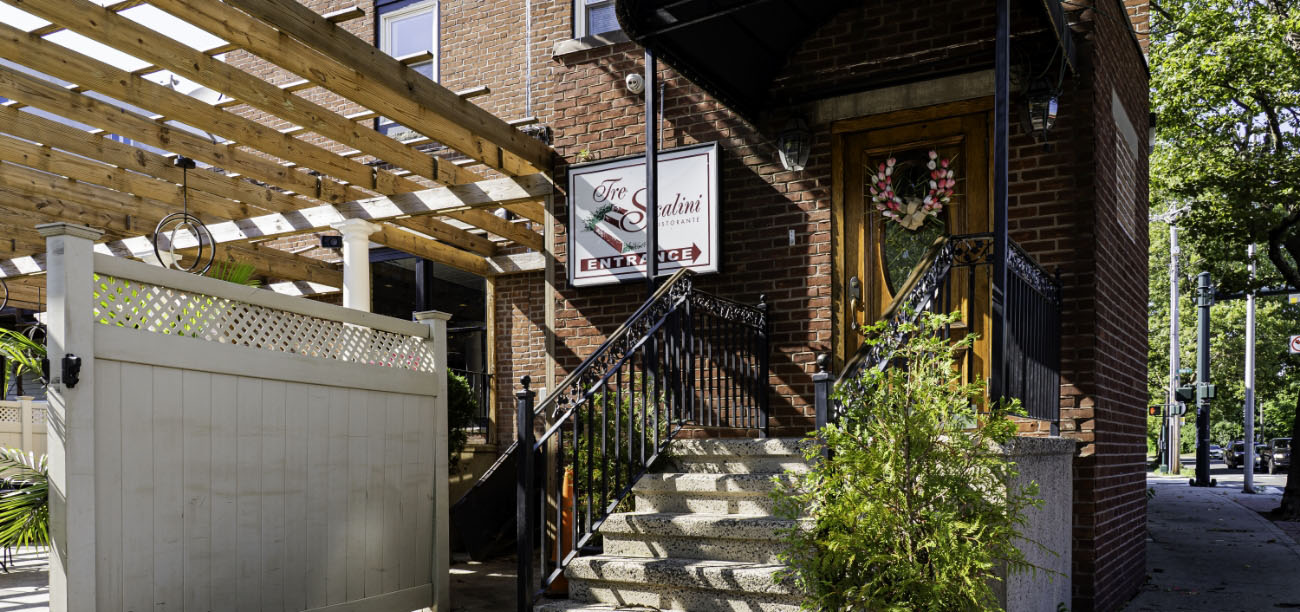
Wooster Street runs off the square as the neighborhood's commercial spine, marked by a wrought iron arch spanning the roadway near Chapel Street. Brick storefronts under fabric awnings line both sides, among them and , each in a three storey brick building with a ground floor storefront and windows above facing the street.
Academy Street and Greene Street hold more of the same period rowhouses, brick and stuccoed, some behind cast iron fences with small front gardens. The historic district covers forty acres of continuous period frontage ringing the park on all four sides.
Shot in Wooster Square
The horror thriller Twisted, produced under the title The Monster, closed a block of Chapel Street between DePalma Court and Wooster Place to film the exterior of a New York City apartment building. A woman in a white dress climbed the Brownstone Row steps for the scene, its interior filmed inside Tarrywile Mansion in Danbury.
Twisted, 2026 (produced as The Monster)
Brownstone Row
Played an apartment building, New York City, present day
A woman scamming apartment buyers in the film's opening con walks up to one of the row's entrances, reaches the top of the steps and turns back, played again and again for the shot. The production dressed nothing on the brownstones themselves, using the row's own facades as a New York City street. Street View
What Wooster Square can double for
Cobble Hill in Brooklyn, New York
Cobble Hill's brownstone rows share the same scale, bracketed cornices and stoops as Chapel Street's Brownstone Row, the block a production already shot as a New York City street rather than travel to New York. Look along Warren and Baltic Streets for the closest match. Cobble Hill's stoops run taller and its blocks are longer, so a tight frame on two or three houses holds the illusion better than a wide one. Try searching brownstone row street now.
College Hill's Federal and Greek Revival houses match Wooster Square's earlier frontage, both built around formal, tree lined streets rather than a commercial grid. Benefit Street has the closest run of unaltered facades. College Hill's streets climb a real hill, so a level frame needs a stretch of Benefit Street rather than the steeper cross streets. Try searching Federal Greek Revival street now.
Beacon Hill in Boston, Massachusetts
Beacon Hill's uniform red brick Federal rowhouses and gas lamps suit an earlier period than Wooster Square's mixed Italianate and Second Empire frontage. The cobblestone streets and bow front windows are a Boston signature, not a New Haven one. Beacon Hill's cobblestones and purple paned windows would need to be avoided or embraced deliberately, since New Haven has neither. Try searching red brick Federal street now.