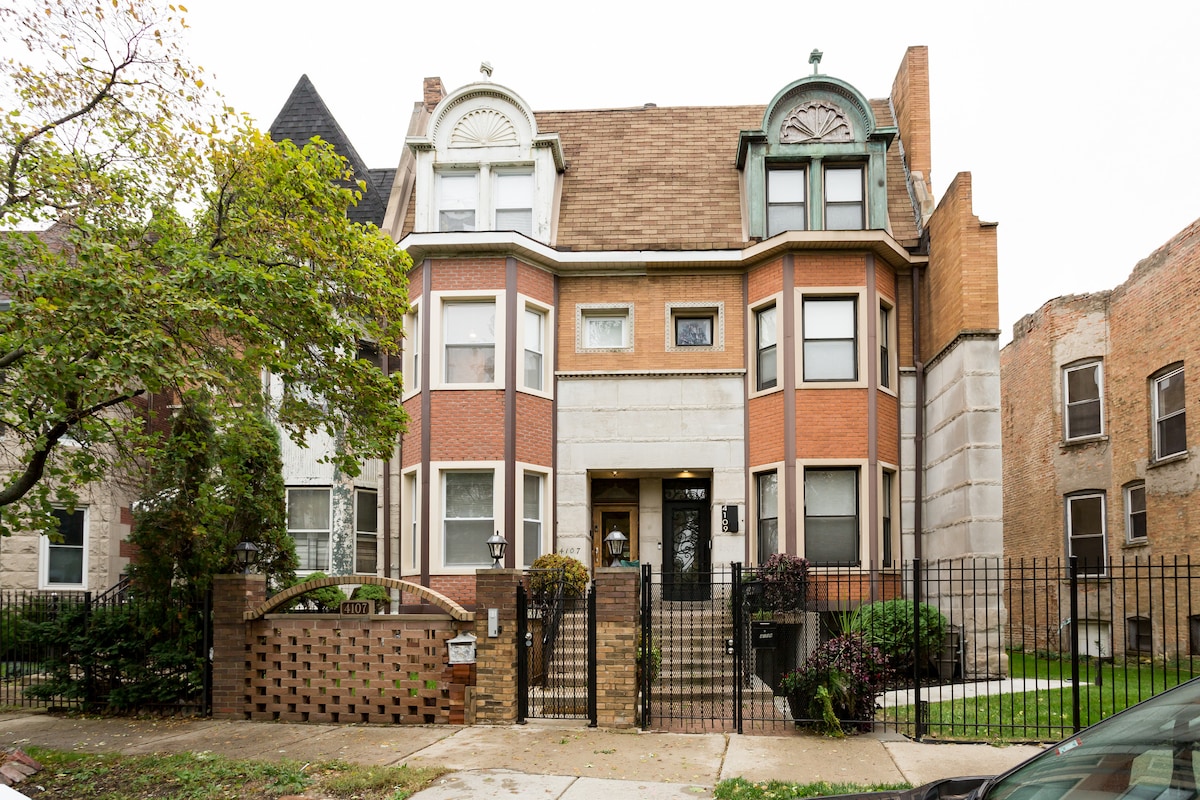
Greystone rowhouses and Victorian mansions behind iron fences on wide boulevards, and the apartment block Transformers used as Chernobyl's Pripyat.
What Bronzeville looks like
Martin Luther King Drive runs as a divided boulevard, a planted median splitting its lanes for blocks at a stretch. Greystone two- and three-flats line the side streets around it, repeating a single bay window and stone stoop from one lot to the next. The holds its own corner in the same pale limestone with a rounded turret.
Farther south on Wabash Avenue, the rises five storeys in brown pressed brick, its windows set in even rows above a stone entrance arch. The stands a few blocks over on State Street, three storeys with green terra cotta cladding the top two floors, now run as a branch library. The nearby is four storeys of yellow brown brick with white terra cotta trim and a name plate set high on its front.
A run of freestanding mansions holds Prairie Avenue and Michigan Avenue near 28th and 29th Streets, rough cut stone gables and turrets behind iron fences and short lawns. The is the grandest of them, red brick and terra cotta rising to a steep front gable over paired arched windows.
At 47th Street and Wabash Avenue, the complex runs along a full block in plain brick, window bays repeating in even rows around a landscaped interior courtyard. Iron balconies break the upper floors on the Wabash side, and small retail spaces line the sidewalk under the corner.
Shot in Bronzeville
The 2011 Transformers sequel filmed the vacant Rosenwald Courts complex at 47th Street and Wabash Avenue as the abandoned town of Pripyat, near the Chernobyl reactor. Colonel Lennox investigates the exclusion zone across the boarded courtyard blocks early in the film.
Transformers: Dark of the Moon, 2011
The Rosenwald Courts block
Played an abandoned apartment block, Pripyat, Ukraine, present day
The complex stood empty and boarded across its full block between Michigan and Wabash Avenues when the production shot it as Pripyat's deserted streets. It reopened in 2016 as occupied apartments called Rosenwald Courts, so a production today would find windows, balconies and a landscaped courtyard rather than the boarded facade the film used.
What Bronzeville can double for
Compton Heights in St. Louis, Missouri
Compton Heights holds turreted mansions in rough cut stone from the same 1890s decade as the Prairie and Michigan Avenue houses, with matching round arched windows and conical roofs. Its blocks run at almost the same scale, one grand stone mansion after another behind an iron fence. Compton Heights curves along wider lawns and gentler streets than the straight blocks here, so a tight frame on one house holds the match better than a wide street shot. Try searching turreted stone mansion now.
Concordia in Milwaukee, Wisconsin
Highland Boulevard's brewing era mansions match the scale of the freestanding Victorian houses on Prairie and Michigan Avenue, brick and stone under steep roofs along a wide boulevard. Both blocks were built up for merchants and manufacturers within the same few decades. Concordia's deeper lawns and rolling grade read differently in a wide establishing shot, so keep the boulevard itself out of frame and favor one house at a time. Try searching victorian mansion boulevard now.
Strivers' Row in Harlem, New York
Strivers' Row lines its blocks with limestone and brown brick rowhouses built in the same 1890s decade, sharing the stoop and cornice rhythm of the greystone blocks here. The houses share a rear courtyard rather than an alley, which is the one structural difference worth knowing. The shared courtyard and the absence of front yards give the block away from above, so a street level frame close to the stoops holds the match best. Try searching limestone rowhouses block now.