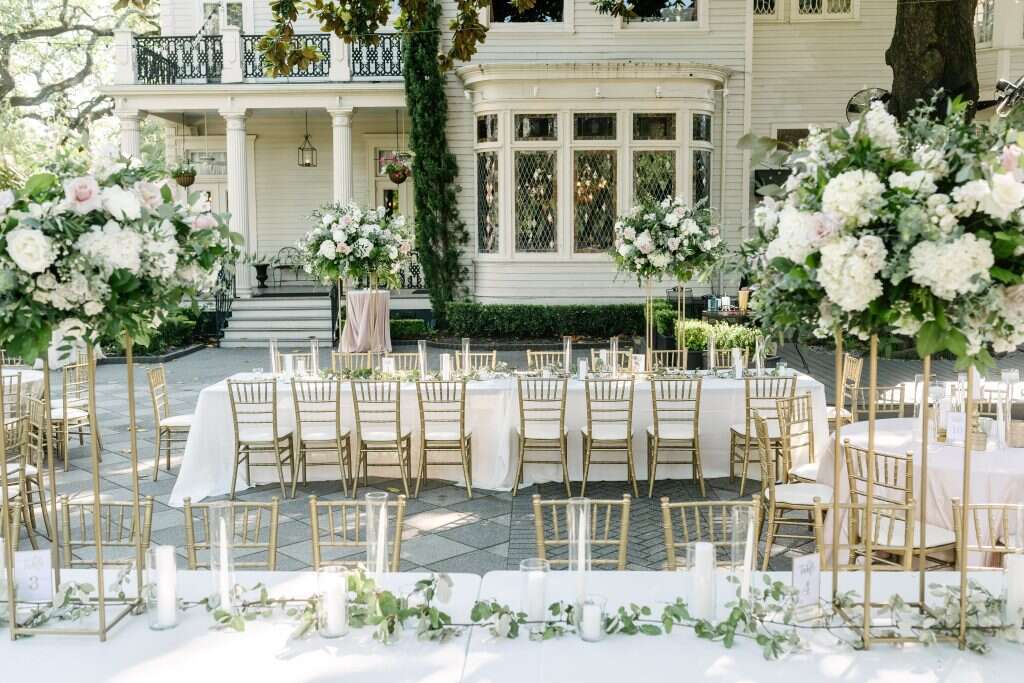
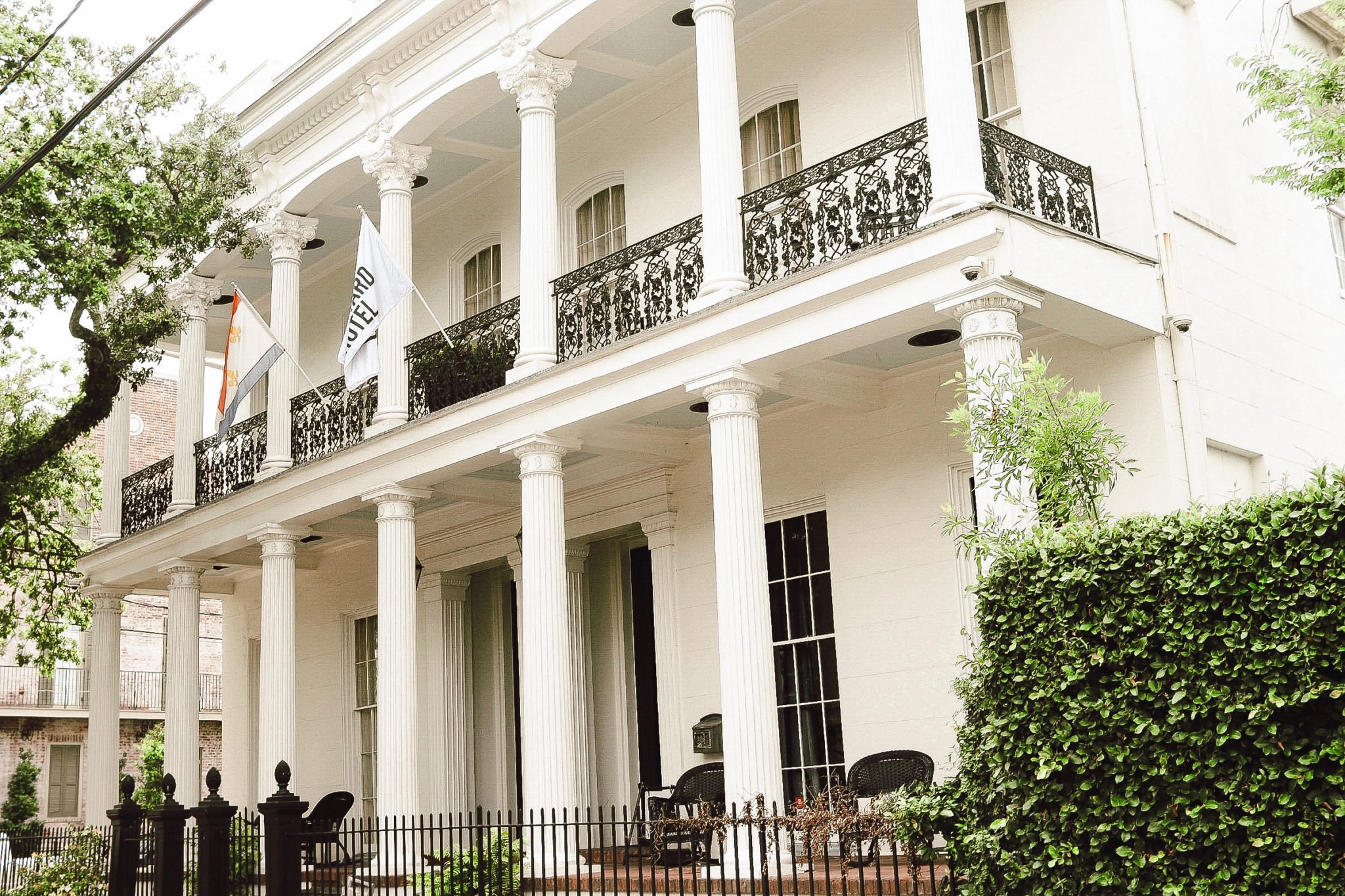
Big houses from the 1850s stand behind cast iron fences, with smaller Victorian houses filling the gaps between them.
What Garden District looks like
Each block in the Garden District usually holds one or two big houses behind their own fence, with several smaller houses filling in the space around them closer to the street. The big ones are Greek Revival or Italianate, built in brick, wood or stucco. Columns or a cast iron gallery run across the front.
On Fourth Street, the house at 1448 has cast iron galleries along two sides and a rounded bay at the corner. Farther up , a white house with Corinthian columns on both floors has an octagonal tower at one end. The double gallery townhouses on are pink and cream wood, with round columns and cast iron railings behind a low fence.
Live oaks line the streets, their branches meeting overhead in places. Brick sidewalks and stone gutters run along several blocks, with iron gratings over the drains and cast iron posts at the corners. Street names are set into the sidewalk concrete in blue and white tile.
Toward the river on , the houses are single storey wood cottages behind iron fences, smaller than the mansions closer to . runs along the district's river edge, with two storey wood and brick buildings and shopfronts on the ground floor. The St. Charles Avenue streetcar runs on the tracks down the grass median on the district's opposite edge.
fills the block on between Prytania and Coliseum Streets, its aboveground tombs visible over a low wall from the sidewalk. It has been closed to visitors since September 2019.
Shot in Garden District
The Buckner Mansion at 1410 Jackson Avenue is the outside of Miss Robichaux's Academy in the FX series American Horror Story, seen in its Coven and Apocalypse seasons. Only the exteriors were shot there. Double Jeopardy shot inside Lafayette Cemetery No. 1 in 1999 and swapped the 1 on the entrance gate for a 3.
The Curious Case of Benjamin Button, 2008
The 2700 block of Coliseum Street
Played The retirement home where Benjamin grows up
David Fincher found the house at 2707 Coliseum Street while scouting in 2006 and wanted it for the retirement home where Benjamin grows up. The owner was Mary Nell Porter Nolan, who had evacuated to Houston after Katrina. She said no. Bill Doyle, the location scout, looked at as many as three hundred other properties. Fincher would not take any of them and she agreed in the end. The house is on the odd side of the block, across the street from the townhouses in this photograph.
What Garden District can double for
Oakleigh Garden Historic District in Mobile, Alabama
Oakleigh Garden Historic District has the same run of Federal, Greek Revival and Italianate houses that fills the New Orleans district, put up mostly across the same decades. Both grew up as garden suburbs on the edge of a river port, one plot at a time rather than as a single planned tract. The district's 288 contributing buildings include some as late as the 1940s, so a wide shot risks catching the later Craftsman bungalows mixed into some blocks. Stay on the Greek Revival and Italianate houses nearest Washington Square to hold the period. Try searching Greek Revival Italianate houses now.
Natchez, Mississippi
Natchez still has a large stock of antebellum mansions, Stanton Hall and Longwood among them, built by the same cotton money that raised the Garden District's own houses. A whole block there can still look like the 1850s, with freestanding porticos and colonnades rather than the street facing cast iron galleries the New Orleans houses carry. Keep the comparison to a single house rather than a block, since Natchez mansions sit on their own grounds and rarely line up shoulder to shoulder the way the Garden District does. A Natchez gallery would need iron dressing to hold a wider New Orleans shot. Try searching antebellum mansions now.
Old Louisville is the country's largest Victorian district, built mostly after 1870, the same decades the Garden District's larger lots were divided and filled in with smaller Victorian houses. Most of Old Louisville is brick rather than the wood and stucco used here, and its houses run to the turrets and stained glass of high Victorian style rather than the plainer infill houses in the Garden District. Keep to street level and avoid wide shots that show the brick and the turrets, since a Garden District production would want the plainer wood houses this district is standing in for. The iron fences along St. James Court read close enough for a tight frame. Try searching Victorian houses now.