Three to five storey masonry rowhouses across a square mile grid, and the church On the Waterfront used for Father Barry's parish.
What Hoboken looks like
runs down the middle of the grid, the avenue's ground floor shops under three and four storeys of apartments the length of the street. On the side streets, three to five storey masonry rowhouses run unbroken from corner to corner, brick and brownstone fronts with stoops and cast iron rails. Hoboken packs more than 48,000 people into its single square mile, one of the densest layouts in the country.
sits at Willow Avenue and Fourth Street. Our Lady of Grace Church faces the square, its twin brick spires rising over the surrounding roofs. Four blocks north on Hudson Street, sits beside , a parish building of the same era.
At the river, keeps its 1907 copper clad facade over a rusticated limestone base, with ferry slips still running out from the waiting room. Tiffany stained glass fills the windows inside, and PATH trains and New Jersey Transit's commuter lines use the same platforms today.
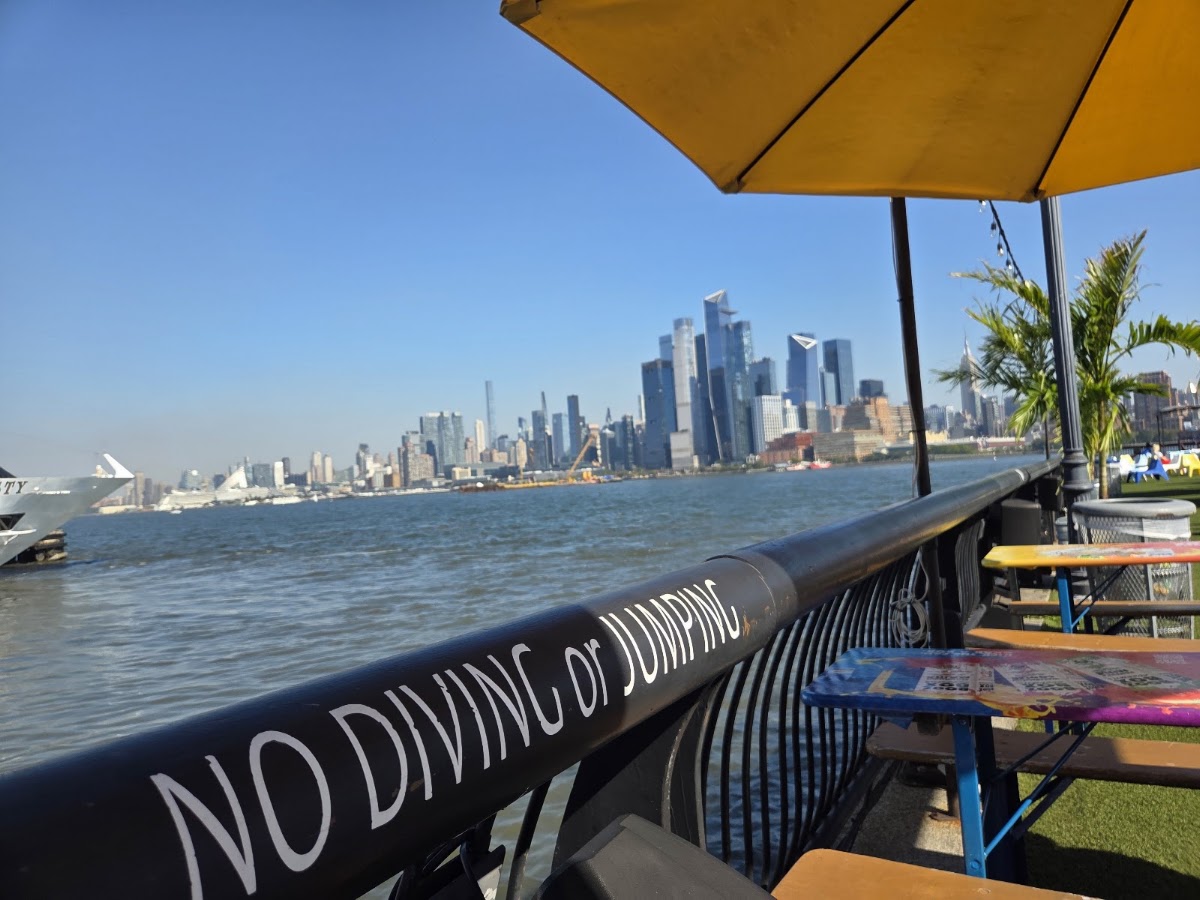
A promenade runs the length of the waterfront as part of the Hudson River Walkway, with Frank Sinatra Park's lawns looking across to the Manhattan skyline. Pier C's curved concrete deck extends out into the river as one of several small parks along the same stretch.
Shot in Hoboken
On the Waterfront was filmed entirely on location in Hoboken over thirty six days. The production used the neighborhood's docks and streets, from workers' dwellings and bars to rooftops and alleys. Stevens Park, four blocks north of Church Square, supplied the walk where Terry Malloy picks up the glove Edie Doyle drops. The dock and warehouse scenes used Hoboken's own waterfront piers, which have since been demolished.
On the Waterfront, 1954
The church stood in for Father Barry's parish, its exterior and steps at Church Square used for the scenes outside. Saints Peter and Paul Church, a few blocks away on Hudson Street, was used for the same parish's interior. Street View
Charlestown's dense brick rowhouses sit on a tight nineteenth century grid across the water from a big city skyline, the same shape Hoboken has across the Hudson. The blocks around City Square hold the closest rowhouse match. Charlestown's streets run steeper and its brick tends redder, so a level rowhouse street with a flatter facade line reads more like Hoboken. Try searching brick rowhouse street with skyline now.
Fells Point's dense masonry rowhouses and cobbled waterfront streets share Hoboken's scale, a working port neighborhood built up close to the water. The blocks around Broadway Square hold the closest rowhouse match. Fells Point's streets are narrower and its cobbled surfaces rougher underfoot than Hoboken's asphalt, so a wider rowhouse street favors Hoboken over a tight one. Try searching cobbled waterfront rowhouse street now.