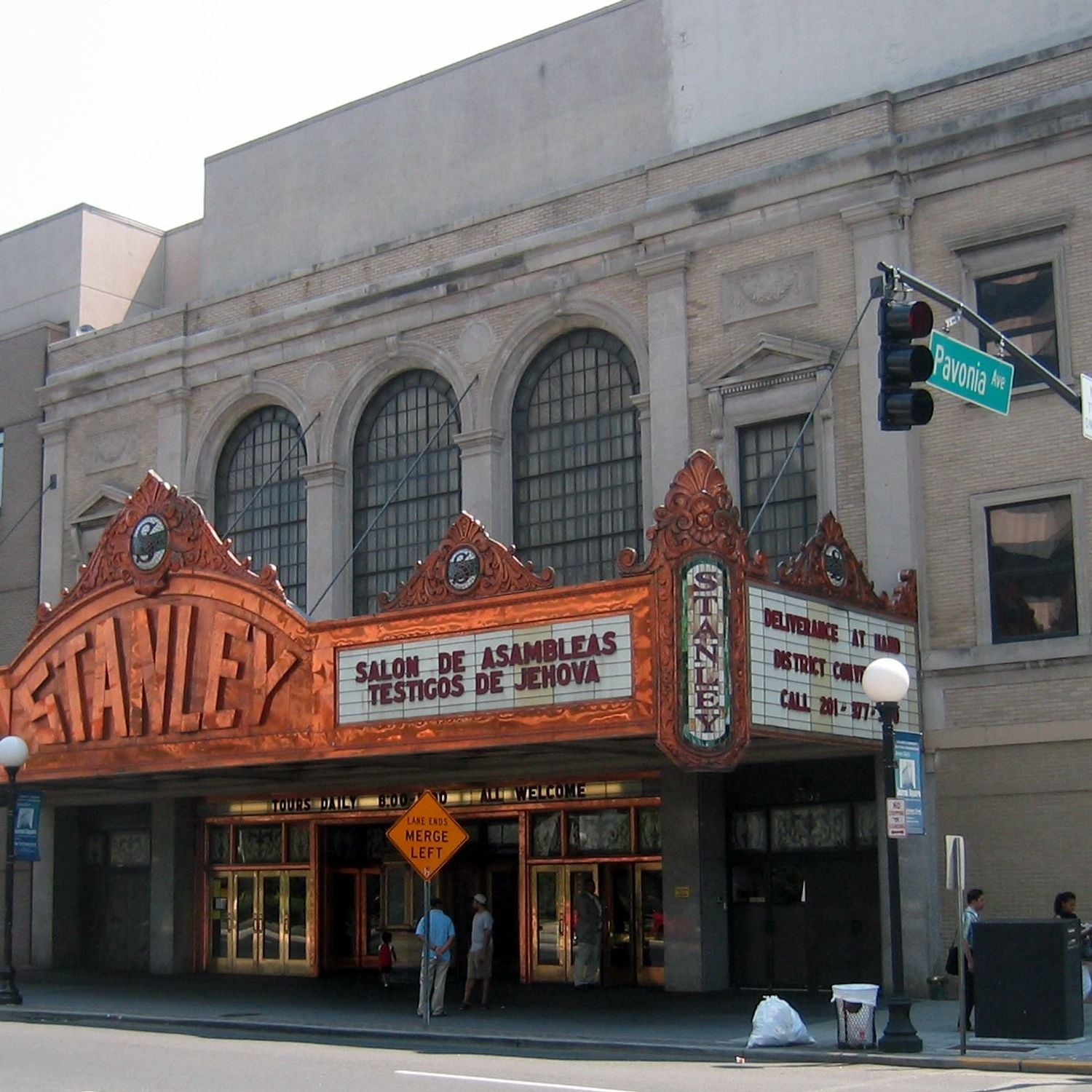
A cream terracotta movie palace from 1929 faces a transit plaza, and Joker turned its exterior into the Monarch Theater.
What Journal Square looks like
Kennedy Boulevard and Bergen Avenue meet at a paved plaza in front of a ten story concrete transportation building, with glass residential high rises rising behind it. Duane Reade and Starbucks fill the tower's ground floor arcade behind a row of hedges and street lamps. NJ Transit buses circle through the bays along the curb.
The stands across the plaza, a cream terracotta front from 1929 topped with a round clock and bronze dragons. Marble columns and a ten tiered chandelier fill the lobby inside, with a red carpeted stair curving up to the balcony.
Below street level, the PATH station's two island platforms sit under a Brutalist concrete headhouse built in the 1970s. A stone wall at the plaza entrance names the transportation center and its PATH plaza, and an arched road bridge holds Kennedy Boulevard above the tracks a block north.
A block south on the boulevard, a fifteen floor Beaux Arts tower in cream stone from 1928 stands over an iron fire escape that zigzags up its brick side wall. The 's own terracotta front stands two blocks up the boulevard, its marquee dark and its doors used now for religious assemblies rather than films.
Shot in Journal Square
For Joker, the production redressed the Loew's Jersey Theatre's exterior as the Monarch Theater, the Gotham cinema the Wayne family is leaving when Thomas and Martha Wayne are killed. The marquee and awning were swapped for the shoot, and the theatre's own facade carried the scene.
Joker, 2019
The Loew's Jersey Theatre exterior
Played the Monarch Theater, Gotham City, 1981
The theatre's marquee was changed to read Monarch Theater, with posters for Blow Out and Zorro the Gay Blade set to place the scene in 1981. Thomas and Martha Wayne are shot in the alley beside the theatre after the screening. Street View
What Journal Square can double for
Grand Concourse in the Bronx, New York
Loew's Paradise Theatre on the Grand Concourse near Fordham Road is one of the same five Loew's Wonder Theatres built in 1929, a movie palace with a matching cream terracotta facade and a clock set in the same kind of carved niche. The pairing of a movie palace facade and a busy transit corner is available a subway ride away. The Grand Concourse is a far wider boulevard with a planted median, which reads differently from Kennedy Boulevard in a wide shot. The bronze Saint George and dragon that once flanked the Paradise's clock have been stolen, leaving only the horse. The theatre itself sits mostly vacant now, with only occasional screenings since 2025. Try searching 1929 movie palace facade now.
Jamaica Avenue in Queens, New York
The Valencia Theatre on Jamaica Avenue is another 1929 Wonder Theatre, its brick and terracotta facade in a matching Spanish and Mexican Baroque style standing over a transit hub with the same density of buses and subway riders passing through Jamaica Center. The building is now a church rather than a working cinema, so an exterior only shoot holds the illusion better than one that needs a lit marquee. The Valencia's upper floors are yellow brick rather than cream terracotta, and Jamaica Avenue runs narrower and more crowded with awnings than Kennedy Boulevard. Try searching 1929 Wonder Theatre facade now.
The Uptown Theatre at Broadway and Lawrence Avenue was designed by the same firm, Rapp and Rapp, in a matching Spanish Baroque style. Its cream terracotta facade rises about eight storeys over the sidewalk, with a marble floored lobby behind it comparable to Loew's Jersey's own. The Uptown has sat closed since 1981 during a stalled restoration, so only its exterior is available for now. Chicago's elevated Red Line runs on a steel trestle rather than over underground PATH tracks, which shows in any shot that tilts up. The Uptown's own marquee also reads a different name entirely. Try searching Rapp and Rapp terracotta facade now.