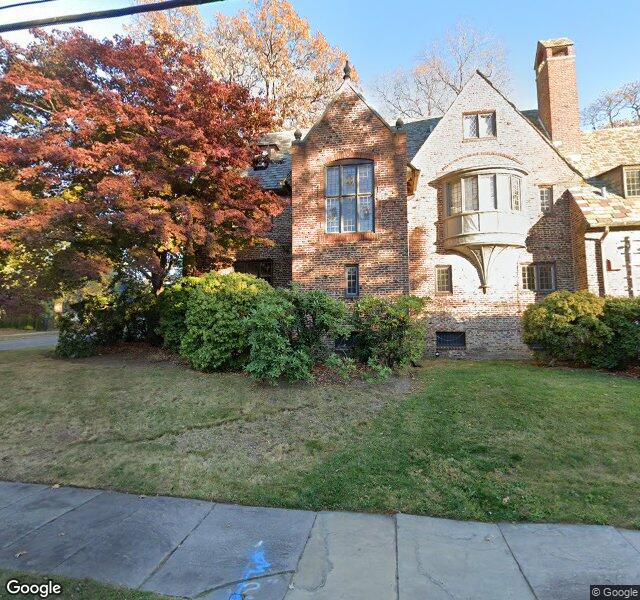
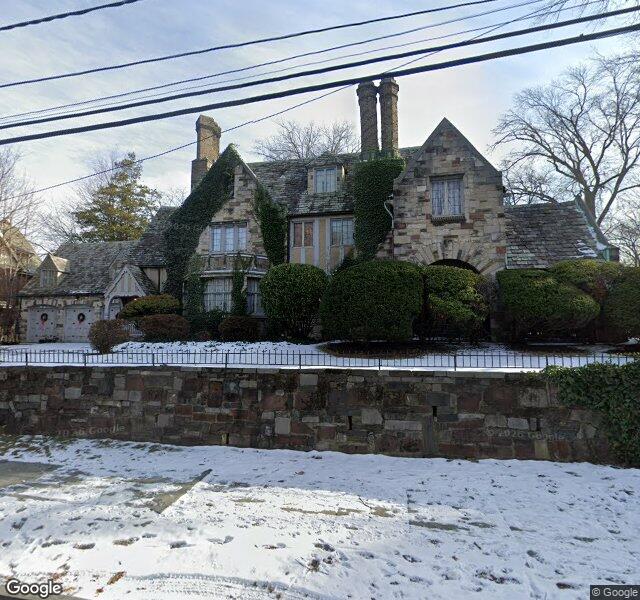
Large brick and stone houses stand behind iron fences on wide tree lined streets, and the Highland Avenue house from The Sopranos.
What Forest Hill looks like
The biggest houses stand on Mount Prospect Avenue, red brick on stone foundations behind iron fences and clipped hedges. The William Clark House was built in 1879 for a thread manufacturer. It takes up almost a full block, its three storeys rising to a marble columned porch under a steep slate roof.
The side streets are wide, with landscaped strips down the middle and every house set back the same distance from the curb. Detached houses line them in Colonial Revival, Queen Anne, Tudor and Craftsman styles. Most were raised between 1890 and 1925, each on its own lawn behind a low wall or a fence.
On Highland Avenue, a yellow sided house at Number 190 has been converted into a storefront church behind a chain link fence. Four blocks north, at Number 380, a similar house played Junior Soprano's on The Sopranos. Its exterior returned across several seasons of the show.
Bloomfield Avenue is the commercial edge, storefronts under apartment blocks and a green and gold Forest Hill welcome disc bolted over the sidewalk. A former bank building with paired stone columns stands at the corner, now a Wells Fargo branch.
Branch Brook Park runs along the western edge, planted with more than five thousand cherry trees that bloom every April. The , two steep roofed stone gatehouses at Ballantine Parkway and Lake Street, marks the walk in from the neighborhood.
Shot in Forest Hill
on The Sopranos used 380 Highland Avenue for its exterior. The show returned to the block across several seasons, including the episode where Tony digs up the front yard looking for money Junior said he had buried.
The Sopranos
Junior Soprano's house
The house one block from Branch Brook Park served as the exterior of Junior Soprano's home. It appears in the season six episode "Members Only," where Tony digs up the front yard hunting for cash Junior claimed he had buried years earlier.
What Forest Hill can double for
Parkside in Buffalo, New York
Parkside's houses sit along curving streets laid out around an Olmsted designed park, the same arrangement as Forest Hill beside Branch Brook Park. They come in the same mix of Tudor, French Chateau and Colonial Revival styles. Jewett Parkway holds some of the largest lots and the grandest houses. Parkside's houses sit closer together and its lots are narrower than Forest Hill's, so a wide establishing shot needs a block with deeper setbacks to hold the illusion. Try searching Tudor houses beside a park now.
Llewellyn Park in West Orange, New Jersey
Llewellyn Park's curving roads were laid out by Alexander Jackson Davis around large villa lots on the same scale as Forest Hill's biggest houses, in the same period. Several of its houses were designed by the same generation of prominent American architects. Llewellyn Park is a private, gated community, so a wide shot needs to avoid the gate lodge and any modern security signage that would give away the gate rather than an open street. Try searching large curving villa lots now.
Ditmas Park in Brooklyn, New York
Ditmas Park's detached houses went up in the same years as Forest Hill's, each set on its own lawn with generous space to the next house. Ditmas Park's houses are mostly wood frame with wraparound porches rather than Forest Hill's brick and stone, so a shot that lingers on the siding or the porch columns gives it away. Wider frames at a distance hold the illusion better. Try searching detached houses wood frame porches now.


_at_Highland_Avenue_in_Newark,_Essex_County,_New_Jersey.jpg)