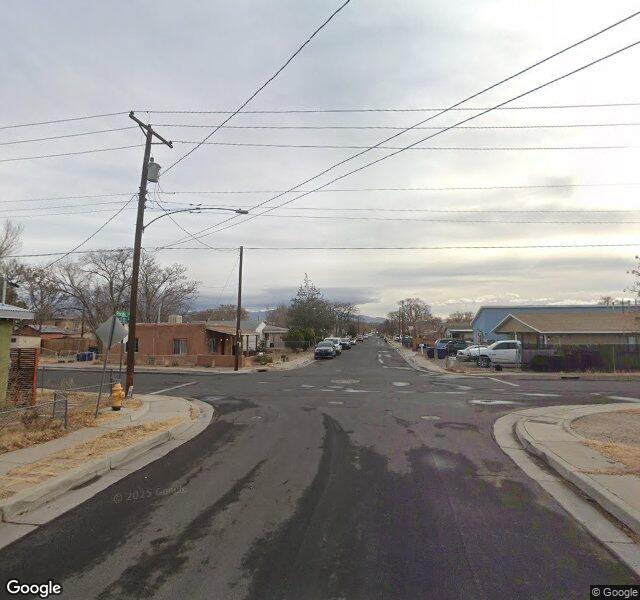
Small adobe houses beside the Santa Fe Railway Shops, where Better Call Saul shot a rail yard confrontation as Philadelphia.
What Barelas looks like
The run in long brick buildings along Second Street, their steel sawtooth roofs lined with rows of glass panes. A chain link fence follows the sidewalk, and a stone fire station with a squat corner tower stands behind it near the tracks. Some of the shop windows are broken through, opening onto wood plank floors and steel trusses inside.
Away from the yards, the houses are one storey and close to the sidewalk, built of stuccoed adobe with rounded parapets and flat roofs. Wood vigas project past the wall line, and canales drain the roofs out through the parapet. The on Second Street keeps its original cornice brackets under a hipped roof.
is the old alignment of Route 66 through the neighborhood, lined with one and two storey stone and stucco storefronts. A stone faced shop farther down still has a hand painted glass and screen service sign over its boarded windows. The keeps its rounded corner sign and screened porch behind a wrought iron fence, closed since 2021 but still standing.
The , a U shaped adobe building from the early 1940s, sits behind a walled courtyard with bare cottonwood trees. 's bell tower rises over Fourth Street a few blocks north. The 's campus runs along the Rio Grande at the neighborhood's western edge, its newer stucco buildings set back behind lawns.
Shot in Barelas
The Santa Fe Railway Shops just off Second Street played a Philadelphia rail yard for two different AMC series. Breaking Bad used the yards for a season four robbery scene, and Better Call Saul returned to the same tracks for Mike Ehrmantraut's confrontation with two corrupt police officers.
Better Call Saul, "Five-O" (season 1, 2015)
The rail yard confrontation
Played Philadelphia, Pennsylvania, 2002
Mike Ehrmantraut lures corrupt police officers Fensky and Hoffman into the rail yards and kills them both in a gunfight. The yards' own tracks and idle rail cars, just off Second Street, play a Philadelphia street corner rather than New Mexico. Street View
Barrio Viejo's dense rows of one storey adobe houses share the same flat roofs, rounded parapets and close set backs as Barelas' own side streets. Both grew up beside a rail line, so the scale of the houses and the narrow lots between them line up closely. Tucson's adobe often runs a deeper red brown than Barelas' stucco, so a close facade match may need paint or a warmer grade. Saguaro and paloverde in the yards need dressing out for a wide shot to hold as New Mexico rather than Arizona. Try searching adobe houses Barrio Viejo now.
Seligman in Arizona
Seligman's Route 66 storefronts share the same one and two storey scale as Fourth Street, with stone and stucco fronts from the same interwar boom in roadside building. Both towns kept their original signage rather than replacing it with a franchise standard. Seligman leans harder into painted Route 66 murals and tourist signage than Barelas does, so a wide shot needs careful framing to avoid them. Barelas' storefronts sit closer to a working rail yard, which Seligman's do not. Try searching Route 66 stone storefronts now.
Pullman's long brick factory wings share the same low industrial scale as the Santa Fe Railway Shops' own brick buildings, with rows of tall windows built from local brick. Both complexes grew up as a company's own rail car works rather than a generic warehouse district. Pullman's arched window heads and Chicago's flatter light read differently from Barelas' steel sash windows and high desert sun, so a close facade shot needs care. Wider shots along a fence line hold up better than a straight on elevation. Try searching brick rail car works now.