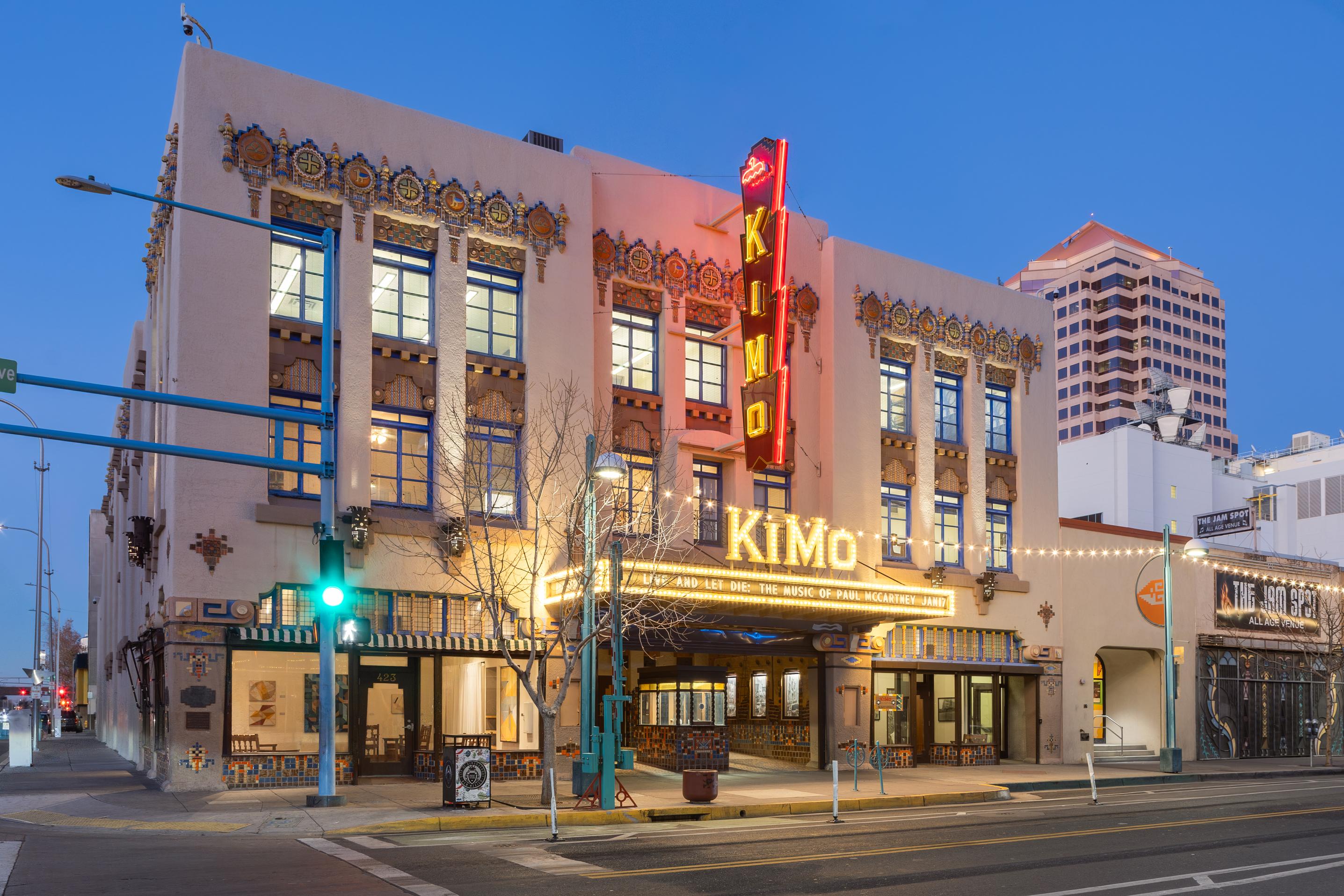
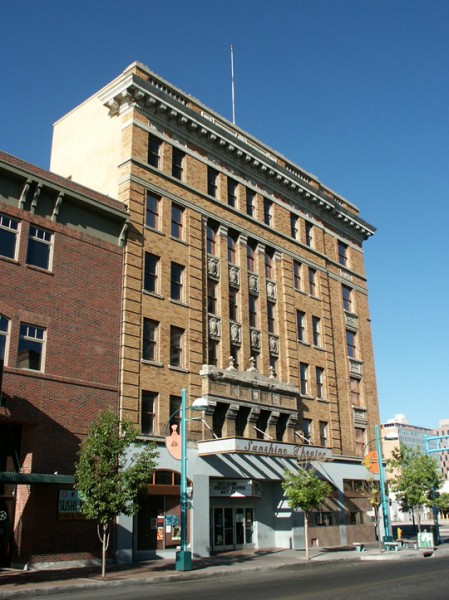
Low 1920s office blocks in concrete and terra cotta line Central Avenue under the KiMo Theater's Pueblo Deco front, where Better Call Saul shot Jimmy McGill's courtroom and hideout scenes.
What Downtown Albuquerque looks like
Central Avenue runs straight through downtown on a wide, numbered street grid, with light traffic and broad sidewalks along the storefronts. Streetlights and signals mark most corners, and the blocks run long and mostly flat toward the rail line on the east side.
The 's Pueblo Deco front mixes rounded stucco parapets with vertical Art Deco piers and pressed relief medallions in a rust and turquoise palette, its marquee still spelling out KIMO in tall red letters over the sidewalk. A block over, the rises nine storeys in concrete and stone above a two storey arcaded base. It is one of the 1920s office towers still standing along Central.
The wraps its corner in a low arcade of white terra cotta and pointed arches, dwarfed by a glass tower behind it. The fronts Central Avenue with a marble base and a Renaissance Revival cornice, and still runs as a music venue behind its yellow brick upper floors.
The sits low at Fourth and Gold, a pale Spanish Colonial Revival wing with arched windows under a red tile roof. Along the rail line at downtown's east edge, brick warehouses carry faded painted lettering for wool and hide dealers behind chain link fences.
stands nearby in earth toned stucco, its New Mexico Territorial Revival front opening onto a two storey arcaded lobby built around a central fountain. Modern towers close out the skyline behind it, glass and granite faces well over twenty storeys above the low 1920s roofline.
Shot in Downtown Albuquerque
The AMC series Better Call Saul used two real downtown addresses across its run. The Old Bernalillo County Courthouse stood in for Jimmy McGill's courtroom and legal scenes, and its fifth season sent Jimmy and Kim into hiding at the Hotel Andaluz after Lalo's visit.
Better Call Saul, season 5
Hotel Andaluz
Jimmy and Kim hide out here after Lalo's visit, inside the two storey arcaded lobby built around a central fountain. The lobby's tile floors and heavy woodwork survive from the hotel's 1939 opening, kept through a 2009 restoration.
What Downtown Albuquerque can double for
El Paso in Texas, United States
Trost and Trost designed Albuquerque's Sunshine Building. The same firm put up a string of 1920s concrete office towers in El Paso, a close match in scale and material for a 1920s office block. The Franklin Mountains rise close behind downtown El Paso, so keep the horizon out of a wide shot to hold the Albuquerque skyline. Try searching 1920s concrete office block now.
Phoenix in Arizona, United States
Trost and Trost also designed Phoenix's Luhrs Building and Luhrs Tower in the 1920s, low office blocks with the same tripartite concrete fronts as Albuquerque's Central Avenue core. Phoenix's palm lined streets and wider setbacks give it away in a full block view, so a tighter frame on the office fronts holds the match better. Try searching tripartite concrete office fronts now.
Tucson in Arizona, United States
Henry Trost began his career in Tucson before forming Trost and Trost in El Paso, and Tucson's own low brick and stucco commercial blocks from the 1900s through the 1920s read at a similar street scale to downtown Albuquerque. Tucson's mountain backdrop and redder brick tone differ from Albuquerque, so a tight frame on a single block front holds the match best. Try searching low brick commercial blocks now.