One and two storey bungalows from the 1920s stand in the shadow of brick public housing towers, a few blocks from the boardwalk.
What Far Rockaway looks like
runs past the elevated subway terminal and the bus loop at Beach 21st Street, both under bare concrete canopies. Storefronts sit low and close together along the avenue, a coffee shop sharing the ground floor of the , its name and the date cut into stone above the door.
A red brick firehouse faces Central Avenue a few blocks north, three arched bay doors marked Engine 264, Engine 328 and Ladder 134 under a stone cornice. The post office nearby is a squat colonial revival building in the same red brick, its corner entrance set under an octagonal dome.
Toward the water, the blocks change completely. Beach 24th, 25th and 26th Streets hold one storey wood frame bungalows from 1921. Arched and gabled porches sit under boxy roof dormers, painted in pale colors and packed close behind chain link fences. Brick public housing towers rise directly behind them, visible over the rooflines from most of the district.
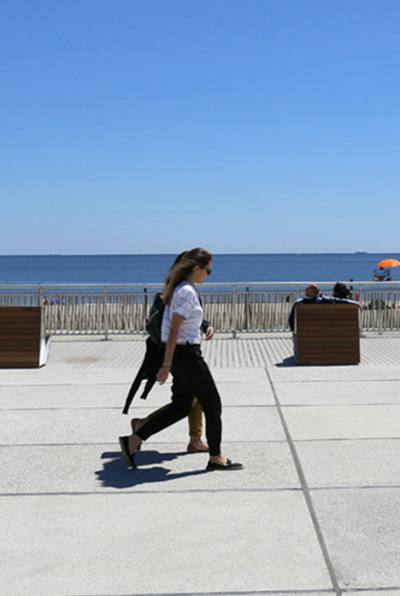
The Rockaway boardwalk, officially the Ocean Promenade, runs along the ocean side from Beach 9th Street to Beach 126th Street. The opened as a vaudeville house in 1919 on Beach 20th Street. It closed as a movie house in 1967 and now runs as a warehouse, its marquee taken down in 2005.
Shot in Far Rockaway
The HBO series Boardwalk Empire filmed here twice. Its pilot episode, in 2009, used the bungalow rows between the boardwalk and Seagirt Avenue. During its final season in 2014, the production built a temporary Atlantic City storefront and hotel front on the boardwalk near Beach 33rd Street for a flashback scene.
Boardwalk Empire, 2009
The pilot episode filmed among these blocks, built in 1921 between the boardwalk and Seagirt Avenue. About 100 of the original bungalows survive along Beach 24th, 25th and 26th Streets.
Cookman Avenue in Asbury Park is lined with the same compact, attached storefronts from the early twentieth century that Mott Avenue is, built at the same scale one block in from its own boardwalk. Cookman Avenue has been restored and re-let over the past decade, fresh paint and new signage throughout, so a production would need to distress a run of storefronts rather than find them ready made the way Mott Avenue's still are. Try searching compact early 1900s storefronts now.
Coney Island's NYCHA towers are still the tallest thing behind its own beach and boardwalk blocks, the same public housing skyline that rises behind Beach 25th Street here. Its own bungalow rows were cleared in the early 1970s, so nothing at ground level still matches. The comparison is the tower line alone. Coney Island's painted amusement park signage and boardwalk rides are visible in any wide shot, so keep the frame tight on the tower line, away from the rides and the beach concessions. Try searching housing towers behind a boardwalk now.