Tudor houses on curving lanes surround a brick paved station square, with a tennis stadium, a mile of storefronts and apartment towers close by.
What Forest Hills looks like
Forest Hills Gardens is a pocket of curving, tree lined streets where every house is built of masonry or concrete in a Tudor or Georgian style. sits at the center, a brick paved plaza finished alongside the Long Island Rail Road station in 1913, its bricks laid to work the crossing bars of a Union Jack into the pattern. More than 800 houses, townhouses and garden apartment buildings now stand in the Gardens.
The West Side Tennis Club moved to the Gardens from Manhattan in 1914 and built its roughly 13,000 seat stadium in 1923. The U.S. National Championships, later the U.S. Open, played there until 1977.
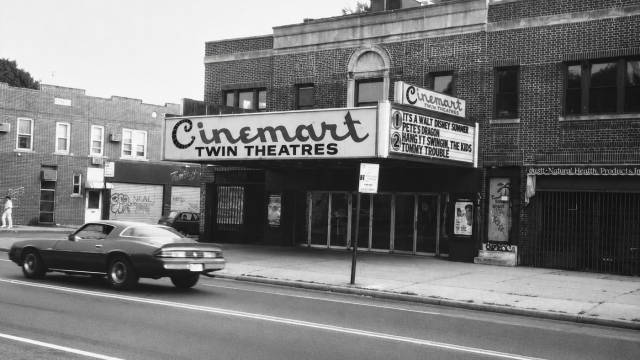
Away from the Gardens, runs about a mile between Yellowstone Boulevard and , lined with restaurants and chain stores. The independent Cinemart Cinemas is south of there on Metropolitan Avenue. is lined with apartment towers, block after block of them behind a wide roadway. In 2021, an independent film called Mouse shot here and in neighboring Kew Gardens, with an all Queens crew.
Shot in Forest Hills
Forest Hills has gone in front of cameras many times, sometimes as itself and sometimes dressed as somewhere else. Alfred Hitchcock shot a real championship match at the tennis stadium for Strangers on a Train. Station Square and Forest Hills Gardens have each been dressed for a different, older elsewhere since.
Strangers on a Train, 1951
Played a national tennis championship match, 1951
Alfred Hitchcock shot a long championship tennis match for the 1951 film Strangers on a Train at the West Side Tennis Club, filming while the actual 1950 Davis Cup finals were being played there. Fifty years later, The Royal Tenenbaums put Luke Wilson's character on the same court for a match of his own.
Zero Hour, 2013
Station Square
Played a small town square, Germany, around 1900
The ABC series Zero Hour filmed at Station Square in September 2012, dressing it up as a small town in Germany around 1900 and giving the Jade restaurant a new facade to use as its base of operations. Station Square has also stood in for a small town in Germany in the ABC series Quantico, which added Polizei signage and German plated cars in 2016.
Mildred Pierce, 2011
Played a Los Angeles neighborhood, Los Angeles, California, 1930s to 1940s
The HBO miniseries Mildred Pierce used Forest Hills Gardens as a stand-in for old Los Angeles when it filmed there in 2010. Bradley Cooper's Maestro filmed on Summer Street and Seasongood Road in the same Gardens in 2022, dressing the block with vintage cars for a story set in the 1930s and 40s.
Garden City is Long Island's own version of the garden suburb model, planned from 1869 by A.T. Stewart. It expanded from 1907 with the Tudor, Georgian and Colonial houses of Garden City Estates on wide tree lined avenues, the same design lineage Forest Hills Gardens drew on a few years later. The Sopranos prequel The Many Saints of Newark filmed for two days in April 2019 at the Fairchild Sons Funeral Home on Franklin Avenue. Garden City's lots and avenues run wider than Forest Hills Gardens' curving lanes, so a tighter street level frame keeps the scale honest. Try searching Tudor Georgian houses avenues now.
Lawrence Park in Westchester County, New York
Lawrence Park in Bronxville was laid out from 1891 with winding roads following the hillside, its 94 houses in Tudor Revival and Colonial Revival styles built of wood and stone with high roofs, gables and half timbering. Forest Hills Gardens is flatter and more formally planned around its station square, but the two share the same Tudor massing and the same instinct for a curving street over a straight one. Lawrence Park's houses sit higher above the road on a wooded hillside than Forest Hills Gardens' flatter lanes, so a frame looking uphill gives away which one it is. Try searching Tudor Revival houses winding roads now.
Hampstead Garden Suburb is the English model Forest Hills Gardens itself followed. Barry Parker and Raymond Unwin planned it from 1906, with low density housing around Central Square. Edwin Lutyens laid out the square with two churches and a meeting house on it, much the way Station Square sits at the center of Forest Hills. Its houses run more to plain Arts and Crafts brick and roughcast than to the masonry Tudor and Georgian fronts the Cord Meyer plan required. Hampstead's brick and roughcast cottages read plainer than Forest Hills Gardens' masonry facades. British road markings and signage are a quick tell too, so keep both out of a wide frame. Try searching central square Tudor houses now.