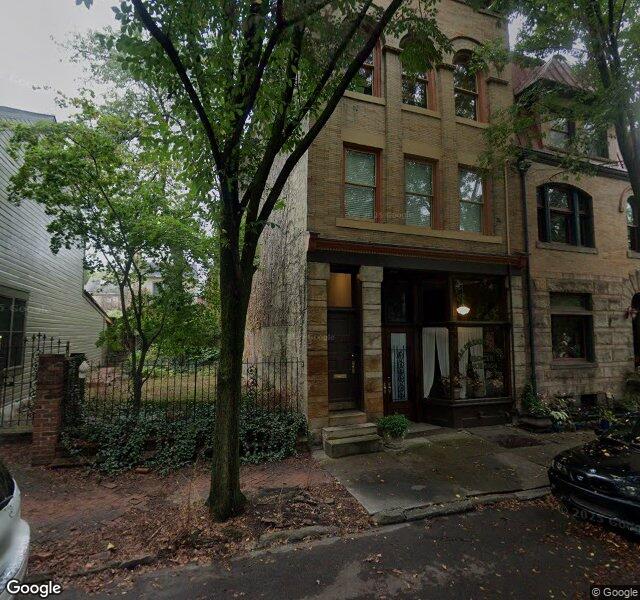
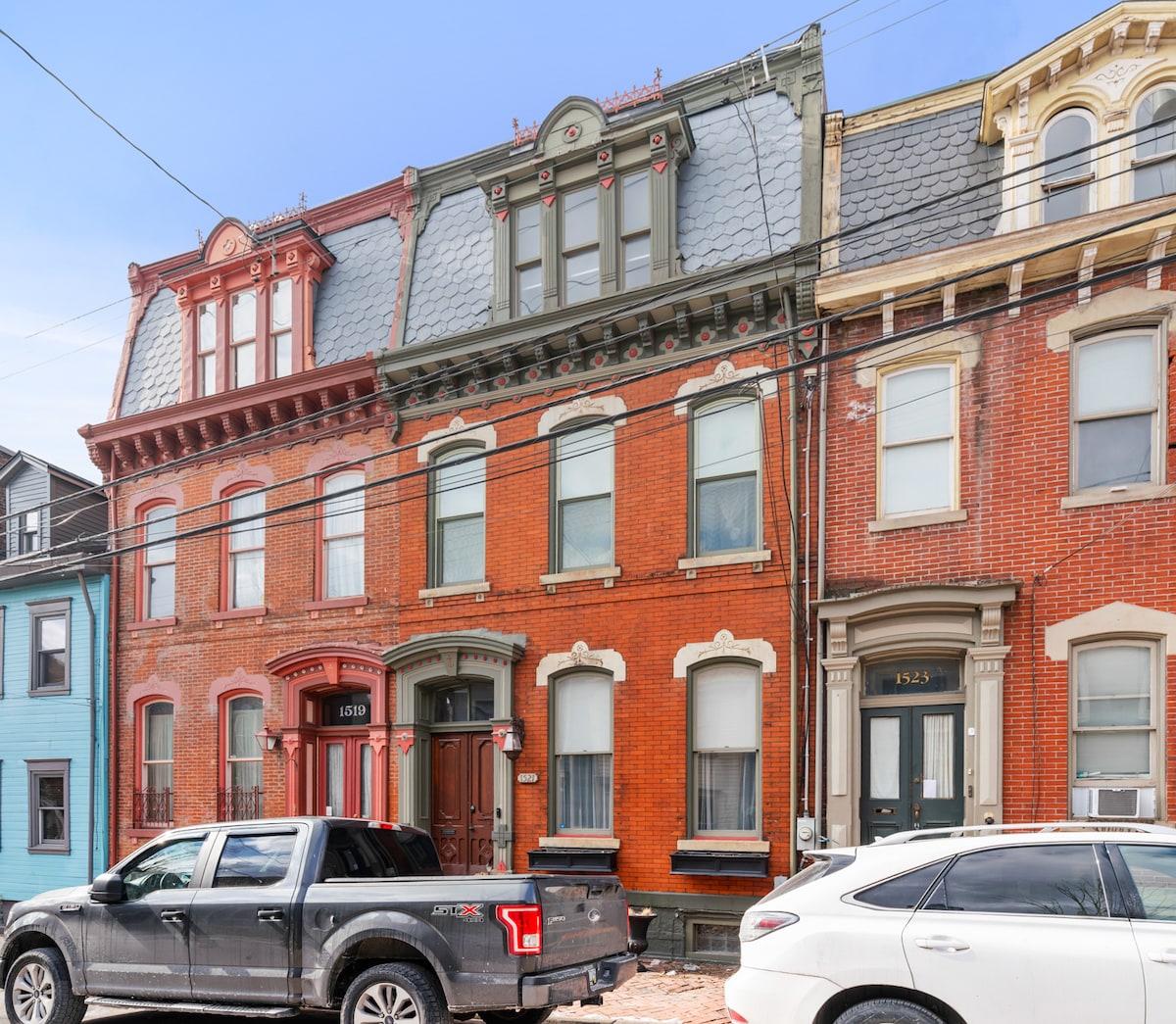
Narrow blocks of Victorian brick rowhouses in Pittsburgh, no front yards and star shaped iron plates at the roofline.
What Mexican War Streets looks like
Brick rowhouses meet the sidewalk directly, with iron front railings and stone steps and no front yard between the door and the curb. Star shaped iron plates sit at the roofline of many facades, one to a bay, anchoring the brick from the outside. The blocks vary house to house rather than repeating a single design. Red brick sits beside brown, and an arched window head faces a flat stone lintel next door. One cornice line breaks where the next roof steps up into its own gable.
Monterey, Palo Alto and Resaca Streets run on a flat grid behind Arch Street, narrow enough that a car parked on either side leaves one lane. Paved alleys behind the rows, among them, carry garages and back doors rather than front stoops. A run of houses on Sampsonia Way is painted floor to roofline in full color murals rather than left as bare brick.
At the corner of West North Avenue, a Queen Anne house built in 1890 has a steep front gable, patterned wood shingles at the peak and a full width porch two storeys up. On Arch Street, a corner house and its yard fence are covered in painted found objects, bottle caps and mannequins in primary colors. The 's building on Sampsonia Way is a plain brick warehouse box, three storeys, with tall factory windows and no ornament at all.
Shot in Mexican War Streets
The Garden Theater stands on North Avenue, the historic district's southern edge, its marquee lit in red neon over the sidewalk. The building played itself in The Fish That Saved Pittsburgh, a 1979 comedy about a fictional professional basketball team.
The Fish That Saved Pittsburgh, 1979
Stockard Channing's fortune teller character keeps her office above the Garden Theater's marquee, reached through the building's own upstairs windows. The production kept the theater's neon signage in shot, including a sign offering "ephemeral analysis" among its other advertisements.
Narrow brick rowhouses meet the sidewalk directly in both neighborhoods, with iron railings and stone steps and no room for a front yard. A rowhouse preservation survey comparing the two cities found Pittsburgh's own blocks read closer to Society Hill and Boston's Beacon Hill than to Baltimore's, because the brick color and roofline change from house to house rather than repeating down the row. Society Hill's own rows carry a more uniform brick color and cornice height than these blocks. A tight shot on one or two houses could pass for either city, but a wider shot needs the mixed rooflines held out of frame. Try searching narrow brick rowhouses now.
Over-the-Rhine in Ohio, United States
Over-the-Rhine's dense Italianate brick rowhouses went up in the same decades and carry the same star shaped tie rod plates bracing the walls, a detail found in both cities' nineteenth century brick construction. The narrow lot widths and shared side walls match as well. Over-the-Rhine's cornices run taller and more ornamented in wider views, so a street level frame on one block holds the match better than a rooftop or skyline shot. Try searching Italianate brick rowhouses block now.
Baltimore's own rowhouses share the same shared wall construction and stone steps straight onto the sidewalk. The comparison is looser than Philadelphia's, because Baltimore's blocks run in unbroken red brick with white marble steps repeated house to house, where these blocks mix brick colors and rooflines within a single row. A single house or a tight two shot holds the illusion better than a block length view, which shows the variation Baltimore's own rows do not have. Try searching red brick rowhouses steps now.