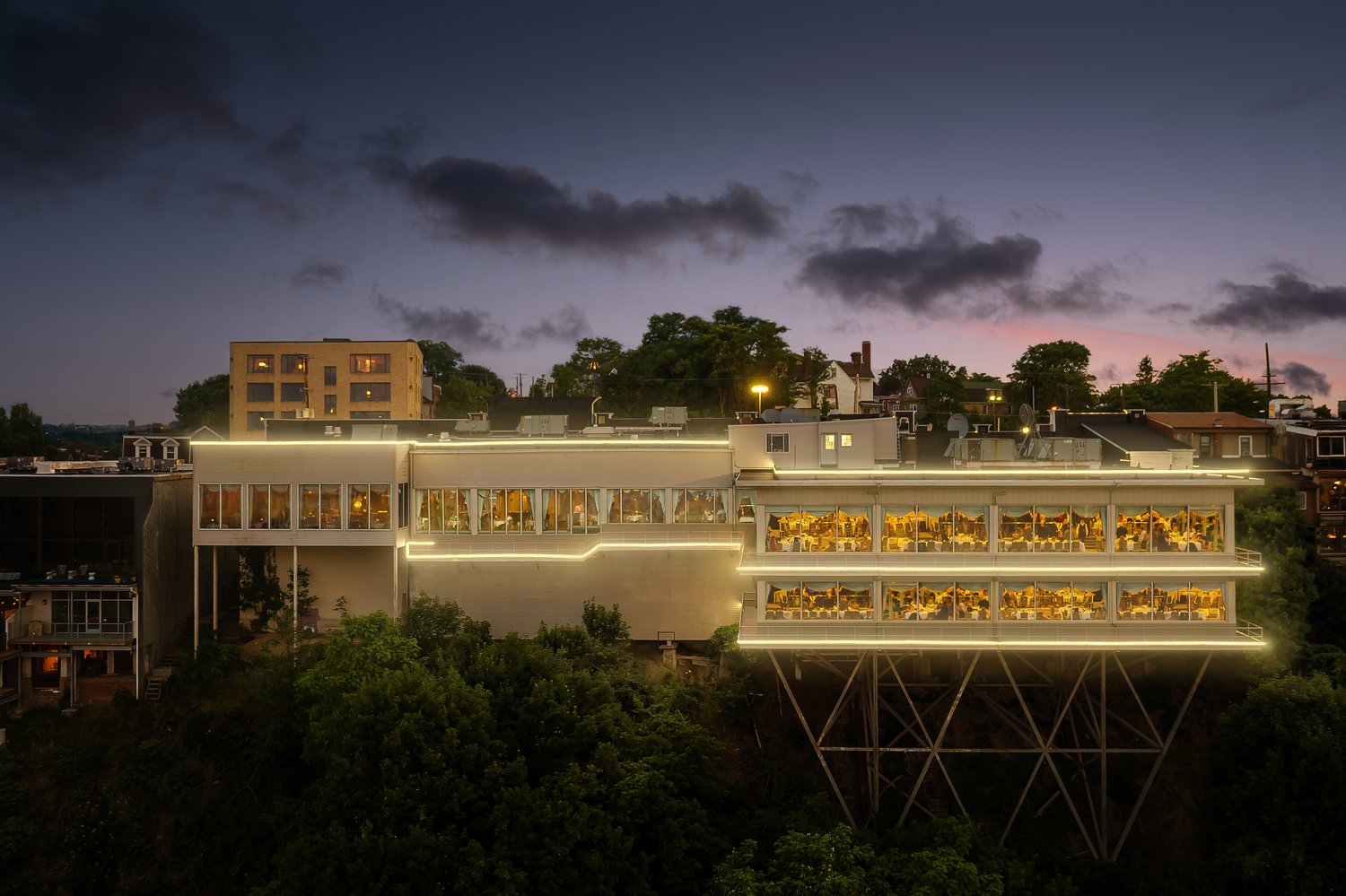
Houses and restaurants line a ridge above the rivers, reached by the incline Alex rides in Flashdance.
What Mount Washington looks like
Houses and small brick apartment blocks line the ridge top streets, set close together with narrow front yards or none at all. Most are two or three storeys, in brick or wood frame, with a scattering of mid century brick blocks toward the newer end of the ridge.
runs the length of the crest, restaurants and their patios facing north over the rivers, an iron railing along the overlook where the ground drops away. Below it, Emerald View Park keeps a band of wooded hillside between the houses and the water.
Two funicular railways climb the cliff from West Carson Street below, both dating to the 1870s and still running daily. The 's green painted station house sits at the top of the track on Grandview Avenue, and a pedestrian bridge crosses West Carson Street to its lower station at the bottom. The runs a separate track nearby, with a red brick lower station beside the river road and a wood sided station at the top by Wyoming Street.
At the south end of the ridge, turns its Neo-Georgian brick buildings inward to shared lawns and walkways instead of a through street. Cars are kept to a few off street lots and garages, built into the site between 1932 and 1936.
Shot in Mount Washington
Both of Pittsburgh's surviving inclines climb from West Carson Street to the ridge, cars running there every day. The Duquesne Incline appears in Flashdance, Lady Beware and The Next Three Days, each production using the real cable cars rather than a built stand in.
Flashdance, 1983
The Duquesne Incline
In Flashdance, Alex rides one of the incline's cable cars up the hillside on her way to visit Hanna. The Duquesne Incline still runs the same route today, one of only two of Pittsburgh's original two dozen inclines left in service. Street View
What Mount Washington can double for
Mount Adams in Cincinnati, Ohio
Mount Adams sits on a hill above the Ohio River in the same way Mount Washington sits above the Monongahela, with restaurants along the ridge and a skyline view below. Cincinnati's own hillside inclines are gone, so the funicular itself is not part of the match, only the streets and the overlook. Mount Adams has narrower streets and denser Victorian frame houses, so a wide establishing shot should stay tight on the ridge and the view rather than the houses. Try searching restaurants along the ridge now.
Angels Flight is a funicular from 1901, the same era as Pittsburgh's own inclines, with a small wooden station house at each end of a short track. It is one structure rather than a neighborhood, so only the incline itself is a fair comparison. Downtown Los Angeles high rises fill the frame behind Angels Flight from almost every angle, so a shot needs to stay close on the cars and the track to avoid giving the city away. Try searching a funicular station house now.
Cerro Alegre in Valparaiso, Chile
Valparaiso's hillside neighborhoods are climbed by funiculars built from the 1880s onward, the same era as Pittsburgh's own inclines, with houses packed close along the ridge above the harbor. The colors and roofline shapes are Chilean rather than American, so this is a period and function match rather than a facade match. Brightly painted corrugated metal siding is common on Cerro Alegre and would need dressing out for a Pittsburgh double. Try searching hillside funicular from the 1880s now.


.jpg)