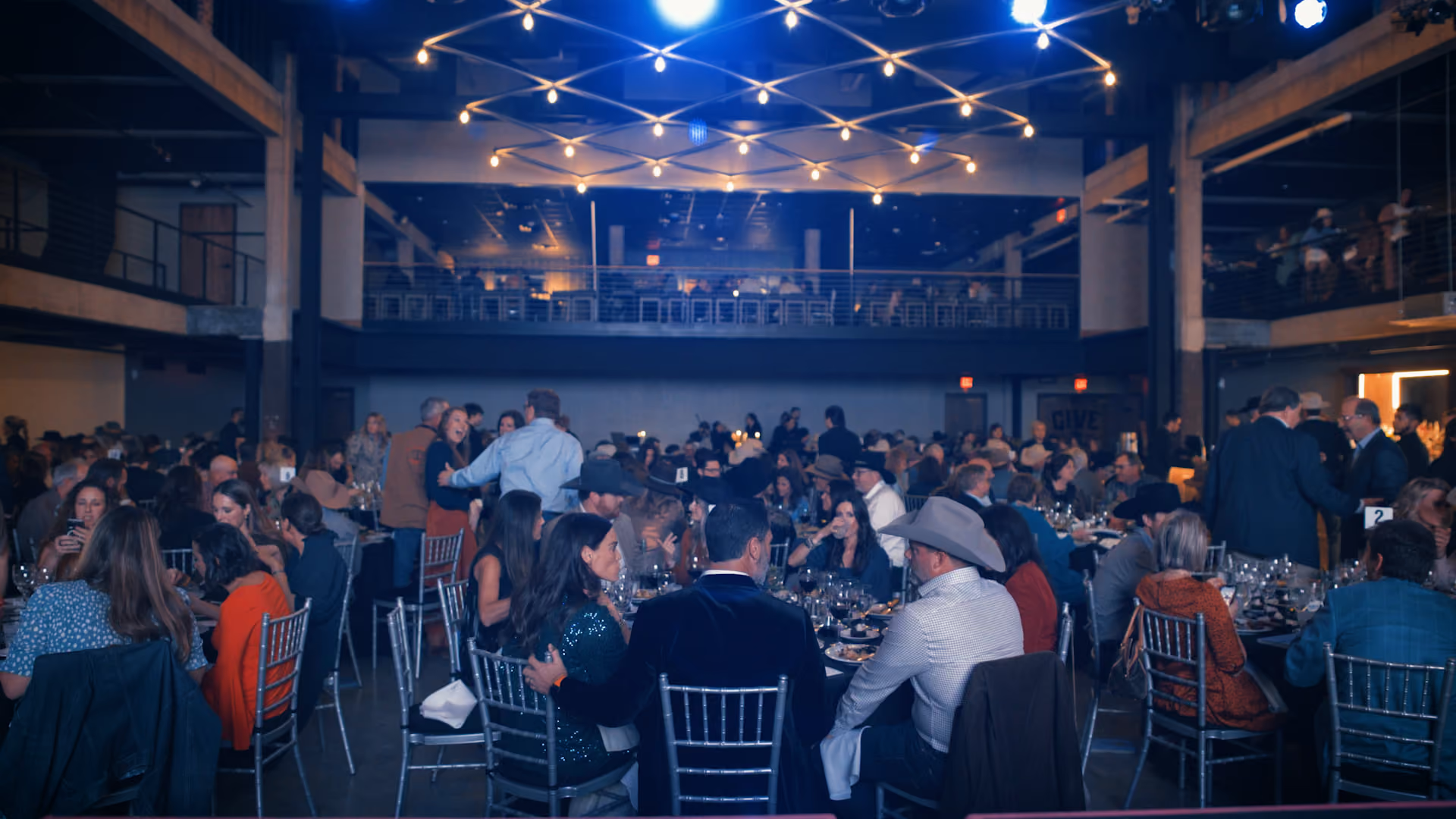
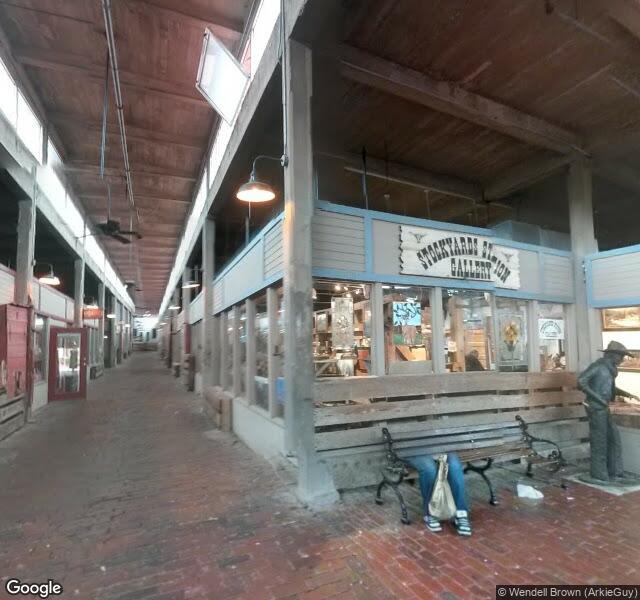
Brick storefronts and wooden awnings line Exchange Avenue beside the working cattle pens and the rail spur behind them.
What Fort Worth Stockyards looks like
runs between two storey brick storefronts under wooden awnings hung from iron posts, their parapets capped in cast stone. The street itself is paved in brick, weathered red and patched in places with asphalt. Painted signs project from the cornices above and the Cody Building, a few doors apart near Main Street.
The and face each other across the avenue in cream stucco, with red tile roofs, round arched windows and deep porticos on wooden columns. Both went up between 1902 and 1908, taller and paler than the brick storefronts around them.
Steel pipe pens and loading chutes run back from the Livestock Exchange Building toward the rail spur, fenced along the street in brick and timber posts. A sign at the corner posts the twice daily cattle drive down the avenue, and the same brick paving continues past the pens.
, off the west end of the avenue, holds a long room of pool tables under stained glass lamps shaped like the state of Texas. A bull rider is worked into one panel and a hitched wagon into the other. Ellis Avenue, a block south, meets Exchange at a cream stucco corner building with a street level awning and plain windows under a flat parapet.
Shot in Fort Worth Stockyards
Productions have used the avenue's own storefronts to play an earlier version of themselves, dressing real buildings rather than building new ones. The ruins of a shuttered meatpacking plant on the district's east side became a federal penitentiary for one season of Prison Break.
1883
The Cody Building
Played Hotel Calhoun, 1883
The Paramount+ series 1883 used the building's ground floor as Hotel Calhoun, the Duttons' first lodging after reaching Fort Worth. The storefront now operates as a live music venue under the Rodeo Exchange sign.
Necessary Roughness, 1991
Billy Bob's Texas
Played a honky tonk bar, Texas, 1991
A bar brawl scene with Scott Bakula was shot inside Billy Bob's Texas, which bills itself as the world's largest honky tonk. The pool tables and dance floor seen in the scene are still in regular use.
Pure Country, 1992
Played a honky tonk bar, Texas, 1992
George Strait's screen debut in Pure Country also used Billy Bob's Texas, the same honky tonk Necessary Roughness had filmed in a year earlier. The venue's other screen credits include Over the Top in 1987 and Baja Oklahoma in 1988.
Tough Enough, 1983
Cowtown Coliseum
Played a boxing arena, Texas, 1983
The rodeo floor doubled as a boxing ring for Dennis Quaid's fight scenes in Tough Enough. The same floor, under the building's tall arched window, still runs weekly rodeos.
Pure Country, 1992
Played a rodeo arena, Texas, 1992
The same film also used the Coliseum for its rodeo and concert scenes. The building's arched window and arcade are visible behind George Strait throughout.
Walker, Texas Ranger
The CBS series Walker, Texas Ranger also shot at the Coliseum under its own name, starting with the show's 1993 premiere. Its gift shop, the Rodeo Shop, now occupies part of the ground floor arcade.
Queen of the South
Livestock Exchange Building
Played an orphanage, Mexico, contemporary
The USA Network series Queen of the South used the building as an orphanage in Mexico. It was built around 1902 as an office for cattle commission companies, and its own name is still lettered across the facade.
What Fort Worth Stockyards can double for
Stockyards City in Oklahoma City, Oklahoma
Stockyards City keeps the same two storey brick storefronts and a working livestock market behind them, down to pipe pens and loading chutes a block off the retail street. The scale and the materials line up closely. Its own pens sit closer to the street than Fort Worth's, so a wide shot needs less dressing to put cattle in frame. Try searching brick storefronts livestock market now.
Old Town Scottsdale in Scottsdale, Arizona
Old Town Scottsdale lines its main block with brick and wood storefronts under deep wooden awnings, built for the same western retail trade as Exchange Avenue. The scale of the street and the awning line match closely. Scottsdale's buildings sit lower and the desert landscaping gives it away in any wide shot with plants in frame. Try searching brick storefronts wooden awnings now.
Old Sacramento in Sacramento, California
Old Sacramento keeps wooden boardwalks and false front stores along its main street, a looser match for the look here since Fort Worth's street is brick rather than wood. The raised boardwalks and taller false fronts set it apart in a wide shot. Keep the frame tight on a single storefront to hide the boardwalk and the different street surface. Try searching wooden boardwalks false front stores now.