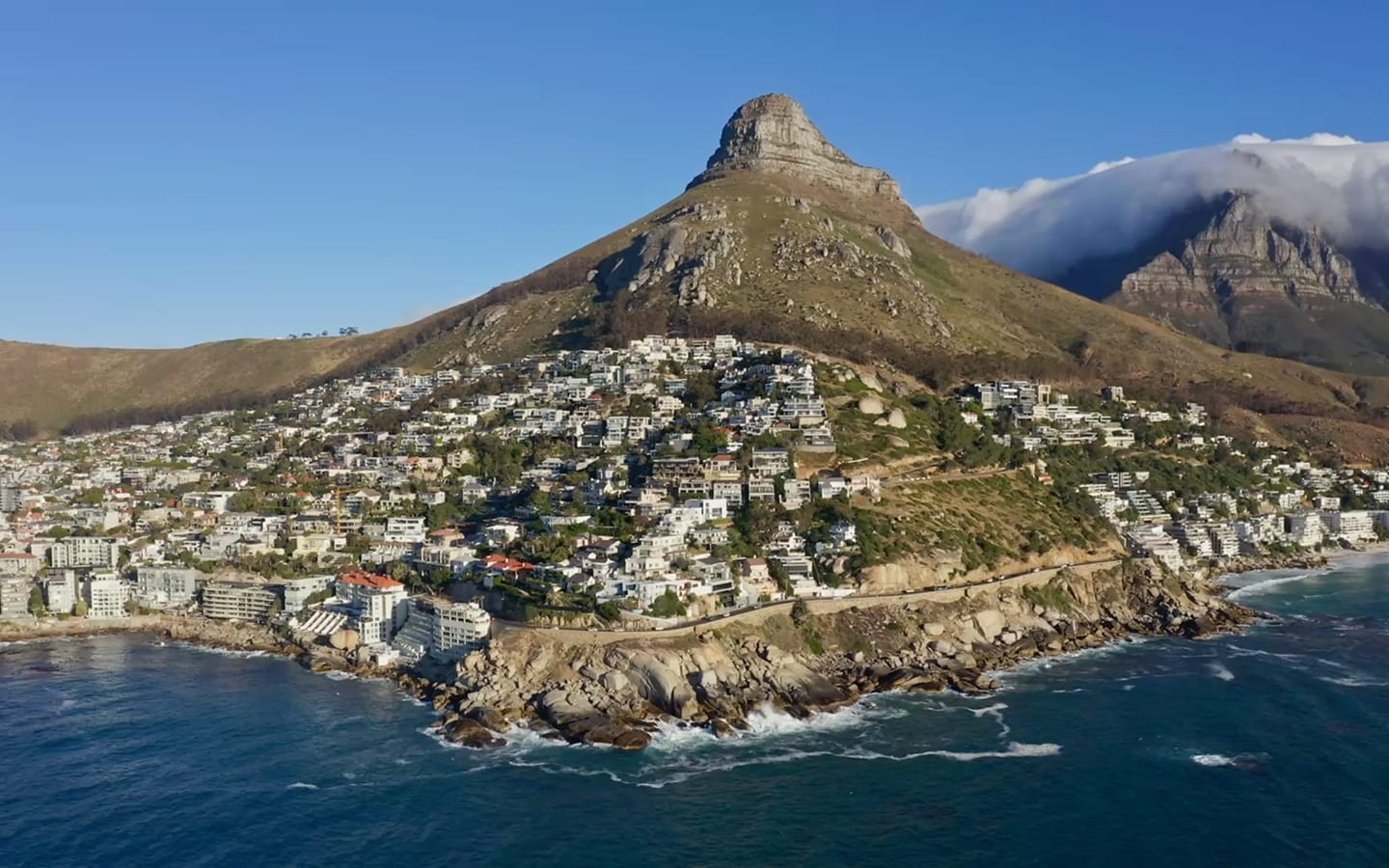
A three kilometre paved promenade separates Beach Road's Art Deco and mid century apartment blocks from a rocky Atlantic shore, with a tidal pool at Saunders' Rock.
What Sea Point looks like
The Sea Point Promenade runs about three kilometres along the Atlantic edge, from Bantry Bay in the south to the in the north. It is a single paved walkway the whole way, with a low concrete seawall on the ocean side and 's traffic on the other.
Beach Road is lined almost without a gap by apartment blocks, six to ten storeys for most of the run and a scattered few taller than twenty. The older ones carry Art Deco details, stepped parapets, porthole windows and rounded corner balconies. Paint runs white, navy or ochre block to block. Lion's Head and Signal Hill rise directly behind the roofline, visible above the buildings from most points on the walk.
Below the seawall the shoreline is rock rather than sand, broken into low outcrops the waves run over at high tide. Near Bantry Bay at the promenade's southern end, is a hexagonal tidal pool set into the granite, sheltered enough to swim in when the open water is rough. Further north, is now a gap in the rocks where a pool once stood, its walls broken through so the tide moves freely in and out.
The , roughly at the promenade's midpoint, holds a municipal lap pool and a diving pool side by side on a paved deck that looks straight out to the water. A set of outdoor exercise bars sits on the grass verge nearby, the apartment wall and the mountain behind it. and run back from the promenade into the suburb, their own blocks a mix of the same mid century apartments and newer infill over ground floor shops.
Shot in Sea Point
The documentary Sea Point Days follows the promenade and its public pools over the course of a year, watching who uses the space and when. Filmed in 2008, it stays entirely on the promenade itself and at the Pavilion pools rather than moving into any surrounding building.
Sea Point Days, 2008
The promenade and its pools
Sea Point Days spends most of its time at the Pavilion's pools and on the promenade outside them, following the different people who use the space through a single year. The film uses no other Sea Point location, staying on the paved deck and the walkway rather than moving into any of the surrounding buildings.
What Sea Point can double for
Avenida Perú in Viña del Mar, Chile
Avenida Peru runs along a rocky Pacific shore with a solid wall of mid century apartment towers directly behind the seafront road, the same relationship of a paved edge, open water and a built wall that Sea Point has. Balconied blocks from the same postwar decades line the road in both places, facing the water with almost no gap between them. The Pacific swell there runs heavier and the rocks sit lower to the road in places, so a wide shot needs care to keep the horizon steady. Local street furniture and signage would need dressing too. Try searching mid century apartment towers now.
The Vedado stretch of the Malecon is a paved sea wall promenade above a rocky shore, with apartment buildings from the 1950s standing right along the road at a scale close to Sea Point's own promenade wall. Waves break over the wall onto the walkway in the same way they do at Sea Point in a southwester. Havana's buildings run older and more weathered than Sea Point's painted blocks, so a shot holding on the facades would need repainting or a tighter frame on the newer sections. Try searching sea wall promenade now.
Ocean Drive's Art Deco apartment and hotel row is the same period and scale as the Art Deco blocks on Sea Point's own Beach Road, with the same stepped parapets and porthole windows. The beach itself is the giveaway, a wide sandy stretch rather than Sea Point's rocks, so the match only holds in shots that stay on the buildings. Keep the frame off the sand and the palm lined median; a facade level shot with the road in front reads closer than any wide angle would. Try searching Art Deco apartment row now.