A Gothic parish church rises over narrow stone lanes, with wheat fields on the plateau and the Oise running below.
What Auvers-sur-Oise looks like
Auvers-sur-Oise sits on the right bank of the Oise, about 27 km northwest of Paris. The old village is built on a limestone cliff above the river, and narrow lanes climb from the water up to the at the top of the slope.
Small stone houses line those lanes. Their walls are a buff coloured limestone, some of them covered in ivy, mostly one or two storeys under steep tiled roofs from the 19th and 20th centuries. Painted shutters and dormer windows break the roofline, and low stone garden walls run along the pavement.
The church was rebuilt from 1137, its nave finished between 1190 and 1225, with a round Romanesque apse at the eastern end and pointed early Gothic windows along the nave. The bell tower, likely finished before 1170, rises above the center of the church. Paired round arched openings sit beneath its clock face.
Farmland covers the plateau above the village, wheat fields running out to a tree line with the church tower visible over the hedgerows. On Rue du Docteur Gachet, below the plateau road, a 19th century house keeps an English style garden and an artist's studio cut into the limestone behind it.
A railway line crosses the Oise near Chaponval on an iron bridge. The old station building, a low limestone block under a tiled roof, now holds a secondhand bookshop. The sits in the Manoir des Colombières, and the 's outbuildings front a cobbled yard behind red painted shutters.
Shot in Auvers-sur-Oise
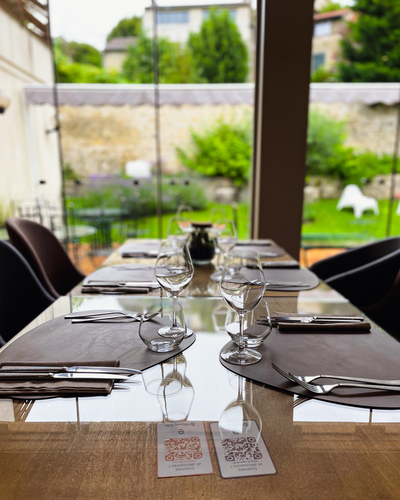
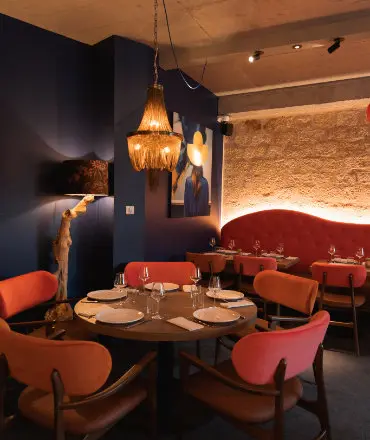
The , on Place de la Mairie, has stood in front of two different productions' cameras. A Very Long Engagement dressed its front as a wartime bistro in 2003, and Lust for Life shot café scenes there and a Bastille Day crowd on the square outside in 1955.
A Very Long Engagement
Place de la Mairie. The production dressed the real inn as a wartime bistro rather than building one.
A Very Long Engagement, 2004
The Auberge Ravoux
Played a bistro near the Bingo Crépuscule trench, the First World War
The production dressed the inn's front as a bistro near the Bingo Crépuscule trench for two days in September 2003. A haystack sat on the pavement, and a vintage car and two horses pulling a cart stood in the square. Decorators also planted the red traffic light opposite the inn with greenery so street scenes could be filmed through the lunch break. Street View
Lust for Life, 1956
The production used the café for scenes with Auvers locals playing extras, then dressed the square outside for a Bastille Day crowd. Producer John Houseman also bought several acres of standing wheat on the plateau above the village to film that summer's harvest scenes. Street View
What Auvers-sur-Oise can double for
Vétheuil in Val-d'Oise, France
Vétheuil sits on a bend of the Seine below its own chalk cliff, with the same run of narrow lanes and a Gothic and Romanesque parish church above the roofs. Wheat covers the slope above the village the same way it does the plateau over Auvers. Vétheuil's cliff is chalk rather than Auvers' buff limestone. Its boves, cave rooms cut into the rock, would need avoiding in a close exterior. Try searching chalk cliff village now.
La Roche-Guyon in Val-d'Oise, France
La Roche-Guyon stands under its own white limestone cliff on the Seine, with the Saint-Samson church and an old market hall among houses built from the same pale stone as Auvers. A troglodyte castle keep is cut into the cliff above the village. That castle and its cliffside boves are a much bigger landmark than anything at Auvers, so a wide shot toward the cliff gives the difference away. Tighter street level frames hold the match better. Try searching white limestone cliff village now.