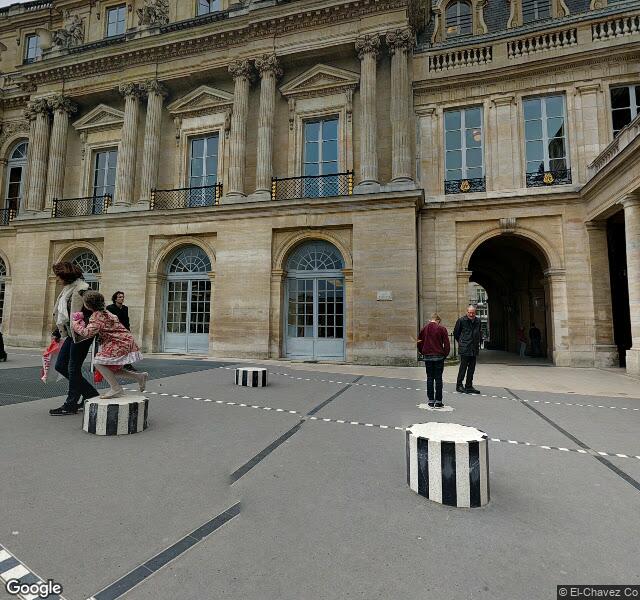
Wide, treeless Haussmann boulevards lined with cream stone facades and wrought iron balconies converge on the Palais Garnier, with the glass domed department stores of Boulevard Haussmann close by.
What Opéra looks like
Avenue de l'Opéra runs straight and treeless from Rue de Rivoli to Place de l'Opéra, lined on both sides by six and seven storey stone buildings. No street trees interrupt the view down its length to the Palais Garnier at the far end.
The buildings are faced in cream limestone ashlar, with continuous wrought iron balconies at the second and fifth floors. A steep zinc mansard roof caps each block at a uniform height, broken only by dormer windows and chimney stacks.
The Palais Garnier itself stands at the avenue's end, facing the square. Its main facade is cut from about seventeen kinds of stone and marble with gilded bronze figures, running 154.9 metres along the square and rising 32 metres to the roofline, fronted by arched arcades at street level.
Printemps and line Boulevard Haussmann. Galeries Lafayette's Neo-Byzantine glass dome rises 43 metres over its central hall, and its stonework matches the cream color of the boulevard around it. occupies the corner of Place de l'Opéra and , its outdoor tables facing the opera house directly across the square.
The Opéra Métro station has several entrances around the square, marked by cast iron candelabra lampposts rather than the Art Nouveau arches used elsewhere in the city. Boulevard des Capucines and Boulevard des Italiens meet Avenue de l'Opéra and Rue de la Paix at the square, so the pavement widens into a point where the four streets converge.
Shot in Opéra
The Palais Garnier has played itself on screen three times and doubled as a fictional hotel once. Interview with the Vampire used its Grand Staircase and lobby for the Paris hotel where Louis and Claudia stay. Marie Antoinette filmed a masquerade ball scene there, and John Wick Chapter 4 used the Grand Foyer for a contract scene. Mission Impossible Fallout used the building only as a backdrop, framing it at the end of a motorcycle chase that comes up out of the Louvre Pyramides car park onto Avenue de l'Opéra.
John Wick: Chapter 4, 2023
Caine's contract scene with the Marquis plays out in the Grand Foyer, under a ceiling painted by Paul Jacques Aimé Baudry. The room runs 54 metres long and 18 metres high, a real hall rather than a built set. Street View
Mission: Impossible - Fallout, 2018
Ethan Hunt's motorcycle chase comes up out of the Louvre Pyramides underground car park and onto Avenue de l'Opéra, heading toward the Palais Garnier at the far end. The avenue's straight, treeless run keeps the opera house in view for the length of the shot. Street View
What Opéra can double for
Avenida de Mayo in Buenos Aires, Argentina
Avenida de Mayo was built with mansard roofed buildings explicitly modeled on Haussmann's Paris, giving it a similar scale and roofline to the blocks around the Opéra. Its own avenue narrows the search to a few blocks rather than the whole city. Spanish signage and different pavement markings need dressing out, and the avenue itself is narrower than Avenue de l'Opéra. Try searching mansard roofed buildings now.
Ringstrasse in Vienna, Austria
The Ringstrasse's grand facades went up in the same decades as the blocks around the Opéra, both forming a monumental public avenue past major institutional buildings. Vienna's flatter rooflines, without the steep zinc mansards here, mean wider shots would need careful framing. Keep frames to street level corners where the rooflines read close; a high wide shot will show the flat Viennese parapets instead of mansards. Try searching monumental public avenue now.
Boulevard Anspach in Brussels, Belgium
Boulevard Anspach was cut through central Brussels in the same decades as Avenue de l'Opéra, forming a similarly wide stone boulevard lined with shopfronts. The buildings run four to five storeys rather than six or seven, so the scale reads smaller in a wide shot. Keep to a single block with a long lens from street level; a high wide shot shows the lower building height clearly. Try searching wide stone boulevard now.