Two wide boulevards of neon shop signs and working cabarets meet at Place Pigalle, with quiet gated lanes climbing toward Montmartre behind them.
What Pigalle looks like
and meet at , both wide enough to carry a paved walk of plane trees down the middle. The fountain at the centre of the square has been recently restored, its roadway relaid in setts and its beds newly planted. Café tables sit under blue awnings on the south side, facing straight down Boulevard de Clichy.
Five and six storey cream stone buildings line both boulevards behind wrought iron balconies. Ground floors along Boulevard de Clichy carry neon signs for sex shops, DVD stores and lingerie next to hotels and pizzerias. The building at 58 and 60 Boulevard de Clichy, the , curves into a glazed corner turret with two arched gateways leading into a courtyard behind it.
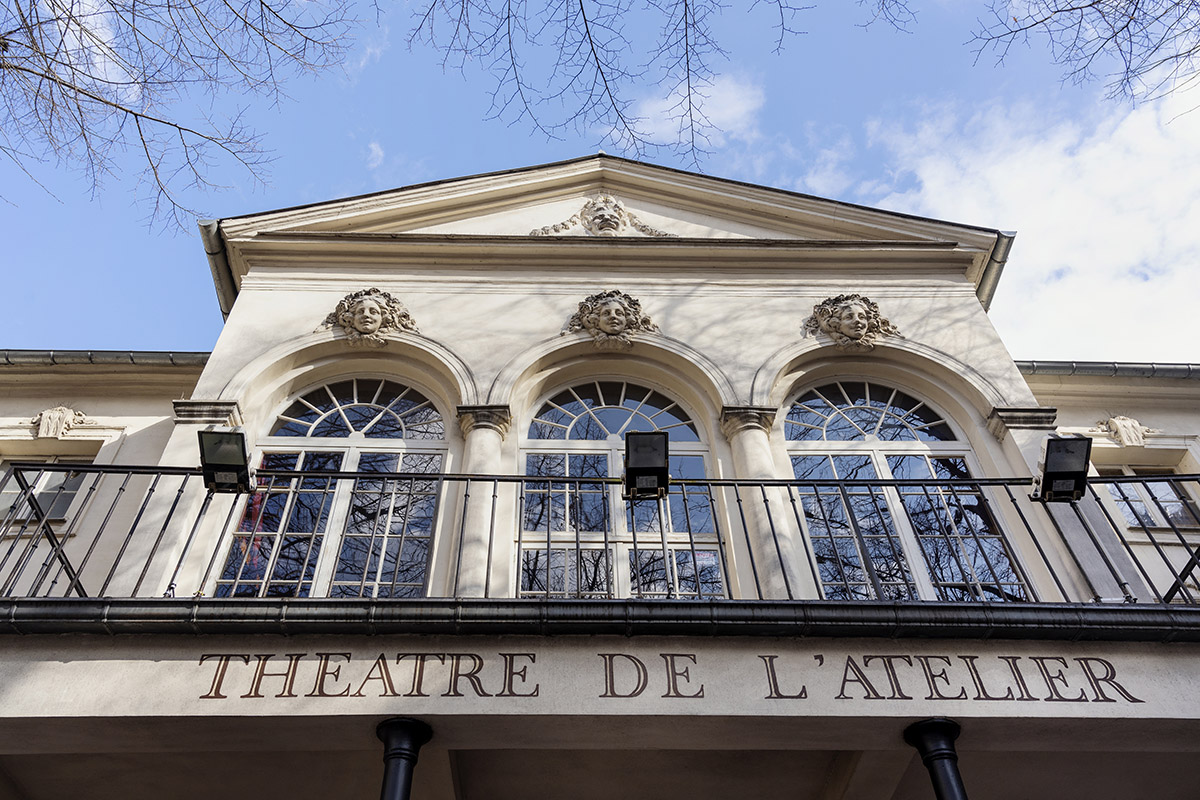
The still runs at Place Blanche, its red windmill turning above a red frontage lined with potted shrubs. Farther along Boulevard de Rochechouart, keeps its white arched theatre front, the words Opérette Comédie Vaudeville Drame cut into the stone above the windows. South of the square, is lined almost entirely with shops selling guitars, drums and other instruments.
Behind the boulevards the streets climb north toward Montmartre and go quiet within a block. is a private cobbled lane behind a locked iron gate, plane trees overhead and white houses with shutters and iron balconies behind garden walls. , open to the street, is a cobbled dead end lined with potted oleanders and an old painted Bains sign on the wall at the far end.
Shot in Pigalle
François Truffaut used the square for Les Quatre Cents Coups in 1959. Jean-Pierre Jeunet used the boulevard for Amélie in 2001. The square itself has been resurfaced since both films, so its fountain, paving and planting are all newer than either one.
Les Quatre Cents Coups, 1959
Avenue Frochot
René's house is on avenue Frochot, the private lane that runs back from Place Pigalle toward rue Victor-Massé. Truffaut filmed its exteriors here. The lane is gated at both ends, so filming needs the residents' agreement.
Les Quatre Cents Coups, 1959
Place Pigalle
Antoine is driven through the square in a police van after his arrest, the last view of Paris he gets before the film ends. The shot takes in the Folies Pigalle building at the edge of frame.
Amélie, 2001
In the film, Nino works in a sex shop on boulevard de Clichy called Palace Vidéo. The shop is at number 37, between Place Pigalle and Place Blanche. It later traded as Toys Palace. Jeunet built its interior at a studio in Cologne, so only the storefront is here.
What Pigalle can double for
Boulevard Anspach in Brussels, Belgium
Brussels' Central Boulevards were cut through the city at almost the same date as Pigalle's own, cream stone apartment blocks in a similar Second Empire style lining a wide straight run. Boulevard Anspach is the closest match, five and six storeys with iron balconies repeating block to block. The boulevard has been car free since 2015 between Place de la Bourse and Place de Brouckère, so a period traffic shot needs a different stretch or dressing. The stone here also reads paler and greyer than Pigalle's warmer cream. Try searching cream stone apartment blocks now.
Kurfürstendamm was widened into a tree lined boulevard of grand apartment buildings and became a centre of cabaret and nightlife through the Golden Twenties, the closest era match to Pigalle's own cabaret years. Cafés and theatres opened along it much as they did on Boulevard de Rochechouart. Much of the avenue was rebuilt after wartime bombing, so a period block needs scouting street by street for surviving prewar facades rather than assuming the whole avenue matches. Try searching prewar apartment boulevard cabaret now.
Calea Victoriei was rebuilt by French trained architects in the same Belle Époque years as Pigalle's own theatres, with cream stone facades and wrought iron balconies along a wide avenue. It reads grander and more ornamented than Pigalle's plainer apartment blocks, closer to a formal boulevard than to a side street cabaret strip. Traffic and modern signage are heavier here than on Pigalle's own boulevard, so tighter frames on individual facades hold the period better than a wide shot down the avenue. Try searching Belle Époque avenue facades now.