Two storey brick terraces run off North End Road, with a red brick football stand and a Tudor palace by the river.
What Fulham looks like
Two storey brick terraces run in long matching rows off , bay windows repeating from one house to the next. On the fronts alternate between plain brick and white painted stucco, cars parked along the kerb on both sides. West of New King's Road, on the , stone lions sit on the gables of each terrace.
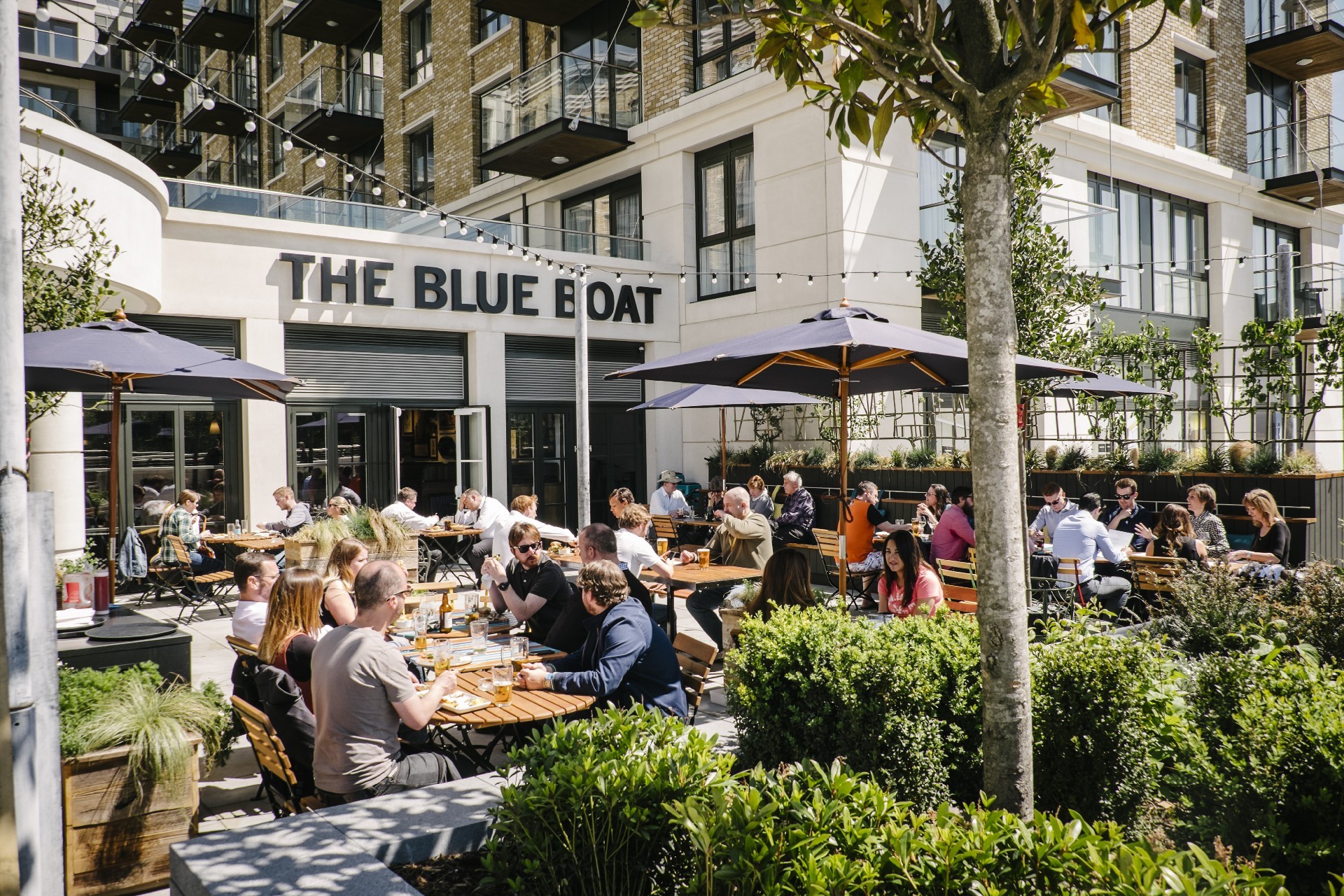
North End Road runs as a market strip, roll down shutters and awnings over grocers, barbers and fast food counters. The old red terracotta station entrance opens onto Fulham Road, its arched ground floor now a market hall. Another bay of the same building is a Wetherspoon pub named Walham Green, the stop's former name. A glazed roof and cast iron columns run over the tables inside.
stands on Stevenage Road by the Thames, the football club's own ground. The Johnny Haynes Stand is red brick, built in 1905 to a design by Archibald Leitch. It is Grade II listed. A short walk south, 's west courtyard is Tudor, brick around a quadrangle. A Georgian range stands beside it on the east side.
stands on the north side of Putney Bridge, its tower over the river. Bishop's Park runs along the Thames between the palace and the church, a footpath at the water's edge.
Shot in Fulham
Sliding Doors used station for the scenes that give the film its title, filmed on the District line platform in 1997. The station's old red terracotta entrance faces Fulham Road, the building standing over the platform below.
Sliding Doors, 1998
Sliding Doors' plot follows two versions of the same day, split by whether Helen catches this train or misses it. The scene was filmed on Fulham Broadway's District line platform. The station's old red terracotta building faces the street above it, its arched entrances now a food hall. Street View
What Fulham can double for
Goodison Park in Liverpool, Merseyside, United Kingdom
Ted Lasso filmed Craven Cottage's exterior on Stevenage Road as Goodison Park for the show's Everton away game in its first season. Both are early twentieth century football grounds with a red brick stand facing the street, built when clubs still fitted stadiums inside a residential grid. The Johnny Haynes Stand has Fulham's own name and crest across it, so a wide shot needs those covered or cropped out to hold the illusion. Try searching red brick football stand now.
Lambeth Palace in London, United Kingdom
Lambeth Palace's Morton's Tower is a five storey brick gatehouse for the Archbishop of Canterbury, completed in 1495. Fulham Palace's own Tudor courtyard, built for the Bishop of London, uses timber felled that same year. Both are riverside London bishops' palaces with battlemented brick towers and stepped gables. Lambeth Palace's grounds are larger and more formal than Fulham's, so a tight frame on the gatehouse itself holds the match better than a wide shot of the wider palace. Try searching brick Tudor gatehouse now.
Cabbagetown's bay and gable rowhouses went up in the same 1880s building boom as the Peterborough Estate, red or buff brick with a projecting bay window on the ground floor. The steep front gable over each bay is the Toronto version of the same speculative terrace built here in plain parapets and stone lions. The decorative bargeboard and pointed gables mark the roofline as Toronto rather than London in any shot that holds it, so keep the frame low on the bay windows and brickwork. Try searching bay and gable rowhouses now.